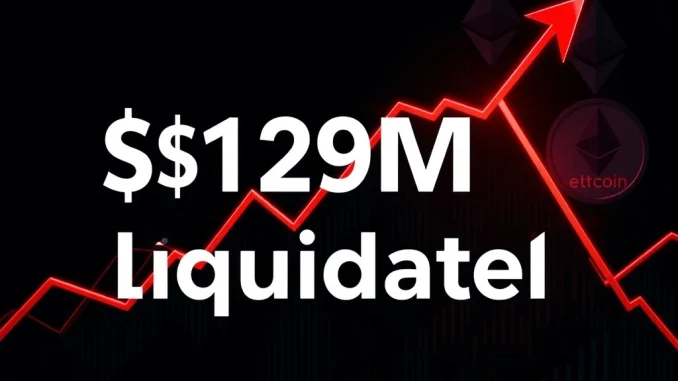
Futures Liquidated: $129 Million Wiped Out in One Hour as Crypto Market Sees Surge in Liquidations
Global Cryptocurrency Markets, April 2025: A sharp spike in market volatility has triggered a significant wave of futures liquidations across major cryptocurrency exchanges. Data from leading analytics platforms confirms that over $129 million worth of futures positions were liquidated in a single hour, with the 24-hour total reaching approximately $395 million. This event highlights the inherent risks and amplified volatility within the cryptocurrency derivatives market, serving as a critical reminder for traders about leverage and risk management protocols.
Futures Liquidated: Analyzing the $129 Million Hour
The core data point of $129 million in liquidated futures within 60 minutes represents a concentrated period of forced position closures. Liquidation occurs when a trader’s leveraged position suffers losses that deplete the initial margin (collateral) below the maintenance margin requirement. At this point, the exchange’s system automatically closes the position to prevent further losses, often at a less favorable price. This hour-long event was not isolated; it contributed to a broader 24-hour liquidation total of $395 million, indicating sustained pressure across the derivatives market. Analysts track this data in real-time as a key metric for market stress and sentiment, with large liquidation clusters often preceding or following significant price movements in spot markets.
Understanding Cryptocurrency Futures and Market Mechanics
To grasp the significance of these figures, one must understand the structure of cryptocurrency futures. Unlike spot trading, where assets are bought and sold for immediate delivery, futures are contracts to buy or sell an asset at a predetermined price on a future date. Traders use leverage, borrowing capital to control larger positions than their collateral would normally allow. While this amplifies potential gains, it also magnifies losses. The recent liquidations primarily involved:
- Long Positions: Contracts betting on price increases. A sudden market drop can quickly trigger stop-losses and liquidations for over-leveraged longs.
- Short Positions: Contracts betting on price decreases. A rapid, unexpected price surge can have the same effect on leveraged shorts.
- Cross-Margin and Isolated Margin: Different account modes that determine how collateral is applied, affecting the liquidation process.
The scale of liquidation suggests a market move substantial enough to wipe out the collateral buffer for a large number of highly leveraged trades across multiple exchanges simultaneously.
Historical Context and Comparative Analysis
While a $129 million hourly liquidation is significant, historical context is essential for perspective. The cryptocurrency market has experienced far larger liquidation events. For instance, during the market downturn of May 2021, single-day liquidations exceeded $10 billion. In November 2022, following the FTX collapse, billions were liquidated over a few days. The current event, while notable for its intensity within a one-hour window, is part of the market’s normal ebb and flow, especially in a climate of evolving regulatory news, macroeconomic data releases, or large institutional trades. A comparative table illustrates the scale:
| Event Period | Approximate Liquidations | Primary Catalyst |
|---|---|---|
| May 2021 | $10B+ (24hr) | Market correction, China mining crackdown |
| November 2022 | $3B+ (24hr) | FTX collapse and contagion fear |
| January 2024 | $600M+ (24hr) | Spot ETF approval volatility |
| April 2025 (This Event) | $395M (24hr) | Sharp hourly price movement |
This context shows that while the hourly rate was high, the total 24-hour volume aligns with periods of heightened, but not catastrophic, market stress.
The Ripple Effect: Implications for Traders and Market Health
A concentrated liquidation event has several immediate implications. First, it acts as a forced rebalancing, removing over-leveraged positions from the market. This can sometimes exacerbate the price move that triggered it—a phenomenon known as a “liquidation cascade” or “long/short squeeze.” As positions are automatically closed, they create additional sell (or buy) pressure in the underlying market. Second, it serves as a stark risk management lesson for retail and institutional traders alike, emphasizing the dangers of excessive leverage. Third, from a market health perspective, such events test the resilience of exchange infrastructure. Major platforms have invested heavily in risk engines and insurance funds to handle these events smoothly and ensure orderly liquidations without system failures. The fact that this occurred across multiple exchanges without major technical issues points to improved industry infrastructure since earlier market cycles.
Expert Insight on Risk and Volatility Management
Professional traders and risk managers view liquidation data as a critical volatility gauge. “Liquidation clusters are a direct reflection of leverage saturation in the market,” explains a veteran derivatives trader from a quantitative fund. “When you see $100+ million wiped out in an hour, it tells you that a significant portion of the market was positioned in one direction with very thin margins of safety. For disciplined traders, this isn’t a signal to panic but to reassess position sizing, leverage ratios, and stop-loss placement. It’s a built-in feature of derivatives markets, not a bug.” This perspective underscores that while dramatic, these events are a mechanistic outcome of how leveraged futures markets operate, providing liquidity but also creating periodic volatility spikes.
Conclusion
The liquidation of $129 million in cryptocurrency futures within one hour, contributing to a $395 million 24-hour total, underscores the dynamic and high-stakes nature of the digital asset derivatives landscape. This event serves as a real-time case study in market mechanics, leverage risk, and exchange stability. For the broader ecosystem, such volatility events are reminders of the importance of robust risk management frameworks for all market participants. As the cryptocurrency market continues to mature and attract more institutional capital, the management of derivative-related volatility remains a key focus for exchanges, regulators, and traders aiming for sustainable growth.
FAQs
Q1: What does “futures liquidated” mean?
A1: It means a leveraged futures trading position was automatically closed by an exchange because its losses eroded the required collateral (margin). The trader loses their initial margin, and the position is sold (if long) or bought back (if short) to cover the loss.
Q2: What typically causes a wave of liquidations like this?
A2: A rapid, significant price movement in the opposite direction of many leveraged positions. For example, a sharp, unexpected price drop can trigger mass liquidations of leveraged long positions that bet on higher prices.
Q3: Is $129 million a large amount for a crypto liquidation event?
A3: In a one-hour window, it is a significant and notable spike in activity. However, in the broader historical context of cryptocurrency markets, single-day liquidations have reached into the billions of dollars during major market events.
Q4: Who bears the loss when a futures position is liquidated?
A4: The trader whose position is liquidated bears the loss, which is the forfeiture of their initial margin collateral. Exchanges use automated systems to close the position, and if the liquidation cannot be filled at a suitable price, an exchange’s insurance fund may cover the residual loss to protect the counterparty.
Q5: How can traders protect themselves from liquidation?
A5: Key strategies include using lower leverage, maintaining ample collateral above the maintenance margin requirement, employing sensible stop-loss orders, actively monitoring positions (especially in volatile periods), and understanding the differences between isolated and cross-margin modes.
Related News
- US Stock Market Reveals Stark Divergence as Major Indices Open Mixed
- Strategic Shift: Cumberland Withdraws 1,900 ETH from Binance in Major Liquidity Rebalancing
- Bitcoin's Pivotal 200-Week EMA: Why Holding $60K Could Signal a Stunning Opportunity
Related: Essential Crypto Presales for 2026: Analyzing ZKP Crypto, BlockchainFX, Bitcoin Hyper, and Pepeto
Related: SUI Price Faces Critical Test as Grayscale's Revolutionary GSUI ETF Launches Tomorrow