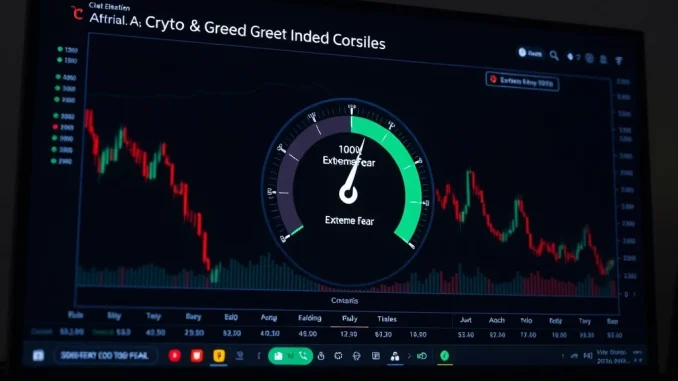
Global, February 2026: The cryptocurrency market is exhibiting classic signs of a sentiment capitulation. The widely monitored Crypto Fear & Greed Index has plummeted to a score of 16, marking its lowest point in over a year and firmly placing market psychology in the “Extreme Fear” zone. This dramatic shift coincides with Bitcoin’s price retreating to approximately $83,000 and a significant 14.5% contraction in the total market capitalization of digital assets. While surface-level indicators paint a picture of panic, a deeper analysis of on-chain data and trading volumes suggests this period of intense fear may be setting the stage for the next market phase, following historical patterns where extreme pessimism often precedes a reversal.
Decoding the Crypto Fear & Greed Index Collapse
The Crypto Fear & Greed Index is a composite metric that aggregates data from multiple sources, including volatility, market momentum, social media sentiment, surveys, and dominance trends, to quantify the prevailing emotional state of the cryptocurrency market. A score of 0 represents maximum fear, while 100 signifies maximum greed. The current reading of 16 is significant because it represents a multi-month low, indicating a broad-based and intense negative shift in investor psychology. Historically, such readings have been contrarian indicators. When the crowd becomes overwhelmingly fearful and convinced of further decline, it often indicates that selling pressure is exhausting itself, potentially creating a foundation for a rebound. Market analytics firm Santiment has noted that these sentiment extremes are among the few bullish signals flashing in an otherwise bleak short-term landscape, suggesting the market may be undergoing a necessary emotional purge.
A Tale of Two Investors: Whale Exodus vs. Retail Accumulation
The current market stress has revealed a stark divergence in behavior between different classes of investors, providing critical context to the fear index reading. On-chain data presents a clear narrative:
- Whale Distribution: Analysis indicates that since December 2025, over 580 Bitcoin wallets holding 10 BTC or more have been emptied or dissolved. This movement suggests that larger, potentially more sophisticated holders (often called “whales”) have been distributing their holdings during this period of price weakness.
- Retail Accumulation: In contrast, data shows smaller wallet addresses (often associated with retail investors) have been net buyers during the dip. This behavior pattern of “buying the fear” is common among long-term retail believers but is often contrasted with the actions of larger entities.
- Long-Term Holder Steadiness: Crucially, there has been no detected mass exodus from long-term holder wallets (addresses holding coins for over 155 days). Their relative inactivity suggests conviction remains among the most experienced cohort, who typically sell into strength, not panic.
This dichotomy underscores a complex market dynamic: smart money appears to be taking profits or repositioning, while the broader retail base sees value, and the most committed holders remain unfazed. This is not a uniform sell-off but a nuanced transfer and consolidation of assets.
The Surge in Trading Volume: Sign of Panic or Purge?
Another critical data point accompanying the fear index plunge is an 85% weekly surge in overall cryptocurrency trading volume. Elevated volume during a price decline typically signals heightened activity and emotional trading. This can be interpreted in two ways:
- Panicked Selling: Newer or leveraged traders may be liquidating positions to cut losses, contributing to downward pressure.
- Strategic Rebalancing: The volume also includes buying activity from those accumulating at lower prices, as well as institutional and algorithmic trades rebalancing portfolios.
This volume spike is characteristic of a capitulation event, where weak hands exit the market en masse. From a technical perspective, such events are frequently viewed as necessary to wash out excess speculation and establish a stronger, more sustainable price floor. The market, in essence, is clearing out leverage and over-optimistic positions.
Historical Context and the Cycle of Market Sentiment
To understand the potential implications of the current extreme fear reading, it is instructive to look at previous crypto market cycles. The Fear & Greed Index has repeatedly hit single-digit or low-teens readings during major market bottoms, such as in late 2018 and mid-2022. In both instances, these periods of maximum pessimism and negative news flow were followed, not immediately, but eventually, by the beginning of new bullish phases. The psychology follows a predictable pattern: Euphoria leads to greed, which leads to complacency, then anxiety, denial, capitulation (extreme fear), and finally, despondency before a slow turn. The current climate suggests the market may be in the capitulation phase. Industry veterans often cite these moments not as endpoints, but as transitions where weak projects fail, valuations reset, and fundamental value is rediscovered by patient capital.
Institutional Perspective: A Long-Term View Amid Short-Term Fear
Despite the grim headline sentiment, commentary from established industry leaders provides a counter-narrative focused on long-term infrastructure development. Executives from major firms like Coinbase and Bitwise have publicly framed the current volatility as a temporary passage within a much larger adoption arc. Hunter Horsley, CEO of Bitwise Asset Management, has reiterated projections that by the end of 2026, a majority of large financial institutions will have some form of cryptocurrency exposure through products and services. This perspective suggests that while retail sentiment swings wildly, the foundational work of integrating digital assets into traditional finance continues unabated. The fear in the market, from this viewpoint, acts as a quality filter, separating speculative noise from substantive technological and financial progress.
Key Market Metrics at a Glance
| Metric | Current Status | Implied Signal |
|---|---|---|
| Crypto Fear & Greed Index | 16 / 100 (Extreme Fear) | Maximum bearish sentiment, potential contrarian indicator |
| Bitcoin (BTC) Price | ~$83,000 (-7% move) | Significant correction from recent highs |
| Whale Wallet Activity | 580+ large wallets dissolved since Dec ’25 | Distribution by large holders |
| Weekly Trading Volume | +85% increase | High activity, signaling capitulation/volatility |
| Total Market Capitalization | -14.5% | Broad-based market contraction |
Conclusion: Fear as a Function, Not a Failure
The plunge of the Crypto Fear & Greed Index to 16 is a definitive snapshot of a market under significant psychological stress. The combination of price decline, whale selling, and surging volume confirms a period of capitulation. However, interpreting this solely as a negative omen misses the nuanced mechanics of market cycles. Historically, such extremes in fear have proven to be fertile ground for subsequent recoveries, as they flush out excess and reset expectations. The current dichotomy between whale distribution and retail accumulation, set against a backdrop of steady long-term holders, paints a picture of a market in transition, not collapse. For disciplined investors, understanding this sentiment extreme is less about predicting an immediate bounce and more about recognizing that the market’s emotional pendulum has swung to one extreme, a condition from which it has always, eventually, begun its return journey. The extreme fear, therefore, may be less a signal of an end and more a painful but necessary function in the market’s ongoing evolution.
FAQs
Q1: What does a Crypto Fear & Greed Index score of 16 mean?
A score of 16 indicates “Extreme Fear” in the market. The index ranges from 0 (maximum fear) to 100 (maximum greed). This low score suggests investors are overwhelmingly pessimistic, which historical data sometimes shows as a potential contrarian indicator for a future sentiment shift.
Q2: Why are Bitcoin “whales” selling while the fear index is so low?
Large holders (whales) may be selling for several reasons: taking profits after a prior run-up, portfolio rebalancing, risk management, or deploying capital elsewhere. Their selling during retail fear can indicate a transfer of assets from weaker to stronger hands or simply profit-taking by sophisticated investors.
Q3: Is extreme fear always a buy signal for cryptocurrency?
Not immediately, and timing is difficult. While extreme fear readings have often coincided with or preceded major market bottoms, they do not guarantee an instant reversal. They signal that selling pressure may be exhausting itself, but markets can remain fearful or decline further for some time before a trend change.
Q4: What causes the Crypto Fear & Greed Index to move?
The index is a composite of several factors including market volatility (25%), momentum and volume (25%), social media sentiment (15%), surveys (15%), Bitcoin dominance (10%), and Google Trends data (10%). A sharp drop typically involves negative moves across most of these metrics.
Q5: How reliable is the Fear & Greed Index as an investment tool?
It is best used as a supplementary sentiment gauge, not a standalone trading signal. It provides context about market psychology. Investors should combine its readings with fundamental analysis, on-chain data, technical analysis, and macroeconomic factors before making any investment decision.