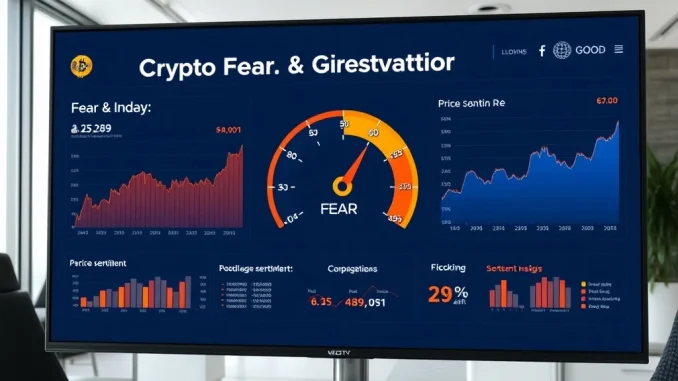
Global, May 2025: The cryptocurrency market continues to exhibit signs of investor apprehension as the widely monitored Crypto Fear & Greed Index remains firmly in ‘fear’ territory. According to the latest data from Alternative, the index holds steady at 29, unchanged from the previous day and reflecting persistent caution among market participants. This stagnation at a fear level provides crucial insights into current market psychology and potential future movements.
Crypto Fear & Greed Index Components and Methodology
The Crypto Fear & Greed Index represents a sophisticated quantitative approach to measuring market sentiment. Developed by data provider Alternative, this tool aggregates multiple data streams to generate a single numerical value between 0 and 100. A reading of 0 indicates extreme fear, while 100 represents extreme greed. The current reading of 29 places the market squarely in the fear category, though not at the extreme end of the spectrum.
The index calculation employs a weighted formula that incorporates six primary factors. Market volatility contributes 25% to the final score, with higher volatility typically pushing the index toward fear. Trading volume accounts for another 25%, where unusually high volume can indicate either panic selling or FOMO buying. Social media sentiment analysis comprises 15% of the score, tracking mentions and tone across major platforms. Survey data from retail and institutional investors adds another 15%.
The remaining 20% comes from two additional metrics. Bitcoin’s market dominance contributes 10%, as shifts in Bitcoin’s share of total cryptocurrency market capitalization can signal changing risk appetites. Finally, Google search trends for cryptocurrency-related terms provide the final 10%, offering insight into public interest and potential retail participation.
Historical Context of the Fear & Greed Index
Understanding the significance of a 29 reading requires examining historical patterns. The index has experienced dramatic fluctuations since its inception, often correlating with major market events. During the 2017 bull market peak, the index reached extreme greed levels above 90. Conversely, the March 2020 COVID-19 market crash drove the index to extreme fear readings below 10.
Recent history shows the index has spent considerable time in fear territory throughout 2024 and early 2025. This prolonged period of cautious sentiment contrasts sharply with the euphoric periods that characterized previous market cycles. The current stagnation at 29 suggests neither worsening panic nor improving confidence, but rather a sustained state of wariness.
Historical analysis reveals several patterns:
- Index readings below 25 often precede market bottoms
- Sustained fear periods typically last 30-90 days before significant reversals
- Rapid shifts from fear to greed frequently signal the beginning of bull markets
- The index tends to be more accurate in extreme readings than in neutral territory
Current Market Conditions Supporting the Fear Reading
Several observable market conditions align with the 29 fear reading. Bitcoin and major altcoins have exhibited elevated volatility without clear directional momentum. Trading volumes, while substantial, show patterns consistent with cautious accumulation rather than aggressive speculation. Social media analysis reveals increased discussion of risk management and portfolio protection strategies rather than price predictions or moon scenarios.
Bitcoin’s market dominance has remained relatively stable in recent weeks, suggesting neither flight to safety into Bitcoin nor rotation into higher-risk altcoins. Google search volume for cryptocurrency terms shows steady but not explosive interest, indicating continued public awareness without the frenzy associated with market peaks. These factors collectively create the environment captured by the 29 reading.
Implications for Different Market Participants
The sustained fear reading carries distinct implications for various market participants. For long-term investors, periods of fear often represent accumulation opportunities, though timing remains challenging. Institutional investors typically view extended fear periods as environments for strategic positioning and infrastructure development. Retail traders face increased psychological pressure during fear periods, often leading to emotional decision-making.
Market analysts note that fear periods frequently coincide with important developments in cryptocurrency fundamentals. During these times, development activity often increases, regulatory frameworks may solidify, and market infrastructure tends to improve. The current fear period appears no different, with several major blockchain upgrades and institutional adoption milestones occurring despite the cautious sentiment.
The following table illustrates typical investor behaviors during fear periods:
| Participant Type | Common Behaviors During Fear | Potential Risks |
|---|---|---|
| Long-term Holders | Dollar-cost averaging, portfolio rebalancing | Early exhaustion of capital |
| Institutional Investors | Strategic accumulation, infrastructure investment | Regulatory uncertainty |
| Retail Traders | Reduced position sizes, increased cash holdings | Missing reversal opportunities |
| Market Makers | Widened spreads, reduced liquidity provision | Increased volatility impact |
Expert Perspectives on Sentiment Indicators
Financial analysts emphasize that sentiment indicators like the Fear & Greed Index serve as contrarian signals when extreme, but as confirmation tools in moderate ranges. At 29, the index suggests caution without panic, potentially indicating a market searching for direction rather than one in freefall. Market psychologists note that sustained fear can create conditions for sharp reversals when positive catalysts emerge, as positioned investors may quickly shift from defensive to offensive postures.
Historical precedent shows that markets can remain in fear territory for extended periods during consolidation phases. The current environment shares characteristics with previous periods that preceded significant moves, though direction remains uncertain. Technical analysts watch for divergences between price action and sentiment readings, as these often signal impending trend changes.
Comparison with Traditional Market Sentiment Indicators
The Crypto Fear & Greed Index operates similarly to established sentiment indicators in traditional finance. The VIX volatility index, often called the ‘fear gauge’ of stock markets, measures expected volatility in S&P 500 options. While the VIX focuses primarily on volatility expectations, the Crypto Fear & Greed Index incorporates broader behavioral data. This difference reflects cryptocurrency markets’ unique characteristics, including 24/7 trading and heavy retail participation.
Other traditional sentiment measures include the AAII Investor Sentiment Survey and various put/call ratios. These tools share the Crypto Fear & Greed Index’s contrarian nature—extreme readings often precede market reversals. However, cryptocurrency markets tend to exhibit more dramatic sentiment swings and faster mean reversion than traditional markets, making sentiment indicators potentially more timely though equally prone to false signals.
Key differences between cryptocurrency and traditional sentiment indicators include:
- Cryptocurrency indicators incorporate social media data more heavily
- Traditional indicators rely more on institutional positioning data
- Crypto markets show faster sentiment cycle completion
- Retail participation influences crypto sentiment more significantly
Conclusion
The Crypto Fear & Greed Index holding at 29 provides a clear snapshot of current market psychology. This sustained fear reading reflects cautious sentiment without panic, suggesting a market in search of directional catalysts. While sentiment indicators offer valuable insights, they represent just one piece of the analytical puzzle. Market participants should consider the Fear & Greed Index alongside fundamental developments, technical patterns, and macroeconomic factors. The current environment of measured fear may present opportunities for disciplined investors while reminding all participants of cryptocurrency markets’ inherent volatility and emotional dynamics.
FAQs
Q1: What does a Crypto Fear & Greed Index reading of 29 mean?
A reading of 29 indicates the market is in ‘fear’ territory but not at extreme levels. It suggests cautious sentiment among investors without panic selling or complete loss of confidence.
Q2: How often does the Crypto Fear & Greed Index update?
The index updates daily, providing a current snapshot of market sentiment based on the previous 24 hours of data across its six component metrics.
Q3: Can the Fear & Greed Index predict market movements?
While not a perfect predictor, extreme readings (below 20 or above 80) have historically correlated with market reversals. Moderate readings like 29 serve more as confirmation of current sentiment than prediction tools.
Q4: How reliable is the Crypto Fear & Greed Index compared to traditional indicators?
The index has proven reasonably reliable for cryptocurrency markets specifically, though all sentiment indicators should be used alongside other analysis methods. Its multi-factor approach makes it more comprehensive than single-metric indicators.
Q5: What typically causes the index to move from fear to greed territory?
Sustained price increases, decreasing volatility, rising trading volumes with positive price action, improving social media sentiment, and increasing Bitcoin dominance during rallies can all contribute to shifts from fear to greed.