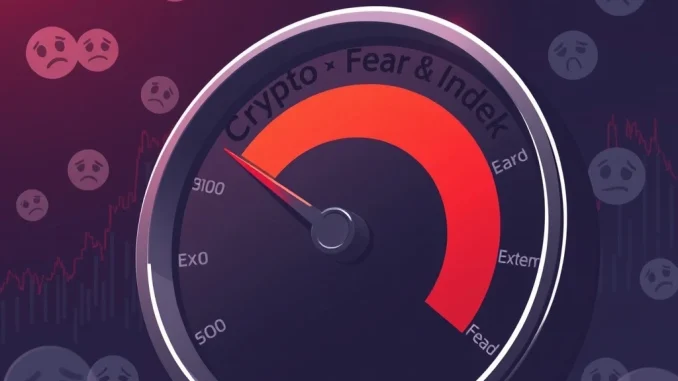
Global cryptocurrency markets witnessed a subtle but notable shift in sentiment on March 21, 2025, as the widely monitored Crypto Fear & Greed Index climbed four points to a reading of 24. Despite this increase, the index firmly remains in the “Extreme Fear” category, highlighting the persistent anxiety and caution dominating digital asset investment. This movement provides a critical data point for analysts and investors navigating the complex market landscape of 2025, where regulatory clarity and macroeconomic factors continue to exert significant pressure.
Decoding the Crypto Fear & Greed Index Rise to 24
The Crypto Fear & Greed Index, published by Alternative.me, serves as a daily barometer for market emotion. It translates complex market data into a simple score from 0 to 100. A score of 0 represents “Extreme Fear,” while 100 signifies “Extreme Greed.” The recent move from 20 to 24, while minor, represents a 20% relative increase from its previous level. This calculation relies on a multifaceted methodology designed to capture both quantitative and qualitative signals from the market.
The index’s algorithm synthesizes six core components, each with a specific weight. Market volatility and trading volume each contribute 25%, offering a pure, numbers-driven view of price swings and investor activity. Social media sentiment and market surveys each account for 15%, capturing the narrative and crowd psychology. Finally, Bitcoin’s market dominance and related Google search trends each make up 10%, indicating the level of public and institutional focus on the flagship cryptocurrency.
The Mechanics Behind the Market Mood
Understanding the index’s rise requires examining its inputs. For instance, a decrease in Bitcoin’s 30-day volatility, a slight uptick in trading volume on major exchanges like Coinbase and Binance, or a reduction in overwhelmingly negative social media commentary could all contribute to a higher score. Conversely, a surge in bearish survey results or a drop in Bitcoin’s dominance could pull the score down. The four-point gain suggests a marginal improvement in one or several of these metrics, though not enough to break the overarching fear narrative.
Historical Context and the Extreme Fear Zone
Placing the current reading of 24 in historical context is essential for a complete analysis. The index has experienced dramatic swings throughout cryptocurrency’s history. For example, it plummeted to single digits during the market capitulation events of late 2018 and mid-2022. Conversely, it soared above 90 during the peak euphoria of late 2017 and late 2021.
The “Extreme Fear” zone, typically encompassing readings below 25, is often associated with potential buying opportunities for long-term, risk-tolerant investors. This contrarian perspective is based on the idea that when fear is maximal, asset prices may be undervalued. However, this zone can also precede further declines, as seen in prolonged bear markets. The table below shows key index levels and their common interpretations:
| Index Range | Sentiment Label | Typical Market Phase |
|---|---|---|
| 0-24 | Extreme Fear | Potential capitulation, high volatility, negative news flow |
| 25-49 | Fear | Caution, consolidation, uncertain trends |
| 50 | Neutral | Balance between fear and greed |
| 51-74 | Greed | Growing optimism, rising prices, increasing FOMO |
| 75-100 | Extreme Greed | Market tops, euphoria, speculation, high risk |
Real-World Market Impacts and Expert Analysis
The index’s persistent “Extreme Fear” reading correlates with several observable market conditions in early 2025. Trading volumes, while showing slight improvement, remain below their historical averages. Furthermore, the market has seen a noticeable trend of assets moving off exchanges into private wallets, a behavior often associated with long-term holding rather than active trading. This so-called “exchange outflow” metric is frequently watched as a sign of investor conviction.
Market analysts from firms like Glassnode and CoinMetrics often cross-reference the Fear & Greed Index with on-chain data. They examine metrics such as:
- Realized Profit/Loss: Measuring the aggregate profit or loss investors are taking by moving coins.
- MVRV Ratio: Comparing market value to realized value to assess if an asset is over or under-valued.
- Network Growth: Tracking new addresses being created on blockchain networks.
Currently, these on-chain metrics generally support the cautious sentiment. For example, the MVRV ratio for Bitcoin has spent significant time below 1, indicating the average holder is at an unrealized loss—a classic bear market signal. However, the slight rise in the Fear & Greed Index may hint at early, tentative steps toward a sentiment shift, often a precursor to broader market movements.
The 2025 Macroeconomic Backdrop
Cryptocurrency markets do not operate in a vacuum. The lingering extreme fear must also be viewed against the macroeconomic landscape of 2025. Key factors include:
- Global interest rate policies set by the U.S. Federal Reserve and other central banks.
- The strength of the U.S. dollar, which has an inverse relationship with risk assets like Bitcoin.
- Evolving regulatory frameworks for digital assets in major economies like the U.S., EU, and UK.
- Institutional adoption trends, including spot Bitcoin ETF flows and corporate treasury allocations.
Uncertainty in any of these areas can suppress investor appetite for risk, directly contributing to lower readings on the sentiment index. Conversely, positive developments, such as clearer regulations or a dovish pivot from central banks, could provide the catalyst needed to push the index out of the extreme fear territory.
Conclusion
The Crypto Fear & Greed Index’s rise to 24 offers a nuanced signal for the market. While the move out of the deep teens indicates a marginal easing of pessimism, the classification within “Extreme Fear” underscores a market still gripped by caution. This sentiment reflects the complex interplay of on-chain activity, macroeconomic pressures, and regulatory developments defining the 2025 landscape. For investors, this index serves not as a standalone timing tool, but as a valuable piece of contextual data. It highlights the prevailing psychological environment, reminding market participants that sustained recoveries often begin when fear is most palpable, though they require fundamental catalysts to take hold. Monitoring future movements of this index, alongside volume, volatility, and on-chain fundamentals, will remain crucial for navigating the next phase of the cryptocurrency cycle.
FAQs
Q1: What does a Crypto Fear & Greed Index score of 24 mean?
A score of 24 places the market sentiment firmly in the “Extreme Fear” zone. This suggests investors are predominantly fearful and risk-averse, which can be associated with potential undervaluation but also high volatility and negative news flow.
Q2: How is the Crypto Fear & Greed Index calculated?
The index is calculated using six weighted factors: volatility (25%), market volume (25%), social media sentiment (15%), surveys (15%), Bitcoin dominance (10%), and Google search trends (10%). These are combined to produce a single score from 0 to 100.
Q3: Is extreme fear a good time to buy cryptocurrency?
From a contrarian investment perspective, periods of extreme fear can present buying opportunities, as prices may be depressed. However, this is a high-risk strategy and does not guarantee a bottom. It should be part of a broader, long-term investment plan and thorough personal research.
Q4: Has the index ever been lower than 24?
Yes, the index has reached single digits during major market crises, such as the collapse of FTX in November 2022 and the bear market lows of 2018. A reading of 24, while low, is not historically unprecedented.
Q5: How often does the Crypto Fear & Greed Index update?
The index updates daily, typically once per 24-hour period. It provides a snapshot of market sentiment based on data from the preceding day, making it a useful tool for tracking short-term sentiment shifts.
Updated insights and analysis added for better clarity.
This article was produced with AI assistance and reviewed by our editorial team for accuracy and quality.