Crypto Fear & Greed Index Plunges to 27: A Stark Signal of Lingering Market Anxiety
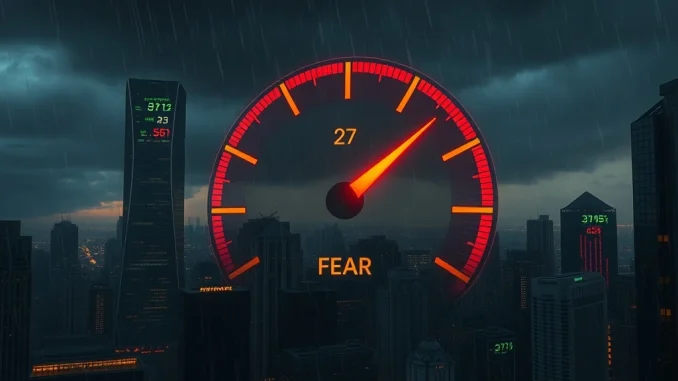
Global cryptocurrency markets are exhibiting clear signs of sustained anxiety, as evidenced by the latest reading from a crucial sentiment indicator. The widely monitored Crypto Fear & Greed Index has registered a notable decline, dropping to a score of 27. This figure firmly places market psychology within the ‘Fear’ territory, according to data from Alternative.me. Consequently, this persistent downtrend in sentiment provides a critical lens through which to analyze current digital asset volatility and investor behavior.
Decoding the Crypto Fear & Greed Index Drop to 27
The Crypto Fear & Greed Index serves as a daily barometer for overall market emotion. It operates on a scale from 0 to 100. A score of 0 represents ‘Extreme Fear,’ while 100 signifies ‘Extreme Greed.’ The recent drop to 27, a two-point decline from the previous reading, indicates a consolidation of fearful sentiment rather than a sudden crash. This metric aggregates data from multiple sources to avoid reliance on any single factor. The index’s calculation involves a weighted analysis of six core components, each offering a different perspective on market dynamics.
- Volatility (25%): This measures price swings, particularly for Bitcoin. Increased volatility often correlates with higher fear.
- Market Volume (25%): Trading volume and momentum are assessed. Sustained low volume can signal investor hesitation.
- Social Media (15%): Sentiment analysis from platforms like Twitter and Reddit gauges public conversation tone.
- Surveys (15%): Polls and community surveys provide direct insight into trader expectations.
- Dominance (10%): Bitcoin’s share of the total crypto market cap indicates a ‘flight to safety’ trend.
- Trends (10%): Google search volume for Bitcoin-related terms reflects mainstream interest and concern.
Therefore, the current score results from a composite of these inputs. The index’s methodology aims to quantify the often-irrational psychological drivers behind market movements. Historically, prolonged periods in the ‘Fear’ zone have presented both significant risk and potential opportunity for strategic investors.
Historical Context and Market Sentiment Analysis
To fully understand the significance of a ’27’ reading, one must examine historical patterns. The index has experienced extreme fluctuations since its inception. For instance, it reached a peak of 95 during the bull market euphoria of late 2021. Conversely, it plummeted to single digits during major market crises, such as the COVID-19 market crash in March 2020 and the collapse of the Terra ecosystem in May 2022. A score of 27, while low, is not unprecedented. It typically reflects a market characterized by caution, negative headlines, and defensive positioning.
Market analysts often interpret sustained fear as a potential contrarian indicator. The ‘Fear & Greed’ model is rooted in behavioral finance principles, suggesting that excessive fear can lead to undervalued asset prices. However, this does not guarantee an immediate reversal. External macroeconomic factors heavily influence crypto markets. Rising interest rates, inflationary pressures, and geopolitical tensions have all contributed to risk-off sentiment across traditional and digital finance in recent years. The index currently reflects this broader financial landscape of uncertainty.
Expert Perspectives on Sentiment Indicators
Financial researchers emphasize that sentiment indicators like the Fear & Greed Index are best used as one tool among many. “While a low index score highlights prevailing pessimism, it must be contextualized with on-chain data and macroeconomic fundamentals,” explains a report from blockchain analytics firm Glassnode. On-chain metrics, such as exchange flows and long-term holder behavior, can confirm whether retail sentiment aligns with the actions of larger, more experienced investors. Currently, data shows a mix of accumulation and distribution patterns, suggesting a market at a crossroads.
Furthermore, the separation of the index’s components reveals nuanced stories. A spike in volatility (contributing to fear) coupled with rising Bitcoin dominance might indicate investors are abandoning altcoins for the relative perceived safety of Bitcoin. Simultaneously, a drop in social media hype could signal a shift from speculative discussion to more fundamental analysis. This multi-factor approach prevents the index from being swayed by temporary social media trends or isolated price swings, aiming instead for a stable, holistic view.
The Impact of Persistent Fear on Crypto Markets
Prolonged fear sentiment has tangible effects on market structure and participant behavior. Firstly, trading volume often contracts as sidelined capital waits for clearer signals. Secondly, development activity on blockchain networks can sometimes increase during bearish periods, as teams focus on building rather than marketing. Thirdly, regulatory developments receive heightened scrutiny, with any negative news having an outsized impact on prices. This environment tests the conviction of long-term believers and filters out short-term speculators.
For retail investors, a fear-driven market presents distinct challenges and considerations. Emotional decision-making, like panic selling at a loss, becomes a greater risk. Conversely, disciplined dollar-cost averaging strategies may be executed at more favorable price points. The table below contrasts typical market characteristics during ‘Extreme Fear’ versus ‘Extreme Greed’ phases, based on historical observations.
| Market Phase | Fear (0-25) | Greed (75-100) |
|---|---|---|
| Media Tone | Predominantly negative, focus on risks and losses. | Overwhelmingly positive, highlighting gains and potential. |
| Investor Activity | Hesitation, accumulation by veterans, selling by novices. | FOMO-driven buying, high leverage, influx of new traders. |
| Price Action | High volatility, strong reactions to negative news. | Momentum-driven rallies, parabolic moves. |
| Network Health | Often stable or improving fundamentals. | Can be strained by high transaction fees and congestion. |
Ultimately, markets are cyclical. Periods of fear inevitably give way to neutrality and eventually greed, though the timing is unpredictable. The current index reading serves as a data point confirming the challenging climate. It does not, however, predict the duration or ultimate resolution of this sentiment phase. Investors must combine this information with rigorous fundamental research.
Conclusion
The Crypto Fear & Greed Index reading of 27 provides a quantitative snapshot of a cautious and apprehensive cryptocurrency market. This drop underscores the ongoing impact of macroeconomic headwinds and a lack of bullish catalysts. By analyzing the index’s components—volatility, volume, social media, surveys, dominance, and search trends—we gain a multidimensional view of investor psychology. While historically, such levels of fear have preceded market recoveries, they also demand heightened risk management and disciplined strategy from participants. Monitoring this sentiment indicator, alongside fundamental on-chain data, remains crucial for navigating the complex and emotional landscape of digital asset investing.
FAQs
Q1: What does a Crypto Fear & Greed Index score of 27 mean?
A score of 27 falls squarely within the ‘Fear’ zone (0-49). It indicates that current market data and sentiment are skewed toward pessimism, caution, and negative expectations among investors.
Q2: Who creates the Crypto Fear & Greed Index and how is it calculated?
The index is provided by data company Alternative.me. It is calculated using a weighted formula analyzing six factors: volatility (25%), market volume/momentum (25%), social media sentiment (15%), surveys (15%), Bitcoin dominance (10%), and Google Trends data for Bitcoin (10%).
Q3: Is a low Fear & Greed Index score a good buying signal?
While historically, periods of extreme fear have often coincided with market bottoms, it is not a standalone timing signal. A low score suggests potential undervaluation but must be confirmed by fundamental analysis and positive on-chain metrics. It can indicate a buying opportunity for long-term investors using disciplined strategies.
Q4: How often does the Crypto Fear & Greed Index update?
The index is updated daily, typically once per 24-hour period. It provides a snapshot of sentiment based on the most recent available data from its various sources.
Q5: Has the index ever been lower than 27?
Yes, the index has reached much lower levels during major market crises. It has dipped into single digits (Extreme Fear) during events like the March 2020 COVID-19 crash and the May 2022 Terra/LUNA collapse, demonstrating that the current reading, while low, is not at an all-time extreme.
Related News
- SHOGGOTH Memecoin Explodes: The Elon Musk Effect Behind the Massive Crypto Pump
- Binance Mastercard Withdrawals Revolutionize Fiat Access for EU Users
- This Viral Streamer Lost $700K Worth of BTC Betting on Kamala Harris to Win
Related: Crypto Market Sentiment Plummets to Extreme Fear as Sector Struggles Amid Volatility
Related: RaveDAO ($RAVE) Surges 80% as Whale Withdrawal from Bitget Defies Crypto Market Downturn
Related: SEC Stablecoin Rules: A Pivotal Shift as Regulators Allow Capital Inclusion with 2% Haircut