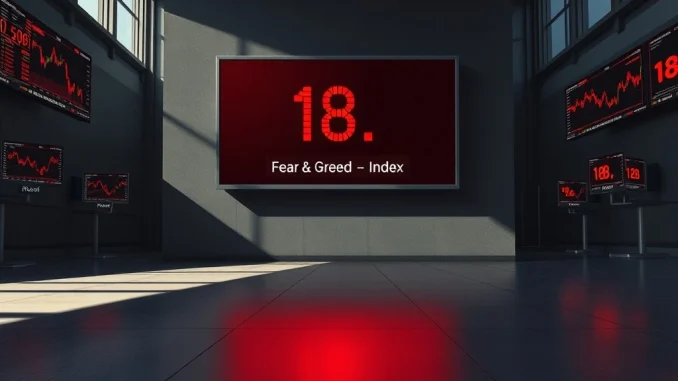
NEW YORK, March 15, 2026 — The Crypto Fear and Greed Index, a critical barometer of market psychology, has collapsed back into “extreme fear” territory, registering a sobering score of 18. This sharp decline, recorded on Friday, March 14, marks a rapid reversal from a brief mid-week recovery and signals deepening pessimism among cryptocurrency investors. The drop reflects the sustained pressure from the October 2025 market crash, compounded by escalating geopolitical friction and persistent macroeconomic headwinds that continue to drain risk appetite from digital assets globally.
Crypto Fear and Greed Index Signals Deepening Market Anxiety
The index’s fall from 20 (“fear”) to 18 (“extreme fear”) may seem numerically small, but it represents a significant psychological shift. According to data from CoinMarketCap, sentiment briefly rallied to a score of 25 on Wednesday, March 12, offering a glimmer of hope. However, that optimism proved fleeting. “The brief spike was likely technical or driven by short-term traders,” explains market analyst Robert Lakin, who reviewed the data. “The underlying fundamentals—geopolitical risk and macroeconomic uncertainty—never changed, so the reversion to extreme fear was almost inevitable.” The index now sits just 13 points above its yearly low of 5, recorded in February 2026 during the darkest period of the current bear market.
This downturn has a clear origin point. The crypto market entered a sustained bear phase following the October 2025 crash, an event that saw Bitcoin (BTC) lose over 50% of its value from its all-time high. While BTC staged a limited recovery, the altcoin market was decimated, erasing hundreds of billions in value. The current sentiment reading suggests the market has not found a stable floor, with fear now being the dominant emotion driving investment decisions.
Altcoins Bear the Brunt as Sentiment Craters
The impact of the pervasive fear is most acutely felt in the altcoin sector, which typically exhibits higher volatility. A startling analysis from CryptoQuant reveals the severity. “38% of altcoins are hovering at or near all-time low prices,” said CryptoQuant analyst Darkfost in a statement to Cointelegraph. “This situation is more severe than the aftermath of the FTX collapse.” Darkfost noted this price collapse coincided with an approximate 50% reduction in overall crypto trading volume, indicating a massive withdrawal of liquidity and participation.
- Liquidity Evaporation: Altcoins are traditionally the last sector where speculative liquidity flows, making their current state a dire indicator of overall market health.
- Social Silence: Supporting this data, the crypto sentiment analysis platform Santiment reported that mentions of altcoins on social media platforms have sunk to their lowest level in two years, showing a collapse in retail investor interest.
- Search Sentiment: Perhaps the most telling signal of mainstream anxiety comes from Google Trends. In February 2026, worldwide search volume for the phrase “Bitcoin going to zero” hit its highest level since 2022, directly corroborating the extreme fear measured by the index.
Expert Analysis on Macroeconomic and Geopolitical Drivers
Analysts uniformly point to factors far beyond the crypto ecosystem for the current climate. “Altcoins remain the last sector of the crypto market where liquidity typically flows, so this situation is not surprising,” Darkfost explained. “The geopolitical and macroeconomic deterioration observed over the past several months is the primary driver.” The tensions specifically cited include the ongoing strategic friction between the US, Israel, and Iran, which creates global uncertainty that disproportionately affects risk-on assets like cryptocurrency.
Furthermore, traditional financial concerns are amplifying the crypto winter. Uncertainty over central bank interest rate policies, questions about global liquidity levels, and rising US government debt are forcing institutional and retail investors alike to adopt a defensive posture. This macroeconomic backdrop provides no fuel for a crypto bull run and instead acts as a constant anchor, pulling sentiment downward.
Historical Context and the Path of the 2026 Downturn
To understand the current “extreme fear” reading, one must view it as a chapter in a longer, painful narrative for crypto in 2026. The market has failed to achieve a sustained recovery since the October 2025 crash. The following table compares key sentiment and market indicators from the crash period to the present state, illustrating the prolonged nature of the downturn:
| Period | Crypto Fear & Greed Index | Bitcoin Price (Approx.) | Primary Market Driver |
|---|---|---|---|
| Pre-Oct 2025 Crash | Greed (55-60) | Near ATH | Speculative Rally |
| October 2025 Crash | Extreme Fear (10-15) | -50% from ATH | Liquidity Crisis, Leverage Unwind |
| February 2026 Low | Extreme Fear (5) | Yearly Low | Geopolitical Shock, Macro Fears |
| March 14, 2026 (Current) | Extreme Fear (18) | Stabilized, but low | Sustained Macro Uncertainty, Low Volume |
This timeline shows a market trapped in a fear cycle, with brief respites quickly snuffed out by external pressures. The current level, while off the absolute bottom, indicates the market lacks the confidence to mount a real recovery.
What Comes Next for Crypto Investor Sentiment?
The immediate future for the Crypto Fear and Greed Index hinges almost entirely on developments in the macro environment. Market technicians will watch for a sustained break above the 25 level (from the recent 25 spike) as a first sign of fear receding. However, most analysts agree that without a resolution or reduction in the key geopolitical tensions or a clearer, more positive trajectory for interest rates and economic growth, sentiment is likely to remain mired in “extreme fear” or “fear” territory.
Market Participant Reactions and Contrarian Views
Within the crypto community, reactions are bifurcated. The predominant mood is one of caution and preservation of capital, as evidenced by the cratering volume. However, a contingent of contrarian investors is beginning to voice a different perspective. Some point to the historical tendency of the Fear and Greed Index to serve as a contrary indicator; extreme fear often precedes major buying opportunities. As reported, some contrarians have suggested that the $60K level during the downturn may have marked Bitcoin’s long-term bottom, arguing that the current pervasive pessimism is itself a signal to cautiously accumulate.
Conclusion
The Crypto Fear and Greed Index reading of 18 is a powerful quantitative confirmation of the qualitative anxiety gripping digital asset markets in March 2026. It underscores a market still deeply wounded from the October 2025 crash and now besieged by external macroeconomic and geopolitical storms. The extreme fear is most visible in the ravaged altcoin sector, where nearly 40% of assets trade near historic lows amid vanishing liquidity. For a sustainable shift in sentiment to occur, the market needs a catalyst from outside itself—a de-escalation of global tensions or a definitive positive turn in economic policy. Until then, the index is likely to remain a stark gauge of extreme fear, reminding investors that crypto’s path to recovery remains fraught with uncertainty.
Frequently Asked Questions
Q1: What does a Crypto Fear and Greed Index score of 18 mean?
A score of 18 falls squarely within the “Extreme Fear” zone (0-25). It indicates that market sentiment is overwhelmingly negative, driven by factors like panic selling, low volume, and negative news. Historically, such levels can signal potential market bottoms but also reflect high risk and uncertainty.
Q2: How does the current extreme fear level impact altcoin prices?
The impact is severe. Data from CryptoQuant shows 38% of altcoins are near all-time lows, worse than after the FTX collapse. Extreme fear leads to disproportionate selling in these riskier assets and a massive withdrawal of trading liquidity, exacerbating price declines.
Q3: What needs to happen for the Crypto Fear and Greed Index to recover?
Recovery requires a change in the external drivers. Key factors include a reduction in major geopolitical tensions (e.g., US-Iran-Israel), clearer and more positive global economic policy, and a sustained increase in trading volume and institutional capital flowing back into the crypto market.
Q4: Is extreme fear a good time to buy cryptocurrency?
Contrarian investment theory suggests periods of extreme fear can present long-term buying opportunities, as assets may be oversold. However, this carries high risk, as fear can persist and prices can fall further. It requires thorough research and a high-risk tolerance, not a reaction to the index alone.
Q5: How reliable is the Crypto Fear and Greed Index as an indicator?
The index is a reliable gauge of current market sentiment and psychology by aggregating data from volatility, volume, social media, surveys, and trends. It is a descriptive tool, not a predictive one. It tells you what the mood is now, not what will happen tomorrow, though extreme readings often precede trend reversals.
Q6: How does this compare to traditional market fear indicators like the VIX?
Both measure market anxiety, but the Crypto Fear and Greed Index is tailored to crypto-specific data sources. While the traditional VIX (“fear index”) has also been elevated due to the same macro factors, the crypto index shows more extreme pessimism, reflecting the asset class’s higher perceived risk and volatility.