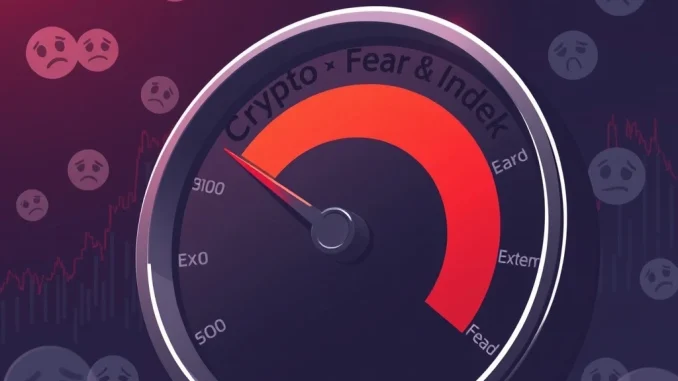
The cryptocurrency market entered another period of pronounced anxiety this week as the widely watched Crypto Fear & Greed Index plunged to a concerning score of 20, firmly cementing the ‘extreme fear’ territory that has characterized recent trading sessions. This four-point drop, reported by data provider Alternative on March 15, 2025, signals deepening investor pessimism across global digital asset exchanges. Market analysts immediately scrutinized the movement, recognizing its potential implications for Bitcoin, Ethereum, and the broader altcoin ecosystem during a period of regulatory uncertainty and macroeconomic pressure.
Crypto Fear & Greed Index Methodology and Current Reading
Alternative’s Crypto Fear & Greed Index provides a crucial quantitative measure of market psychology. The index operates on a straightforward zero-to-100 scale. Consequently, a score of zero represents maximum fear, while 100 indicates extreme greed. The current reading of 20 sits deep within the ‘extreme fear’ band, which the index defines as scores below 25. This classification stems from a proprietary formula analyzing six distinct market dimensions.
The index calculation assigns specific weights to each component. Market volatility and trading volume each contribute 25% to the final score. Social media sentiment and market surveys each account for 15%. Meanwhile, Bitcoin’s dominance over the total cryptocurrency market capitalization represents 10%. Finally, search volume data from Google comprises the remaining 10%. This multi-factor approach aims to capture both on-chain activity and broader investor interest.
Historically, sustained periods of extreme fear have often preceded market rebounds, creating potential buying opportunities for contrarian investors. However, prolonged fear can also trigger significant capital outflow and reduced liquidity. The current environment presents a complex picture where technical indicators conflict with fundamental narratives across the blockchain sector.
Analyzing the Components Behind the Extreme Fear Signal
Several concurrent factors drove the index to its current low level. Firstly, increased price volatility across major cryptocurrencies contributed heavily to the 25% volatility component. Bitcoin experienced several sharp intraday swings exceeding 5% recently. Similarly, Ethereum and other major altcoins mirrored this unstable price action. This volatility often erodes investor confidence and triggers risk-off behavior.
Secondly, trading volume patterns revealed notable trends. Spot trading volume on centralized exchanges showed a modest increase, typically associated with fear-driven selling. Conversely, derivatives volume, particularly in futures and perpetual swaps, indicated heightened leverage and potential liquidation risks. These volume dynamics directly influence the index’s 25% volume metric.
The social media component, weighted at 15%, reflected a surge in negative sentiment across platforms like X (formerly Twitter), Reddit, and specialized crypto forums. Analysis of keyword frequency showed increased mentions of ‘crash,’ ‘sell-off,’ and ‘bear market.’ Survey data from retail and institutional investors, another 15% component, corroborated this pessimistic outlook. Many participants expressed concerns about regulatory developments and macroeconomic interest rate policies.
Bitcoin Dominance and Search Trends Provide Context
Bitcoin’s market dominance, representing its share of the total crypto market cap, currently sits around 52%. This 10% index component suggests a moderate flight to relative safety within the largest cryptocurrency. Historically, rising Bitcoin dominance during market stress indicates investors are abandoning higher-risk altcoins for the perceived stability of Bitcoin. This dynamic often exacerbates selling pressure across smaller-cap tokens.
Google search volume for terms like ‘crypto crash’ and ‘Bitcoin price’ spiked approximately 40% over the past week. This 10% component of the index clearly signals heightened public anxiety and mainstream attention to market downturns. Search interest typically peaks during price declines rather than rallies, reflecting retail investor concern. This behavioral pattern consistently appears in historical index data.
Historical Comparisons and Market Cycle Context
Placing the current score of 20 in historical context provides valuable perspective. The index has reached similar or lower levels during several notable market events. For instance, it touched single digits during the March 2020 COVID-19 market crash. It also plummeted during the November 2022 FTX collapse. Comparatively, the current reading suggests serious concern but not yet the panic levels seen during those systemic crises.
The following table illustrates key historical Fear & Greed Index readings and their corresponding market phases:
| Index Score | Sentiment | Example Period | BTC Price (Approx.) |
|---|---|---|---|
| 5-10 | Extreme Fear (Panic) | March 2020 | $5,000 |
| 15-25 | Extreme Fear | Current (March 2025) | To be determined |
| 45-55 | Neutral | Q3 2023 | $27,000 |
| 75-85 | Extreme Greed | November 2021 | $69,000 |
Market cycles demonstrate that sentiment often reaches extremes before reversing. The ‘extreme fear’ zone has frequently marked accumulation phases for long-term investors. However, identifying the precise inflection point remains challenging. Current macroeconomic conditions, including central bank policies and geopolitical tensions, add layers of complexity not present in previous cycles.
Expert Analysis on Sentiment and Market Structure
Financial analysts emphasize that sentiment indicators like the Fear & Greed Index serve as contrarian signals rather than direct price predictors. When fear becomes extreme, it often indicates that selling pressure may be exhausting itself. Market technicians watch for divergences where prices make new lows but the sentiment index fails to follow, potentially signaling a bottom formation.
Blockchain data analytics firms report several on-chain metrics that align with the fearful sentiment. For example:
- Exchange Net Flow: Recent data shows net inflows to exchanges, suggesting holders are moving assets to sell.
- Realized Losses: The magnitude of realized losses has increased, indicating capitulation events.
- MVRV Ratio: The Market Value to Realized Value ratio for Bitcoin approaches levels historically associated with market bottoms.
Institutional perspectives remain divided. Some asset managers view the extreme fear as a buying signal for a long-term digital asset allocation. Others caution that structural changes in regulation and macroeconomic policy require more cautious positioning. This professional disagreement itself contributes to market uncertainty and volatility.
The Impact of External Macroeconomic Factors
The cryptocurrency market does not operate in a vacuum. Global financial conditions significantly influence digital asset prices and sentiment. Rising interest rates in major economies traditionally pressure risk assets like technology stocks and cryptocurrencies. Furthermore, strength in the U.S. dollar index often correlates with weakness in Bitcoin priced in USD.
Recent comments from Federal Reserve officials regarding inflation persistence have dampened hopes for imminent rate cuts. This macroeconomic backdrop contributes to the risk-off environment captured by the Fear & Greed Index. Additionally, regulatory developments in the United States and European Union create uncertainty for market participants. These factors collectively suppress the greed component of market psychology.
Potential Market Scenarios and Trader Psychology
Market participants currently face several plausible scenarios. The extreme fear reading could precede a swift sentiment reversal if positive catalysts emerge. Potential catalysts include clearer regulatory frameworks, institutional adoption announcements, or favorable macroeconomic data. Alternatively, the fear could deepen if negative news triggers further selling, potentially testing the lower bounds of the index scale.
Trader psychology during such periods often follows predictable patterns. The sequence frequently moves from denial to fear, then to capitulation, before eventual recovery. The current index level suggests the market is in the fear phase, possibly approaching capitulation if prices break key technical support levels. Monitoring derivatives funding rates and open interest provides additional insight into trader positioning and potential leverage unwinds.
Retail investor behavior typically lags professional moves during sentiment extremes. Data often shows retail selling accelerates near market bottoms, while institutional accumulation begins quietly. The Fear & Greed Index helps quantify this emotional disconnect. It provides a data-driven alternative to the anecdotal sentiment often found on social media platforms.
Conclusion
The Crypto Fear & Greed Index reading of 20 provides a clear, quantitative snapshot of prevailing market anxiety. This extreme fear sentiment stems from multiple factors including price volatility, trading patterns, social media discourse, and macroeconomic concerns. While historically such readings have sometimes preceded market recoveries, they also reflect genuine current risks and investor caution. Market participants should consider this index as one tool among many, integrating its signal with fundamental analysis, on-chain data, and macroeconomic assessment. The index’s continued presence in extreme fear territory underscores the challenging environment facing cryptocurrency investors in early 2025, highlighting the importance of risk management and disciplined investment strategies during periods of pronounced market stress.
FAQs
Q1: What does a Crypto Fear & Greed Index score of 20 mean?
A score of 20 indicates ‘extreme fear’ among cryptocurrency market participants. The index ranges from 0 (maximum fear) to 100 (maximum greed), with scores below 25 representing extreme fear conditions often associated with market stress and potential capitulation events.
Q2: How is the Crypto Fear & Greed Index calculated?
The index uses a weighted formula incorporating six components: volatility (25%), market volume (25%), social media sentiment (15%), surveys (15%), Bitcoin dominance (10%), and Google search trends (10%). Alternative.me compiles this data daily to produce the sentiment score.
Q3: Has the index been this low before?
Yes, the index has reached similar or lower levels during major market crises. It fell to single digits during the March 2020 COVID crash and again during the November 2022 FTX collapse. The current reading shows significant fear but not yet panic-level extremes.
Q4: Is extreme fear a good time to buy cryptocurrencies?
Historically, extreme fear periods have sometimes presented buying opportunities for long-term investors, as prices may be depressed. However, this is not a guaranteed signal, and investors must conduct independent research and consider their risk tolerance, as fear can persist and prices can decline further.
Q5: How often does the Crypto Fear & Greed Index update?
The index updates daily, typically reflecting data from the previous 24-hour period. This frequent updating allows traders and investors to monitor shifts in market sentiment in near real-time as conditions evolve.
Updated insights and analysis added for better clarity.
This article was produced with AI assistance and reviewed by our editorial team for accuracy and quality.