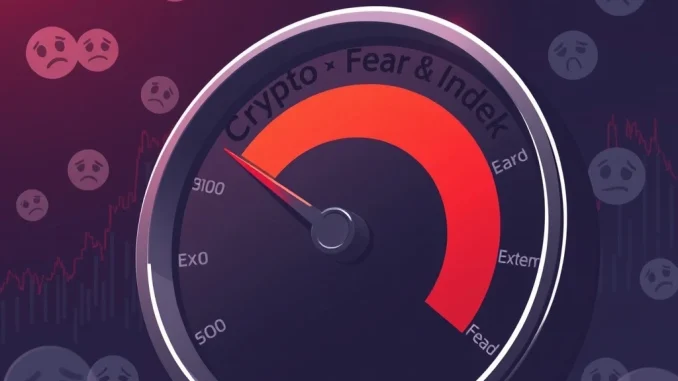
Global cryptocurrency markets have entered a state of pronounced anxiety, as evidenced by the Crypto Fear & Greed Index plunging eight points to a reading of 24, firmly placing investor sentiment in the ‘Extreme Fear’ territory. This significant shift, recorded on April 10, 2025, marks a rapid deterioration from the previous day’s ‘Fear’ classification and signals heightened uncertainty among digital asset traders worldwide. The index, a crucial barometer developed by data provider Alternative.me, serves as a composite measure of the emotional temperature driving market movements, and its current low reading demands a thorough, factual examination.
Decoding the Crypto Fear & Greed Index Plunge
The Crypto Fear & Greed Index operates on a scale from 0 to 100. A score of 0 represents maximum fear, while 100 indicates extreme greed. The current reading of 24 sits deep within the ‘Extreme Fear’ band, which typically spans from 0 to 25. This metric is not a simple survey; it is a calculated composite derived from multiple market data sources. The index’s methodology provides a robust, multi-faceted view of sentiment. For instance, market volatility and trading volume each contribute 25% to the final score. Social media sentiment and ongoing market surveys each account for 15%. Finally, Bitcoin’s dominance share of the total cryptocurrency market cap and relevant Google search trends each provide the remaining 10% of the data.
Consequently, a drop to 24 reflects a confluence of negative signals across these channels. Typically, such a shift correlates with increased price swings, declining trading volumes relative to peaks, and a surge in negative or anxious commentary across social platforms like X (formerly Twitter) and crypto-focused forums. Historically, periods of ‘Extreme Fear’ have often preceded market bottoms or significant consolidation phases, though this is a historical observation, not a predictive guarantee. The index functions as a lagging indicator, confirming the emotional state of the market rather than forecasting its future direction.
Contextualizing the Extreme Fear Sentiment
To understand the gravity of a score of 24, it is essential to review recent historical context. Throughout early 2025, the index had shown moderate fluctuation, often oscillating between ‘Neutral’ and ‘Fear’ zones. The sharp, single-day eight-point decline is notable for its speed. This move suggests a reactive market responding to a specific catalyst or a culmination of sustained pressures. Market analysts often cross-reference this sentiment data with on-chain metrics, such as exchange net flows and wallet activity, to gauge whether the fear is driving retail sell-offs or accumulation by larger, long-term holders.
Furthermore, the ‘Extreme Fear’ phase does not exist in a vacuum. It interacts directly with broader financial conditions. For example, prevailing interest rate policies from major central banks, macroeconomic inflation data, and geopolitical stability all indirectly influence cryptocurrency investor psychology. When traditional markets experience risk-off sentiment, capital often flees speculative assets like cryptocurrencies, amplifying fear within the digital asset ecosystem. This interconnectedness means the Crypto Fear & Greed Index, while specific to crypto, is a piece of a larger global financial sentiment puzzle.
Expert Analysis on Sentiment Indicators
Financial behavioral analysts emphasize that sentiment indicators like the Fear & Greed Index are tools for measuring crowd psychology. “Markets are driven by two primary emotions: fear and greed,” notes a report from the Cambridge Centre for Alternative Finance, which studies digital asset ecosystems. “Quantifying these emotions provides a snapshot of market participant bias, which is often contrarian in its extremes.” This perspective aligns with a long-held market axiom: extreme fear can sometimes signal a potential buying opportunity for value investors, while extreme greed can warn of an overextended, bubble-like market. However, experts uniformly caution against using the index as a standalone trading signal, advising it be used in conjunction with fundamental and technical analysis.
The index’s incorporation of social media data is particularly relevant in 2025. Research from the MIT Media Lab has previously demonstrated a correlation between social media sentiment and cryptocurrency price movements. The 15% weighting given to this factor acknowledges the decentralized, community-driven nature of crypto markets, where discourse on major platforms can rapidly influence trader behavior and, consequently, market prices. Therefore, the current ‘Extreme Fear’ reading implies a measurable and significant negative shift in the aggregate tone of online cryptocurrency conversations.
Historical Precedents and Market Impact
Examining past instances where the index entered ‘Extreme Fear’ reveals varied outcomes. For example, prolonged periods during the bear market of 2022 saw the index repeatedly test lows near 10. Conversely, sharp, violent dips into extreme fear have sometimes marked local price bottoms before swift recoveries, as seen in several instances during 2023. The table below summarizes key components influencing the current score:
| Index Component | Weighting | Likely Current Contribution |
|---|---|---|
| Volatility | 25% | High (Increased price swings) |
| Market Volume | 25% | Low/Stagnant (Lack of buying momentum) |
| Social Media | 15% | Negative (Heightened fear discourse) |
| Surveys | 15% | Pessimistic (Bearish respondent outlook) |
| BTC Dominance | 10% | Variable (Shifts to/from altcoins) |
| Search Trends | 10% | Fear-based queries rising |
The immediate market impact of such a sentiment shift is often visible in several ways. Firstly, trading volumes may concentrate on stablecoin pairs as investors seek safety. Secondly, the volatility component of the index itself may increase, creating a feedback loop of uncertainty. Finally, funding rates in perpetual swap markets can turn significantly negative, indicating that traders are paying to hold short positions, a clear sign of bearish leverage in the market. These are observable, data-driven consequences that stem from the collective psychology the index measures.
Conclusion
The Crypto Fear & Greed Index’s descent to 24, squarely in the ‘Extreme Fear’ zone, provides a critical, data-backed snapshot of current cryptocurrency market sentiment. This movement results from a calculated synthesis of volatility, volume, social media tone, survey data, Bitcoin dominance, and search trends. While historical patterns show that such extreme readings can precede market inflection points, they primarily serve as a confirmation of prevailing negative psychology rather than a crystal ball. For investors and observers, this index is a vital tool for understanding the emotional undercurrents of the market, emphasizing that digital asset prices are driven not only by technology and adoption but also by the powerful and quantifiable forces of human fear and greed. Monitoring this index, alongside fundamental on-chain data, remains essential for navigating the complex cryptocurrency landscape.
FAQs
Q1: What does a Crypto Fear & Greed Index score of 24 mean?
A score of 24 indicates the market is in a state of ‘Extreme Fear,’ based on a composite of data including volatility, trading volume, and social media sentiment. It reflects widespread pessimism and caution among cryptocurrency investors.
Q2: Who creates the Crypto Fear & Greed Index and how is it calculated?
The index is created by data provider Alternative.me. It is calculated using six factors: volatility (25%), trading volume (25%), social media (15%), surveys (15%), Bitcoin dominance (10%), and Google search trends (10%).
Q3: Is the ‘Extreme Fear’ zone a good time to buy cryptocurrency?
Historically, extreme fear has sometimes coincided with market lows, leading some to view it as a potential contrarian signal. However, it is not a guaranteed timing tool. Experts strongly advise using it in combination with other fundamental and technical analyses, not as a sole investment trigger.
Q4: How often does the Crypto Fear & Greed Index update?
The index is updated daily, providing a near-real-time gauge of shifting market sentiment based on the previous 24 hours of data across its source metrics.
Q5: Has the index been this low before?
Yes. The index has reached similar or lower levels during previous bear markets and periods of acute stress, such as in 2018 and 2022. Each instance had unique macroeconomic and industry-specific causes.
Q6: Does the index only measure sentiment for Bitcoin?
While Bitcoin’s market dominance is a direct input (10%), the other data sources—like social media, surveys, and overall market volatility—encompass the broader cryptocurrency ecosystem. Therefore, it is widely considered a gauge for general crypto market sentiment, though Bitcoin’s influence is significant.
Updated insights and analysis added for better clarity.
This article was produced with AI assistance and reviewed by our editorial team for accuracy and quality.