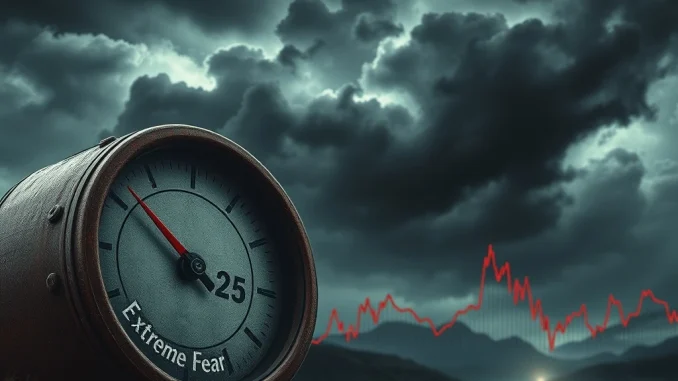
Global cryptocurrency markets continue to exhibit profound caution as the widely monitored Crypto Fear & Greed Index registers a score of 25 for March 2025, firmly anchoring investor sentiment within the ‘Extreme Fear’ territory. This single-point rise from the previous day offers little solace to traders, underscoring a prolonged period of risk aversion and uncertainty that has characterized the digital asset landscape for several quarters. The index, a crucial barometer of market psychology, suggests that despite intermittent price rallies, the underlying emotional driver for most participants remains deeply negative.
Decoding the Crypto Fear & Greed Index Score of 25
Alternative’s Crypto Fear & Greed Index provides a quantifiable snapshot of market emotion. A reading of 25 sits deep within the ‘Extreme Fear’ zone, which spans from 0 to 25. Consequently, this latest data point indicates sentiment is at the upper boundary of maximum pessimism. The index’s methodology is deliberately multifaceted, designed to counteract the volatility of any single metric. It synthesizes data from six core components, each weighted to reflect its historical correlation with market sentiment.
- Volatility (25%): Current price swings, especially negative volatility, heavily influence the score.
- Market Volume (25%): Trading activity levels; sustained low volume often accompanies fear.
- Social Media (15%): Analysis of sentiment and volume on platforms like Twitter and Reddit.
- Surveys (15%): Polls and community feedback from various cryptocurrency platforms.
- Dominance (10%): Bitcoin’s share of the total crypto market cap; rising dominance can signal a ‘flight to safety’.
- Trends (10%): Search interest data for cryptocurrency-related terms.
Therefore, a stagnant score of 25 implies that improvements in one or two metrics, such as a slight drop in volatility or a minor uptick in volume, were offset by persistent negativity in others, like social media discourse or survey results.
Historical Context and Comparative Market Analysis
To fully grasp the significance of a ’25’ reading, one must examine it against historical extremes. For instance, the index plummeted to single digits during the market capitulation events of late 2022 and the COVID-19-induced crash of March 2020. Conversely, it soared above 90 during the euphoric peaks of late 2017 and late 2021. The current prolonged period in ‘Extreme Fear’ is notable. It does not reflect a sudden crash but rather a grinding, sustained lack of confidence. This pattern often occurs during extended bear markets or periods of regulatory uncertainty, where hope for a quick recovery repeatedly fades.
Analysts from firms like Glassnode and CoinMetrics frequently cross-reference this sentiment data with on-chain metrics. Their research shows that prolonged fear phases, while painful for short-term holders, can create foundations for future rallies. They often coincide with accumulation by long-term investors, as evidenced by rising balances in illiquid wallets. However, the transition from fear to neutrality or greed requires a catalyst—typically a macroeconomic shift, a clear regulatory development, or a major technological adoption milestone.
The Macroeconomic and Regulatory Overlay
The sentiment captured by the index does not exist in a vacuum. As of early 2025, global financial markets continue to navigate a complex environment. Central bank policies on interest rates, lingering inflationary pressures, and geopolitical tensions directly impact risk assets like cryptocurrency. Furthermore, the regulatory landscape for digital assets remains in flux across major economies like the United States and the European Union. This regulatory ambiguity acts as a persistent overhang, discouraging institutional capital from entering the market at scale and contributing to the ‘extreme fear’ sentiment. Market participants are not merely reacting to price; they are assessing systemic risks and future viability.
Impact on Trader Behavior and Market Structure
A sentiment reading of 25 actively shapes market dynamics. Retail investors often exhibit paralysis or engage in panic selling on minor downticks. Conversely, sophisticated traders and algorithmic systems may interpret sustained fear as a potential contrarian indicator, leading to complex derivatives positioning. Funding rates in perpetual swap markets tend to be negative or flat during such periods, indicating that leveraged traders are paying to hold short positions or are unwilling to pay a premium for longs. This creates a fragile equilibrium where any positive news can trigger a sharp, short-covering rally, but the underlying sentiment lacks the strength for a sustained trend reversal without fundamental change.
Conclusion
The Crypto Fear & Greed Index’s position at 25 is a powerful diagnostic tool, confirming that extreme fear remains the dominant psychological force in cryptocurrency markets. This reading reflects a confluence of factors: historical price patterns, current volatility, subdued trading activity, cautious social discourse, and a challenging macro-regulatory backdrop. While such depths of pessimism have historically preceded major buying opportunities, the index alone does not forecast timing. It serves as a critical reminder that market recoveries are built not just on price action, but on a gradual restoration of confidence, clarity, and fundamental progress across the entire digital asset ecosystem.
FAQs
Q1: What does a Crypto Fear & Greed Index score of 25 mean?
A score of 25 signifies the market is in a state of ‘Extreme Fear.’ It is the highest value within that category (0-25), indicating maximum pessimism among investors, though not at the absolute lowest possible reading.
Q2: Who creates the Crypto Fear & Greed Index and how is it calculated?
The index is created by the data provider Alternative. It uses a proprietary formula weighting six factors: volatility (25%), market volume (25%), social media sentiment (15%), surveys (15%), Bitcoin dominance (10%), and search trends (10%).
Q3: Is ‘Extreme Fear’ a good time to buy cryptocurrency?
Historically, periods of extreme fear have often coincided with market bottoms and subsequent long-term buying opportunities. However, it is not a timing signal. It indicates high risk aversion, and prices can remain low or go lower for extended periods. Investment decisions should be based on comprehensive research, not sentiment alone.
Q4: How often does the Crypto Fear & Greed Index update?
The index updates daily, providing a near-real-time gauge of shifting market sentiment based on the previous 24 hours of data.
Q5: Has the index ever been wrong in predicting market direction?
The index is a measure of current sentiment, not a direct price predictor. Sentiment can remain in ‘Extreme Fear’ or ‘Extreme Greed’ for prolonged periods while prices move sideways. It is best used as a contextual tool alongside technical and fundamental analysis, not as a standalone trading signal.
Updated insights and analysis added for better clarity.
This article was produced with AI assistance and reviewed by our editorial team for accuracy and quality.