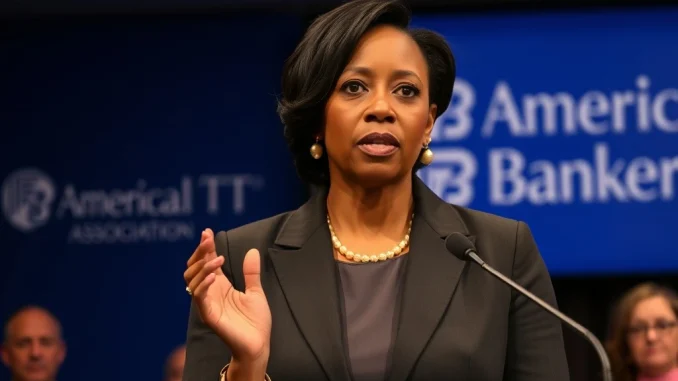
WASHINGTON, D.C. — In a pivotal development for cryptocurrency regulation, U.S. Senator Angela Alsobrooks (D-MD) declared on Tuesday, March 18, 2026, that both the cryptocurrency industry and traditional banking lobbies must accept being “a bit unhappy” for a critical market structure bill to advance. Speaking at an American Bankers Association conference, the key Democrat on the Senate Banking Committee revealed she is working with Republican Senator Thom Tillis (R-NC) on a compromise proposal to break the legislative stalemate that has stalled comprehensive crypto oversight for years. This crypto bill compromise centers on the contentious issue of stablecoin yield payments, which banking groups argue pose a systemic risk to deposit stability.
Senator Alsobrooks Outlines the Path Forward for Crypto Legislation
Senator Angela Alsobrooks framed the current impasse as a classic legislative challenge where perfection becomes the enemy of progress. “All of us will probably walk away just a little bit unhappy,” she told the audience, emphasizing that compromise is the only viable path. Her statement directly addresses the core conflict: banking groups demand a ban on third-party stablecoin yield payments to prevent deposit flight, while crypto exchanges and lobbyists fiercely defend these yields as essential competitive products. The senator warned that the alternative—an unregulated crypto system without guardrails—poses a greater threat. “What we don’t want is to have an unregulated system—to have crypto not regulated at all—and not to have the guardrails to allow a situation where we will have deposit flight,” she stated, anchoring the debate in financial stability concerns.
The legislative vehicle in question is the pending crypto market structure bill, which outlines how agencies like the Securities and Exchange Commission (SEC) and Commodity Futures Trading Commission (CFTC) would police digital asset markets. This bill has been stuck in committee since late 2025, primarily due to the stablecoin yield dispute. Alsobrooks confirmed that lawmakers anticipated revisiting the “issue around interest and yield” when they previously negotiated the GENIUS Act, which initially banned stablecoin issuers from offering yield. The current proposal seeks to close what banks see as a loophole, extending that ban to third parties like exchanges.
The Core Conflict: Stablecoin Yields vs. Banking Stability
The fight over stablecoin yields represents a fundamental clash between financial innovation and traditional banking safeguards. Banking groups, led by the American Bankers Association, argue that high-yield stablecoin products offered by crypto platforms directly compete with bank savings accounts. They contend this siphons deposits away from the regulated banking system, potentially reducing the capital available for consumer and business loans and creating instability. In contrast, crypto lobbyists, including groups like the Blockchain Association and Coinbase, view these yields as a legitimate feature that attracts users and provides returns in a digital asset ecosystem. They argue a blanket ban stifles innovation and consumer choice.
- Banking Sector Risk: The ABA’s primary concern is deposit flight. They cite models suggesting that if even 5-10% of retail deposits moved to crypto yield products during a high-interest-rate environment, it could strain regional bank liquidity.
- Crypto Industry Pushback: Crypto exchanges argue that yield products are often generated through secure, over-collateralized lending or staking mechanisms, not unlike money market funds, and should be regulated rather than banned.
- Regulatory Philosophy: Senator Alsobrooks encapsulated the regulatory perspective with a simple analogy: “If it quacks like a duck and looks like a duck, it is a duck. Making sure that we are not allowing bank-like products without bank-like protections—this is what we know is really important.”
Expert Analysis and Institutional Stakes
Financial policy experts see this moment as a critical inflection point. Dr. Sarah Jenkins, a former Federal Reserve economist now with the Brookings Institution, notes, “The debate isn’t just about yields; it’s about defining the regulatory perimeter for the 21st century. Are crypto savings products ‘banking,’ and if so, do they require FDIC insurance and Basel capital standards? That’s the subtext.” The American Bankers Association bolstered its position by releasing a Morning Consult survey conducted in February 2026. The poll of 4,456 U.S. adults found that 42% agreed Congress should ban stablecoin yields if there’s any risk of reducing money available to banks, and a striking 84% agreed that any business offering bank-like services should be held to the same consumer protection standards.
Broader Legislative Context and Political Dynamics
This compromise effort occurs within a complex political landscape. The 2025 passage of the GENIUS Act created a foundational framework for stablecoin issuance but left significant gaps regarding secondary market activities. The current Senate Banking Committee is narrowly divided, making bipartisan cooperation between Senators Alsobrooks and Tillis essential. Furthermore, the issue has drawn attention from presidential politics. Former President Donald Trump recently criticized banking groups for stalling the broader crypto bill, signaling that digital asset regulation may feature prominently in the 2026 midterm elections. The table below outlines the key positions and proposed solutions from major stakeholders.
| Stakeholder | Primary Position on Stablecoin Yields | Key Argument |
|---|---|---|
| American Bankers Association | Support a comprehensive ban | Prevents deposit flight and maintains banking system stability |
| Crypto Exchanges (e.g., Coinbase, Kraken) | Oppose any ban; support activity-based regulation | A ban stifles innovation and removes a key consumer product |
| Senator Alsobrooks (D) | Seek a compromise that addresses the risk | Cannot allow unregulated bank-like products; guardrails are necessary |
| Senator Tillis (R) | Seek a compromise that allows innovation | Overly restrictive rules could push activity offshore |
What Happens Next: The Road to a Senate Vote
The immediate next step is for Senators Alsobrooks and Tillis to formalize their compromise proposal and present it to the Senate Banking Committee. Sources close to the negotiations suggest the draft may include a tiered approach: allowing yields on stablecoins below a certain user threshold or mandating specific reserve and disclosure requirements for platforms offering yields, rather than an outright ban. Committee markup could occur as early as April 2026. The success of this effort will depend on whether the compromise can secure at least 3-4 additional votes from moderate Democrats and Republicans on the committee who have remained undecided. Passage out of committee would set the stage for a full Senate vote, likely tied to a larger financial services package.
Industry and Market Reactions
Initial reactions from both sides have been cautiously pragmatic. A spokesperson for the Blockchain Association stated, “We appreciate Senator Alsobrooks’ direct engagement. While we oppose a ban, we are ready to discuss serious regulatory frameworks that protect consumers without eliminating products.” Conversely, a senior vice president at the American Bankers Association commented, “The Senator understands the systemic risk. We are hopeful the final legislation will squarely address the deposit flight issue.” Crypto markets showed minimal volatility on the news, suggesting traders had priced in a prolonged negotiation, though analysts note that clarity on regulatory rules, even restrictive ones, is often viewed as a long-term positive for institutional adoption.
Conclusion
The revelation of a active crypto bill compromise effort led by Senator Angela Alsobrooks marks the most significant movement in digital asset market structure legislation in months. Her candid admission that all sides must be “a bit unhappy” underscores the difficult trade-offs between fostering financial innovation and ensuring systemic stability. The core issue of stablecoin yield payments has become the linchpin, with the banking sector’s fear of deposit flight directly opposing the crypto industry’s defense of a key business model. As the compromise proposal takes shape, its details will reveal whether Washington can craft rules for a hybrid financial future or if the deep-seated conflict between old and new finance will result in further deadlock. The coming weeks in the Senate Banking Committee will be decisive for the trajectory of cryptocurrency regulation in the United States.
Frequently Asked Questions
Q1: What is the main issue holding up the crypto market structure bill?
The primary obstacle is disagreement over whether to ban third-party stablecoin yield payments. Banking groups demand a ban to prevent deposit flight from traditional banks, while the crypto industry argues such a ban would stifle innovation and consumer choice.
Q2: Who is Senator Angela Alsobrooks and what is her role?
Senator Angela Alsobrooks is a Democratic member of the U.S. Senate from Maryland and a key figure on the Senate Banking Committee. She is leading compromise negotiations with Republican Senator Thom Tillis to find a path forward for the stalled cryptocurrency legislation.
Q3: What did the American Bankers Association survey find?
A Morning Consult poll commissioned by the ABA in February 2026 found that 42% of 4,456 U.S. adults surveyed agreed Congress should ban stablecoin yields if there’s a risk to bank deposits, and 84% agreed businesses offering bank-like services should face the same consumer protection standards as banks.
Q4: What is the GENIUS Act and how does it relate to this bill?
The GENIUS Act, passed in 2025, established rules for stablecoin issuers, including a ban on them offering yield directly. The current debate focuses on extending regulations to third-party platforms (like exchanges) that offer yield on stablecoins deposited with them, which banks see as a loophole.
Q5: What is deposit flight and why are banks concerned?
Deposit flight refers to customers moving their money out of traditional bank savings accounts into other products offering higher returns. Banks argue that if crypto platforms offer high yields on stablecoins—which are designed to mimic the stability of cash—it could pull significant deposits out of the banking system, affecting their ability to lend.
Q6: What are the potential next steps and timeline for this legislation?
Senators Alsobrooks and Tillis will finalize their compromise proposal, which will then be reviewed by the Senate Banking Committee. A committee markup session could occur in April 2026. If approved, the bill would proceed to the full Senate for a vote, likely as part of a larger financial services package.