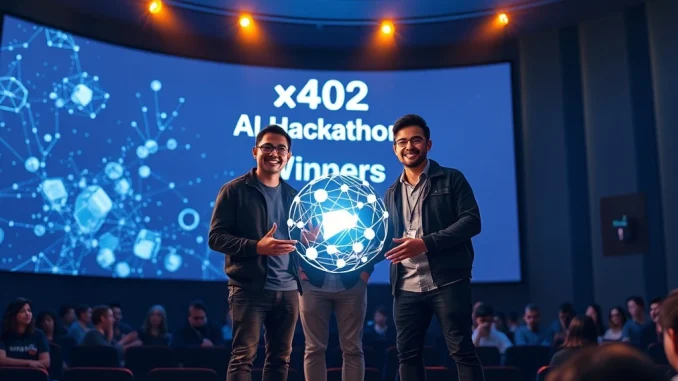
SINGAPORE, March 15, 2026 — The Cronos blockchain ecosystem, in a major collaboration with global crypto exchange Crypto.com, has officially announced the winning projects of its groundbreaking x402 AI hackathon. The event, which concluded its final judging phase this week, aimed to accelerate the development of AI-powered decentralized finance (DeFi), next-generation security protocols, and autonomous payment systems. Organizers revealed the results from their Singapore headquarters, highlighting a surge in practical applications that merge advanced artificial intelligence with blockchain infrastructure. This announcement marks a critical step in Cronos’s strategic roadmap to position itself at the forefront of agentic finance, where autonomous AI agents manage complex financial transactions and strategies.
Cronos x402 AI Hackathon Winners Drive New Financial Paradigm
The hackathon, named “x402” as a nod to the future of autonomous systems, attracted over 450 developer teams from 60 countries during its eight-week runtime. A panel of 12 judges, including senior engineers from Cronos Labs and Crypto.com’s product leadership, evaluated submissions based on innovation, technical execution, real-world utility, and security robustness. The grand prize winner, a project named “Aegis Sentinel” from a team based in Berlin, developed an AI-driven security layer that performs real-time, on-chain anomaly detection to prevent DeFi exploits before they finalize. “The quality of submissions, particularly in the security track, exceeded our most optimistic projections,” stated Ken Timsit, Managing Director of Cronos Labs, in an official statement released alongside the winners list. The hackathon’s structure specifically encouraged projects that moved beyond simple automation into truly agentic systems capable of learning and independent action within defined parameters.
Industry analysts immediately noted the timing of this reveal. It follows a series of high-profile smart contract exploits in early 2026 that drained over $200 million from various protocols. Consequently, the focus on pre-emptive security tools reflects a clear industry pivot. Furthermore, the collaboration with Crypto.com provides a direct pathway for promising projects to access the exchange’s 100+ million user base and venture funding arm. The hackathon operated with a total prize pool exceeding $500,000 in CRO tokens, mentorship opportunities, and potential incubation offers.
Impact on Agentic Finance and Autonomous Payment Tools
The winning projects signal three immediate impacts for the broader crypto and fintech landscape. First, they demonstrate a tangible reduction in the conceptual gap between AI research and blockchain utility. Second, they provide tested codebases that other developers can fork and build upon, accelerating open-source innovation. Third, they validate Cronos’s technical architecture, built on the Cosmos SDK and Ethereum Virtual Machine (EVM) compatibility, as a viable home for complex AI-on-chain applications.
- DeFi Security Reinforcement: Winning projects like Aegis Sentinel introduce behavioral AI models that monitor transaction mempools and smart contract interactions in real-time, flagging malicious patterns that resemble known attack vectors before block confirmation.
- Autonomous Agent Economy: The first-runner-up, “Harbor Protocol,” created a framework for AI agents to act as autonomous liquidity managers, negotiating fee rates and rebalancing portfolios across multiple Cronos-based DeFi protocols without constant human oversight.
- Frictionless Payment Systems: Several highlighted projects focused on AI-optimized payment rails that can predict network congestion and gas fees, automatically routing transactions through the most efficient and cost-effective paths, a boon for micro-transactions and merchant adoption.
Expert Analysis on the Hackathon’s Significance
Dr. Elena Rodriguez, a research fellow specializing in AI and blockchain convergence at the Stanford Digital Currency Initiative, provided context for the development. “What we’re seeing from the x402 hackathon winners isn’t just incremental improvement; it’s a foundational shift,” Rodriguez explained. “These projects treat AI not as an external tool but as an integral, agentic participant within the crypto-economic system. The winning security project, for instance, uses a reinforcement learning model that improves its detection capabilities with every attempted exploit it analyzes, creating a stronger network defense over time.” This external expert perspective underscores the technical leap represented by the submissions. Rodriguez also referenced a recent Gartner forecast predicting that by 2028, over 40% of mid-sized DeFi protocols will integrate some form of AI-driven risk management, a trend this hackathon directly catalyzes.
Broader Context: The Race for AI-Blockchain Integration
The Cronos x402 event enters a competitive landscape where other layer-1 and layer-2 blockchains are aggressively pursuing AI integration. The table below compares recent major AI-focused blockchain initiatives, highlighting the distinct focus of the Cronos hackathon.
| Blockchain/Initiative | Primary AI Focus | Key Output/Event | Year |
|---|---|---|---|
| Cronos (x402 Hackathon) | Agentic Finance & Autonomous Security | Working prototypes for DeFi AI agents & exploit prevention | 2026 |
| Solana (AI Accelerator) | High-Speed Inference & Model Training | Grants for projects reducing AI inference latency on-chain | 2025 |
| NEAR Protocol (AI Research DAO) | Decentralized AI Data & Governance | Framework for community-owned AI training data pools | 2025 |
| Polygon (zkML Grants) | Privacy-Preserving AI (Zero-Knowledge ML) | SDKs for verifiable AI inferences without revealing model data | 2024 |
This comparative view shows Cronos and Crypto.com carving a unique niche focused on applied, economic agents rather than underlying infrastructure or privacy. The hackathon’s requirement for fully functional prototypes, as opposed to whitepapers or concepts, pushed developers to confront practical challenges like gas cost optimization for AI computations and the security of AI model weights stored on-chain.
What Happens Next for the Winning Projects
The forward trajectory for the top teams is already mapped. According to the hackathon’s terms, all winning code is open-sourced, encouraging community audit and collaboration. The top three teams enter a 12-week incubation program with Cronos Labs, receiving direct engineering support, architectural review, and go-to-market strategy sessions. A spokesperson for Crypto.com confirmed that its capital investment team will conduct due diligence on several winners for potential strategic investment, with a focus on projects that align with the exchange’s plans for automated customer portfolio management tools. The first integration of a hackathon project—a gas-forecasting AI from a payments-track winner—is scheduled for a pilot on the Crypto.com Pay merchant platform in Q2 2026.
Community and Developer Reactions
Within developer circles on platforms like GitHub and Discord, reaction has been notably technical and focused on code review. Many are dissecting the novel consensus mechanisms proposed by some winners for validating AI agent decisions. On social media, the broader crypto community has greeted the news with cautious optimism, emphasizing the need for rigorous security audits before any mainnet deployment. “Seeing AI move from a buzzword to compiled, auditable code on a major chain like Cronos is the progress we need,” commented a prominent DeFi educator on X (formerly Twitter), capturing a common sentiment that the value lies in execution, not just announcement.
Conclusion
The revelation of the Cronos x402 AI hackathon winners in partnership with Crypto.com represents a milestone in the maturation of blockchain technology. It successfully transitioned AI integration from theoretical research and speculative hype into a cohort of functional, judged, and soon-to-be-incubated projects. The clear emphasis on agentic finance and proactive security provides a concrete response to pressing industry vulnerabilities. While the long-term success of any single project remains to be proven, the hackathon has undeniably enriched the Cronos ecosystem’s developer toolkit and demonstrated a viable model for corporate-blockchain collaboration. Observers should monitor the progress of the incubation cohort throughout 2026, as their success or failure will offer critical data points on the real-world viability of autonomous AI within decentralized networks.
Frequently Asked Questions
Q1: What was the main goal of the Cronos x402 AI hackathon?
The primary goal was to spur the development of practical, AI-powered applications on the Cronos blockchain, with specific tracks focused on creating autonomous financial agents (agentic finance), enhancing blockchain security through AI, and building smarter, self-optimizing payment tools.
Q2: How will the winning projects impact ordinary crypto users?
End-users could see benefits like better-protected DeFi investments from AI-driven security monitors, more efficient and cheaper transactions from AI-optimized payment routers, and eventually, access to automated AI investment agents that manage portfolios based on personalized goals.
Q3: What are the next steps for the hackathon winners?
The top teams enter a 12-week incubation program with Cronos Labs for further development. Their code is open-sourced, and they are eligible for strategic investment and potential integration pilots with Crypto.com’s products, starting with a gas-forecasting tool in Q2 2026.
Q4: What is “agentic finance”?
Agentic finance refers to a system where autonomous AI software agents, not just automated scripts, can perform complex financial tasks. These agents can learn, negotiate, and make strategic decisions within predefined rules, acting as independent participants in DeFi ecosystems.
Q5: How does this hackathon compare to other blockchain AI initiatives?
Unlike initiatives focused on AI infrastructure (like Solana) or data privacy (like Polygon’s zkML), the Cronos x402 hackathon uniquely emphasized applied, economic agents—building AI that actively participates in and secures financial applications, as shown in the comparison table within the article.
Q6: How does this affect developers not involved in the hackathon?
All winning code is publicly available, providing a valuable resource and starting point for any developer looking to build AI-on-chain applications. It sets a new benchmark for functionality and opens new design patterns for the entire Cronos developer community.
Updated insights and analysis added for better clarity.
This article was produced with AI assistance and reviewed by our editorial team for accuracy and quality.