Global financial markets face a pivotal week packed with critical data releases and high-stakes speeches that will test investor sentiment and shape monetary policy trajectories. From a U.S. market holiday to key inflation prints and central bank decisions in Asia, these financial events provide a crucial stress test for the global economic outlook in late January. Analysts closely monitor this confluence of indicators for signals on growth, inflation, and geopolitical stability.
Key Financial Events and Market Holidays
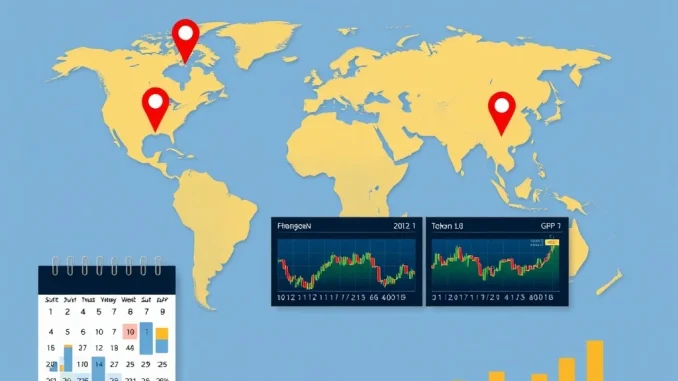
This week’s financial calendar begins with a pause, as U.S. equity and bond markets close on Monday, January 19th, in observance of Martin Luther King Jr. Day. Consequently, trading volumes in Europe and Asia often experience a temporary lull. However, market participants use this quiet period to position themselves for the intense data flow that follows. The closure provides a brief respite before a sequence of potentially market-moving announcements.
Historically, weeks containing a U.S. market holiday can see increased volatility upon reopening, especially when major economic data is scheduled immediately afterward. Traders and algorithms must digest a backlog of global developments once trading resumes on Tuesday. This structural pause makes the subsequent data releases even more significant for setting the weekly tone.
The Asian Opening Act: China’s Loan Prime Rate
At 1:00 a.m. UTC on Tuesday, January 20th, the People’s Bank of China (PBoC) announces its Loan Prime Rate (LPR). As China’s benchmark lending rate, the LPR directly influences borrowing costs for households and businesses across the world’s second-largest economy. Financial institutions worldwide scrutinize this decision for clues about Beijing’s policy stance amid ongoing property sector challenges and targeted stimulus efforts.
Most analysts project the central bank will hold the one-year and five-year LPRs steady. However, any unexpected cut would signal heightened concern about domestic demand and could trigger positive reactions in commodity and Asian equity markets. The LPR decision remains a cornerstone event for gauging China’s economic health and its ripple effects on global supply chains and emerging market currencies.
Geopolitics Meets Finance: The Davos Spotlight
At 1:30 p.m. UTC on Wednesday, January 21st, former U.S. President Donald Trump is scheduled to speak at the World Economic Forum in Davos, Switzerland. His remarks consistently command global attention and can cause immediate fluctuations in currency and equity futures markets. Investors will parse his commentary for signals on trade policy, regulatory approaches, and international relations, particularly concerning China and Europe.
Market reactions to political speeches at Davos often hinge on perceived implications for trade flows, corporate taxation, and geopolitical risk. A tone focused on economic nationalism or trade barriers could pressure risk assets, while a message promoting growth and stability might provide a temporary boost. This event underscores how geopolitical rhetoric remains a tangible driver of short-term market sentiment alongside traditional economic data.
U.S. Economic Health Under the Microscope
Thursday, January 22nd, delivers a powerful one-two punch of U.S. economic data, starting at 1:30 p.m. UTC with the preliminary estimate for third-quarter Gross Domestic Product (GDP) and the weekly report on Initial Jobless Claims. The GDP figure offers a backward-looking but crucial confirmation of economic resilience or weakness. Concurrently, jobless claims provide a near-real-time pulse on the labor market’s strength.
| Time (UTC) | Event | Market Focus |
|---|---|---|
| 1:30 p.m. | U.S. Q3 GDP (Preliminary) | Overall economic growth pace |
| 1:30 p.m. | U.S. Initial Jobless Claims | Labor market health |
| 3:00 p.m. | U.S. Core PCE Price Index (Nov) | Federal Reserve’s preferred inflation gauge |
Then, at 3:00 p.m. UTC, the U.S. Bureau of Economic Analysis releases the November Core Personal Consumption Expenditures (PCE) Price Index data. As the Federal Reserve’s preferred inflation metric, this report carries immense weight for interest rate expectations. A reading above or below consensus forecasts can swiftly recalibrate market bets on the timing and magnitude of future Fed rate cuts or hikes.
Financial events like the PCE release directly influence Treasury yields, the U.S. dollar index, and equity valuations. A hotter-than-expected core PCE print could dampen hopes for imminent monetary policy easing, potentially strengthening the dollar and pressuring growth stocks. Conversely, a cooler reading might fuel risk-on rallies. The data’s details, including services inflation and supercore metrics, will undergo intense scrutiny.
The Bank of Japan’s Delicate Balancing Act
The week concludes with a major central bank event from Asia. At 3:00 a.m. UTC on Friday, January 23rd, the Bank of Japan (BoJ) announces its interest rate decision and releases its quarterly Outlook Report. Markets have long anticipated a potential shift away from the BoJ’s ultra-accommodative yield curve control (YCC) policy and negative short-term rates. Any hint of policy normalization sends tremors through global bond and currency markets.
Key factors the BoJ must balance include:
- Sustained inflation: Whether wage-growth trends justify a policy shift.
- Yen stability: Preventing excessive currency weakness or volatility.
- Government debt: Managing the cost of servicing Japan’s massive public debt.
- Global spillover: Minimizing disruptive capital flows from Japan into foreign bonds.
A decision to tweak or abandon YCC could trigger a sharp rally in the Japanese yen and a sell-off in global sovereign bonds, as Japanese investors repatriate funds. Conversely, a dovish hold might weaken the yen further and support risk assets. This event caps a week where the interplay between major central banks becomes starkly visible.
Interconnected Impacts and Market Implications
The sequence of these financial events creates a complex web of potential outcomes. For instance, a dovish BoJ decision could amplify the market impact of a hawkish U.S. PCE print by widening interest rate differentials. Similarly, Trump’s Davos comments could overshadow technical data points if they signal significant policy shifts. Portfolio managers must therefore assess not just individual data points, but their combined narrative effect.
Asset classes likely to experience heightened volatility include:
- Forex: USD/JPY and EUR/USD pairs around the BoJ and PCE data.
- U.S. Treasuries: Particularly the 10-year yield, sensitive to GDP, PCE, and BoJ actions.
- Global Equities: Tech and banking sectors are often most reactive to rate expectations.
- Commodities: Copper and oil, as barometers of global growth from China and U.S. data.
Ultimately, this week serves as a microcosm of modern market drivers: intertwined monetary policy, geopolitical rhetoric, and hard economic data. The outcomes will provide critical evidence for whether the global economy is navigating towards a soft landing, a reacceleration of inflation, or a growth slowdown.
Conclusion
This week’s slate of financial events offers a comprehensive check-up on the global economy, from Chinese credit conditions and U.S. inflation to Japanese monetary policy. Each data point and speech contributes to the broader mosaic influencing investor confidence and central bank calculus. Market participants should prepare for potential volatility, especially upon the U.S. market reopening and around the key releases on Thursday and Friday. Navigating these events successfully requires focusing on the underlying economic trends they reveal, rather than reacting impulsively to individual headlines. The collective insight gained will be instrumental for shaping investment strategy for the coming quarter.
FAQs
Q1: Why is the U.S. Core PCE data more important than the CPI?
The Federal Reserve explicitly targets the PCE index for its 2% inflation goal. It has a broader scope of expenditures and adjusts for consumer substitution, making it the Fed’s preferred gauge for underlying price trends.
Q2: How could the Bank of Japan’s decision affect U.S. markets?
A BoJ policy tightening could lead to higher global bond yields as Japanese investors pull money home, potentially pressuring U.S. tech and growth stocks that are sensitive to discount rates. It could also strengthen the yen against the dollar.
Q3: What is the typical market reaction to U.S. GDP revisions?
Significant revisions to prior GDP estimates can alter perceptions of the economic cycle’s strength. A large upward revision may dampen expectations for near-term Fed rate cuts, while a downward revision could have the opposite effect, influencing Treasury yields and the dollar.
Q4: Does a U.S. market holiday affect trading in Europe and Asia?
Yes, trading volumes in other global markets often decline during U.S. holidays due to the absence of major U.S. banks and funds. However, localized news and data can still drive significant price action in those regions.
Q5: What is the significance of China’s Loan Prime Rate (LPR)?
The LPR is the benchmark for most new and outstanding loans in China. Changes directly influence corporate borrowing costs, mortgage rates, and overall credit conditions, making it a powerful tool for steering the world’s second-largest economy.
Updated insights and analysis added for better clarity.
This article was produced with AI assistance and reviewed by our editorial team for accuracy and quality.