NEW YORK, February 15, 2026 — Cryptocurrency exchange Coinbase Global Inc. reported a staggering $667 million net loss in its fourth-quarter earnings Thursday, abruptly ending an eight-quarter profitability streak that began in 2023. The disappointing results arrived as Ethereum analysts predicted a potential “V-shaped recovery” for the second-largest cryptocurrency, creating a stark contrast in market narratives during a volatile February trading period. This Coinbase Q4 earnings report marks the first quarterly loss for the exchange since 2022, coinciding with significant outflows from spot Bitcoin ETFs and heightened regulatory scrutiny across the digital asset industry.
Coinbase’s Profit Streak Shattered by Market Downturn
Coinbase disclosed earnings per share of 66 cents for Q4 2025, missing analyst expectations of 92 cents by a substantial 26-cent margin. The company’s net revenue fell 21.5% year-on-year to $1.78 billion, also falling short of the anticipated $1.85 billion. Transaction-related revenue experienced the sharpest decline, dropping nearly 37% year-on-year to $982.7 million, while subscription and services revenue showed resilience with a 13% increase to $727.4 million. Company executives attributed the downturn to reduced retail trading activity during the quarter’s crypto market correction, which saw total market capitalization decline approximately 25% from October 2025 peaks.
Market analysts immediately noted the significance of this earnings miss. “Coinbase’s results reflect broader market conditions rather than company-specific issues,” explained financial analyst Maria Chen of Bernstein Research. “When crypto markets experience extended downturns, exchange revenues inevitably follow. The subscription revenue growth demonstrates their diversification efforts are working, but not quickly enough to offset trading declines.” The earnings release triggered after-hours trading volatility, with COIN shares declining 8% in extended trading Thursday evening.
Ethereum’s Historical Pattern Suggests Rapid Recovery Potential
As Coinbase reported losses, Fundstrat Global Advisors head of research Tom Lee presented compelling historical data suggesting Ethereum could be poised for another rapid recovery. Speaking at the Asia Blockchain Summit in Hong Kong Wednesday, Lee noted that Ethereum has experienced eight declines exceeding 50% since 2018, with each followed by what he termed a “V-shaped recovery.” “A lot of people are frustrated, but keep in mind that Ethereum, since 2018, has fallen more than 50% eight times,” Lee told conference attendees. “Eight out of eight times, Ethereum has had a V-shaped bottom. So it has recovered 100% of the time within almost the same speed that it fell.”
Lee specifically referenced Ethereum’s 64% decline from January to March 2025 as the most recent example of this pattern. His analysis comes as Ethereum trades around $2,061, approximately 40% below its 2025 peak. Technical analysts have identified strong support between $1,950 and $2,000, a level that has held through three separate tests since December. Meanwhile, Ethereum developers continue advancing the network’s capabilities, with Ethereum Foundation AI lead Davide Crapis and co-founder Vitalik Buterin recently proposing zero-knowledge proof implementations to anonymize AI interactions on the network.
Bitcoin ETF Outflows Accelerate Market Pressure
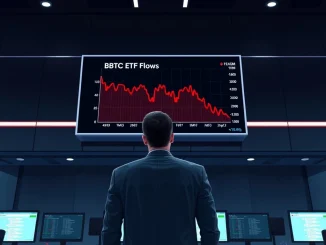
The cryptocurrency market faced additional pressure from substantial outflows in spot Bitcoin exchange-traded funds. According to SoSoValue data, these ETFs recorded $410.4 million in outflows Thursday alone, extending weekly losses to $375.1 million. Unless Friday brings substantial inflows, the funds are on track for a fourth consecutive week of losses, with assets under management declining to approximately $80 billion from an October 2025 peak near $170 billion. The outflows coincided with Standard Chartered lowering its 2026 Bitcoin price target, citing regulatory uncertainty and reduced institutional adoption rates.
“The ETF outflows reflect profit-taking after the 2025 rally and concerns about regulatory clarity,” noted Michael Sonnenshein, CEO of Grayscale Investments. “We’re seeing a natural market cycle where early investors are rebalancing portfolios after significant gains.” The outflows occurred despite growing anticipation for the SEC’s decision on Ethereum ETF applications, expected by May 2026. Market participants increasingly view regulatory developments as the primary driver of short-term price action across major cryptocurrencies.
Broader Crypto Ecosystem Developments and Challenges
Beyond exchange earnings and price predictions, several significant developments shaped the cryptocurrency landscape during the February 8-14 period. Elon Musk announced that X Money, the payment system central to his “everything app” vision for platform X, would launch in “limited beta” within one to two months. “This is intended to be the place where all money is. The central source of all monetary transactions,” Musk declared during his AI company’s “All Hands” presentation Wednesday. The payment system represents a crucial component of X’s strategy to increase user engagement and transaction volume.
| Company/Project | Key Development | Market Impact |
|---|---|---|
| Coinbase | $667M Q4 loss ends 8-quarter profit streak | Exchange stocks decline, raises diversification questions |
| Ethereum | Fundstrat predicts V-shaped recovery pattern | Technical analysis suggests $1,950-$2,000 support zone |
| Bitcoin ETFs | $410.4M single-day outflows Thursday | AUM declines to $80B from $170B October peak |
| X (Twitter) | X Money limited beta launching in 1-2 months | Potential payments integration for 500M+ users |
| Binance France | Employee targeted in home invasion robbery | Highlights security concerns for crypto executives |
Security Incidents and Regulatory Enforcement Actions
The week also featured concerning security developments and regulatory actions. Binance confirmed that an employee at its French unit was targeted in a home invasion early Thursday morning, with three suspects arrested following the incident in Val-de-Marne. Meanwhile, U.S. authorities sentenced Praetorian Group International CEO Ramil Ventura Palafox to 20 years in prison for operating a $200 million Bitcoin Ponzi scheme that defrauded tens of thousands of investors. Chainalysis further reported an 85% year-over-year increase in cryptocurrency flows to suspected human trafficking networks in 2025, though the analytics firm noted blockchain transparency could help disrupt these operations.
These developments occurred against a backdrop of ongoing regulatory uncertainty. U.S. Treasury Secretary Scott Bessant commented, “In a time when we are having one of these historically volatile sell-offs, I think some clarity on the CLARITY bill would give great comfort to the market, and we could move forward from there.” The proposed Crypto Law and Regulatory Infrastructure for Technology and Yield (CLARITY) bill has been stalled in congressional committees since late 2025, creating what many industry participants describe as a regulatory limbo affecting investment decisions and product development.
Market Performance and Altcoin Movements
At week’s end, Bitcoin traded at $70,124 with Ethereum at $2,061 and XRP at $1.58. The total cryptocurrency market capitalization stood at $2.41 trillion, according to CoinMarketCap data. Among the top 100 cryptocurrencies by market capitalization, notable performers included Pippin (PIPPIN) with 263.93% weekly gains, Humanity Protocol (H) at 76.29%, and Kite (KITE) at 43.34%. Conversely, significant decliners included MYX Finance (MYX) down 70.47%, MemeCore (M) falling 17.45%, and Aptos (APT) declining 11.25%.
The divergent performance between major cryptocurrencies and smaller altcoins reflects what analysts describe as a “flight to quality” during market uncertainty. “When volatility increases, capital typically rotates toward established assets with greater liquidity and clearer regulatory status,” explained James Wang of Artemis Capital. “This pattern explains why Bitcoin and Ethereum have shown relative stability while many altcoins experience exaggerated moves in both directions.” The performance gap has widened throughout February as regulatory concerns have dominated market sentiment.
Conclusion
Coinbase’s earnings miss and Ethereum’s potential recovery pattern represent two sides of the same cryptocurrency market story in February 2026. The exchange’s results demonstrate how even established industry leaders remain vulnerable to market cycles, while Ethereum’s historical resilience suggests underlying strength despite current price pressures. The simultaneous developments highlight the cryptocurrency sector’s continued maturation alongside persistent volatility. Market participants now await several crucial developments: regulatory clarity from Washington, the launch of X Money’s beta program, and whether Ethereum will indeed follow its historical V-shaped recovery pattern. As these narratives unfold, the interplay between technological innovation, market psychology, and regulatory evolution will continue defining cryptocurrency’s trajectory through 2026 and beyond.
Frequently Asked Questions
Q1: Why did Coinbase report a $667 million loss after eight profitable quarters?
Coinbase’s Q4 2025 loss resulted primarily from a 37% year-on-year decline in transaction revenue as cryptocurrency trading activity decreased during market corrections. The company also faced increased operational costs related to international expansion and regulatory compliance efforts.
Q2: What historical evidence supports Ethereum’s potential V-shaped recovery?
Fundstrat’s Tom Lee identified eight instances since 2018 where Ethereum declined more than 50%, with each followed by a complete recovery at approximately the same speed as the decline. The most recent example occurred from January to March 2025 with a 64% decline and subsequent recovery.
Q3: How significant are the Bitcoin ETF outflows for the broader market?
The $410.4 million single-day outflow represents approximately 0.5% of total ETF assets under management. While notable, these outflows follow substantial inflows throughout 2025, and many analysts view them as normal profit-taking rather than a fundamental shift in institutional sentiment.
Q4: What is X Money and how might it impact cryptocurrency adoption?
X Money is Elon Musk’s payment system for platform X, scheduled for limited beta release within two months. With over 500 million monthly users, successful integration could significantly increase mainstream exposure to digital payment systems, potentially creating bridges to cryptocurrency functionality.
Q5: How does regulatory uncertainty currently affect cryptocurrency markets?
The stalled CLARITY bill in Congress has created regulatory ambiguity that analysts cite as a primary factor in recent market volatility. Clear regulatory frameworks typically reduce uncertainty and could encourage greater institutional participation in cryptocurrency markets.
Q6: What should investors watch for in coming weeks regarding these developments?
Key indicators include Coinbase’s Q1 2026 guidance, Ethereum’s price action around the $2,000 support level, Bitcoin ETF flow reversals, regulatory developments in Washington, and the X Money beta launch timeline. These factors will collectively signal market direction through early spring.