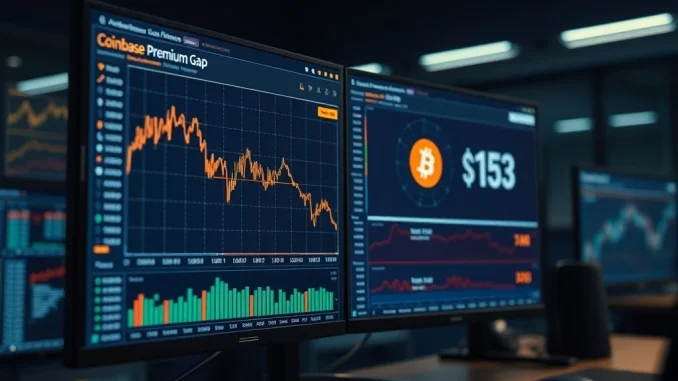
Global, May 2025: A critical cryptocurrency market metric, the Coinbase Premium Gap, has plunged to its lowest level in over a year. This significant move signals a notable shift in trading dynamics, where Bitcoin is now trading at a consistent discount on the U.S.-based Coinbase exchange compared to global giant Binance. Market analysts interpret this widening gap as a potential indicator of sustained selling pressure from institutional entities, a development that could have profound implications for Bitcoin’s near-term price trajectory and overall market structure.
Understanding the Coinbase Premium Gap
The Coinbase Premium Gap is a nuanced but powerful indicator watched closely by professional traders. It measures the percentage difference between Bitcoin’s price on Coinbase Pro and its price on Binance. Historically, a positive premium—where Bitcoin trades higher on Coinbase—has been associated with strong buying demand from U.S. institutional investors and high-net-worth individuals who predominantly use the compliant, U.S.-based platform. This premium often widens during periods of bullish momentum or following major regulatory milestones, such as ETF approvals. Conversely, a negative gap, or discount, suggests the opposite: selling pressure or weaker demand on Coinbase relative to the global market represented by Binance. The metric’s descent to a yearly low is not a fleeting anomaly but a sustained trend observed over recent weeks, adding weight to its significance.
Analyzing the Data and Institutional Context
The current data reveals a clear and persistent pattern. Throughout April and into May 2025, the premium has eroded, turning firmly negative. This coincides with publicly available flow data from U.S. Spot Bitcoin Exchange-Traded Funds (ETFs), which have shown consecutive days of net outflows after a period of record inflows earlier in the year. The correlation is compelling. Institutional players, including ETF authorized participants and large asset managers, often use Coinbase as a primary trading and custody venue. When these entities execute sell orders or rebalance portfolios, the liquidity and order book on Coinbase feel the immediate impact, often before it fully propagates to other global exchanges.
- ETF Flow Correlation: Daily net outflows from U.S. Bitcoin ETFs frequently align with a deepening of the Coinbase discount.
- Market Maker Behavior: Arbitrage desks that typically buy on Coinbase and sell on Binance to capture the premium are inactive or reversed when the gap is negative, reducing buy-side liquidity.
- Historical Precedent: Similar prolonged negative premiums preceded periods of market consolidation or correction in 2023 and 2024, though they were not always immediate predictors of a major downturn.
Expert Insight on Market Mechanics
Market structure experts explain this phenomenon through the lens of order flow and liquidity. “The Coinbase Premium is a real-time gauge of U.S. dollar-denominated demand versus global demand,” explains a veteran crypto market analyst from a quantitative trading firm. “When U.S. institutions are net buyers, they absorb sell orders on Coinbase, pushing the price above Binance. What we’re seeing now is the reverse. Sell orders from large holders are being met with insufficient institutional buy-side depth on Coinbase, causing the price to lag. The arbitrage mechanism that normally closes this gap is less effective when the selling is continuous and sizable.” This analysis underscores that the indicator reflects a fundamental imbalance in supply and demand between two of the world’s largest crypto liquidity pools.
Broader Market Indicators and Implications
The declining Coinbase Premium does not exist in a vacuum. It aligns with other on-chain and derivatives metrics pointing to renewed market stress. Funding rates for Bitcoin perpetual swaps have normalized from positive to neutral, indicating reduced speculative long leverage. Furthermore, the aggregate open interest in Bitcoin futures has declined slightly, suggesting a deleveraging or risk-off posture among traders. The implications are multifaceted. For retail investors, a sustained discount may present arbitrage opportunities but also signals caution from sophisticated market participants. For the broader ecosystem, it tests the resilience of Bitcoin’s price discovery mechanism in a post-ETF world, where traditional finance flows have a more direct and measurable impact.
Conclusion
The Coinbase Premium Gap hitting a yearly low is a substantive data point that warrants close attention. It provides a transparent, quantifiable signal of shifting institutional sentiment and capital flows in the cryptocurrency market. While a single metric should never be used in isolation to predict market direction, its convergence with ETF outflow data and other derivatives metrics paints a coherent picture of current headwinds. This development matters because it offers a window into the behavior of the most influential class of Bitcoin holders, whose actions increasingly set the tone for global market dynamics. Monitoring whether this premium stabilizes, reverses, or continues to decline will be crucial for understanding the next phase of Bitcoin’s market cycle.
FAQs
Q1: What exactly is the Coinbase Premium Gap?
The Coinbase Premium Gap is the percentage difference between the price of Bitcoin on the Coinbase exchange and its price on the Binance exchange. A positive gap means Bitcoin is more expensive on Coinbase, while a negative gap (or discount) means it is cheaper.
Q2: Why does a negative Coinbase Premium suggest institutional selling?
Coinbase is a primary on-ramp and trading venue for U.S. institutional investors and ETFs. Sustained selling pressure from these large entities on Coinbase, without matching buy-side demand, pushes its price below the global average on Binance, creating a negative gap.
Q3: Does a negative premium always mean the Bitcoin price will fall?
Not necessarily. While it indicates selling pressure from a key cohort, it is a short-to-medium-term flow indicator. Other macroeconomic factors and broader adoption trends ultimately determine long-term price direction.
Q4: How does this relate to Bitcoin ETF flows?
There is a strong observed correlation. Days with significant net outflows from U.S. Spot Bitcoin ETFs often see the Coinbase Premium Gap turn more negative, as the ETFs’ authorized participants likely sell Bitcoin on Coinbase to meet redemption requests.
Q5: Can retail traders use this information?
Yes, as a context tool. A deeply negative premium might suggest a local imbalance, but retail traders should consider it alongside other fundamental and technical analysis, not as a standalone trading signal.
Updated insights and analysis added for better clarity.
This article was produced with AI assistance and reviewed by our editorial team for accuracy and quality.