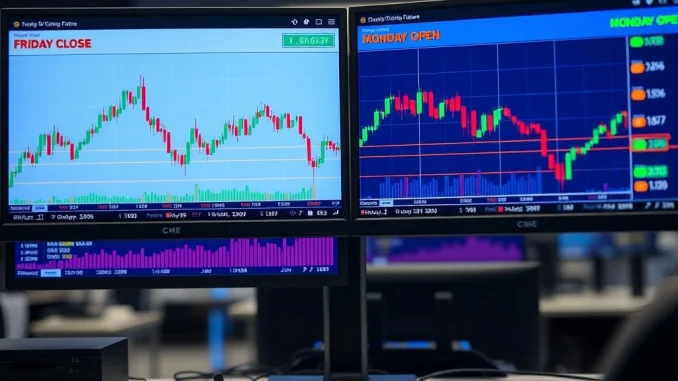
Global Markets, April 2025: The Chicago Mercantile Exchange (CME) Bitcoin futures market opened its weekly session with a dramatic and significant event: a price gap of approximately $6,830. This divergence, where futures opened at $77,730 against a previous close of $84,560, represents the second-largest such gap in the history of CME Bitcoin futures trading. This development immediately captured the attention of institutional and retail traders alike, prompting analysis of the underlying mechanics and potential market consequences. The occurrence highlights the unique structural interplay between regulated, time-bound derivatives markets and the ceaseless, global cryptocurrency spot markets.
Understanding the CME Bitcoin Futures Gap
The CME Bitcoin futures gap is a well-documented phenomenon rooted in market structure. Unlike the Bitcoin spot market, which trades 24 hours a day, seven days a week across global exchanges, the CME’s futures market operates on a traditional schedule. It closes on Friday afternoon Chicago time and reopens on Sunday evening. During this approximately 48-hour window, significant price movements can and do occur in the spot market due to news, macroeconomic events, or shifts in sentiment. When the CME futures market reopens, its price must adjust instantaneously to reflect the new global spot price equilibrium, often resulting in a large gap on the price chart. This recent $6,830 gap is a direct result of substantial selling pressure in the spot market over the weekend, driving the price down from the prior Friday’s settlement level.
Historical Context and Record Gaps
To appreciate the magnitude of this event, one must examine historical precedents. The CME launched Bitcoin futures in December 2017, and since then, weekend gaps have become a regular feature. However, gaps of this scale are rare and typically correspond with periods of extreme volatility. The current $6,830 gap now ranks as the second-largest on record. It sits behind only the monumental $10,350 gap recorded on March 3, 2024, a period marked by intense market uncertainty and rapid deleveraging. The table below illustrates the top five largest CME Bitcoin futures opening gaps to date, providing crucial context for traders and analysts.
| Rank | Date | Previous Close | Session Open | Gap Size (USD) |
|---|---|---|---|---|
| 1 | March 3, 2024 | $62,780 | $52,430 | $10,350 |
| 2 | April 2025 | $84,560 | $77,730 | $6,830 |
| 3 | January 2022 | $47,200 | $40,985 | $6,215 |
| 4 | May 2021 | $58,950 | $53,230 | $5,720 |
| 5 | November 2022 | $20,650 | $15,590 | $5,060 |
The Mechanics of Price Convergence
Following the opening gap, a critical market process begins: convergence. The existence of a disparity between the futures price and the underlying spot price creates an arbitrage opportunity. Sophisticated traders, often employing algorithmic systems, can execute a strategy known as cash-and-carry arbitrage. In its simplest form for a downward gap, this involves simultaneously selling the relatively overpriced futures contract and buying the equivalent amount of Bitcoin in the spot market. This action applies selling pressure to the futures market and buying pressure to the spot market, working to close the gap. Consequently, market participants closely monitor whether the futures price will rise or the spot price will fall to meet in the middle, a process that can influence short-term volatility and liquidity.
Implications for Traders and the Broader Market
The emergence of a large CME gap has several immediate and longer-term implications. For active futures traders, the gap represents a clear technical event that can influence trading strategies and risk models. Many chartists view gaps as areas of “unfinished business” that the price may eventually revisit, creating potential support or resistance zones. For the broader cryptocurrency ecosystem, large CME gaps serve as a stark reminder of the market’s inherent volatility and the structural differences between traditional finance (TradFi) gateways like the CME and the native crypto markets. Furthermore, these events are closely watched by institutional investors, as extreme volatility and gaps can impact the perceived stability and maturity of Bitcoin as an asset class for corporate treasuries or pension funds.
- Risk Management: Traders with open positions over the CME weekend face significant gap risk, where their position can be instantly exposed to substantial profit or loss upon the market’s reopening.
- Liquidity Signals: The speed at which the gap closes can serve as an informal gauge of market liquidity and the presence of active arbitrage capital.
- Sentiment Indicator: The direction of the gap—whether up or down—provides a clear, aggregated signal of net buying or selling pressure that occurred during the offline period.
Expert Perspective on Market Structure Evolution
Market structure analysts point out that while gaps are inherent to the current system, their frequency and size could evolve. The growth of 24/7 TradFi-linked products, such as exchange-traded funds (ETFs) that hold spot Bitcoin, may gradually alter weekend trading dynamics by providing another conduit for institutional activity outside of CME hours. However, as long as a major, regulated price discovery venue like the CME maintains a weekend closure, the potential for significant dislocations between its listed price and the global spot price will remain a key feature of the market landscape. This structural nuance is a fundamental piece of knowledge for anyone engaging with Bitcoin through regulated derivatives.
Conclusion
The CME Bitcoin futures gap of $6,830 stands as a significant market event, underscoring the ongoing interplay between traditional financial infrastructure and the digital asset world. As the second-largest gap on record, it provides a valuable case study in market mechanics, arbitrage, and volatility. For traders, understanding the cause and typical behavior following such gaps is essential for effective navigation of the futures market. For the industry at large, these events highlight both the maturation of Bitcoin as it integrates with established exchanges and the unique challenges that remain. Monitoring how this specific gap resolves will offer immediate insights into current market depth and participant behavior.
FAQs
Q1: What causes a CME Bitcoin futures gap?
A CME Bitcoin futures gap occurs because the CME market closes for the weekend (from Friday to Sunday Chicago time), while the global Bitcoin spot market trades continuously. Any significant price movement in the spot market during this closure results in the futures market opening at a different price, creating a gap on the chart.
Q2: How does the $6,830 gap compare historically?
The $6,830 gap is the second-largest opening gap in the history of CME Bitcoin futures. The largest recorded gap was $10,350, which occurred on March 3, 2024.
Q3: Do these gaps always get filled or closed?
While not a certainty, price gaps often act as magnets due to arbitrage activity and technical trading psychology. Traders employ strategies to profit from the difference between futures and spot prices, which typically pushes the prices toward convergence, effectively “closing” the gap.
Q4: What is the practical impact on a retail futures trader?
A retail trader holding a CME Bitcoin futures position over the weekend is exposed to “gap risk.” Their position will be subject to immediate and significant profit or loss based on the opening price, which is unknown when they enter the weekend. This necessitates careful risk management, including the use of stop-loss orders where applicable.
Q5: Could this gap indicate a major trend change for Bitcoin?
A single gap, while significant, is not a definitive indicator of a long-term trend reversal on its own. It is a reflection of concentrated selling or buying pressure during a specific, illiquid period for one venue. Analysts consider it alongside broader market fundamentals, on-chain data, and macroeconomic factors to assess trend direction.
Updated insights and analysis added for better clarity.
This article was produced with AI assistance and reviewed by our editorial team for accuracy and quality.