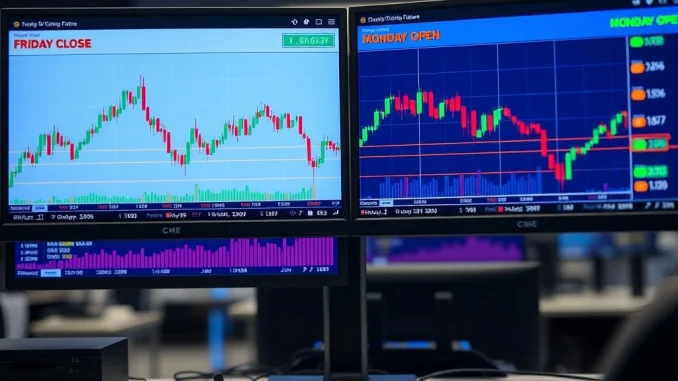
Chicago, Monday: The Chicago Mercantile Exchange (CME) Bitcoin futures market opened the week with a pronounced gap, as the derivative contract began trading at $86,560—approximately $2,940 below its previous Friday settlement price of $89,500. This significant CME Bitcoin futures gap immediately captured the attention of institutional and retail traders, serving as a stark visual reminder of the inherent disconnect between regulated, time-bound derivatives markets and the perpetual trading of the underlying Bitcoin spot market. The event underscores a critical, recurring dynamic in cryptocurrency finance with tangible implications for trading strategies and market sentiment.
Understanding the CME Bitcoin Futures Gap Phenomenon
The opening gap in CME Bitcoin futures is not an anomaly but a structural feature of how traditional finance interfaces with digital assets. The CME, a regulated exchange, operates on a set schedule. Its Bitcoin futures market closes on Friday afternoon (5:00 p.m. Central Time) and reopens on Sunday evening (6:00 p.m. CT). In stark contrast, the global Bitcoin spot market—comprising hundreds of exchanges worldwide—trades 24 hours a day, 7 days a week, 365 days a year. This creates a 49 to 53-hour window where the underlying asset continues to move while the primary institutional derivatives market is dormant.
When the CME reopens, its futures price is not set arbitrarily. It is derived from the CME CF Bitcoin Reference Rate (BRR), a once-daily benchmark price calculated from the spot trading activity on several major constituent exchanges at 4:00 p.m. London time. Therefore, the Monday opening price reflects the aggregated spot market activity that occurred over the weekend. If the spot price declines significantly between Friday’s CME close and the Sunday benchmark calculation, as it did this week, the futures market will open lower, creating a downward gap on the chart. The size of the gap is a direct function of weekend spot market volatility.
Mechanics and Market Implications of the Price Dislocation
This specific $2,940 gap represents a price decline of roughly 3.3% from Friday’s close. For market participants, such gaps are more than just chart patterns; they represent real financial dislocations and potential trading signals. The most discussed concept following a gap is “gap filling.” This is the theory that the price will eventually return to trade through the price level where the gap occurred, driven by market psychology and arbitrage forces.
- Arbitrage Pressure: If the futures price is trading at a significant discount to the spot price (a condition this gap can create), arbitrageurs may sell spot Bitcoin and buy the cheaper futures contract, locking in a risk-free profit upon contract expiration. This buying pressure in futures can help push the price up toward the gap.
- Technical Trading: Many algorithmic and discretionary traders program strategies to trade gap fills. A large gap often acts as a magnet for price action, as buy or sell orders cluster around the gap area.
- Liquidity and Sentiment: A large downward gap can indicate negative weekend sentiment, often driven by retail and Asian market activity. It sets a bearish tone for institutional players returning on Monday, potentially leading to follow-through selling or, conversely, contrarian buying if the move is seen as an overreaction.
The table below illustrates recent notable CME Bitcoin futures gaps for context:
| Date | Gap Size (Approx.) | Direction | Primary Weekend Catalyst |
|---|---|---|---|
| This Week | $2,940 | Down | Broader market risk-off sentiment |
| January 2024 | $1,800 | Up | Positive ETF inflow data |
| November 2023 | $3,200 | Up | Spot ETF approval speculation surge |
Historical Context and Evolving Market Structure
The significance of CME gaps has evolved alongside Bitcoin’s maturation. In the market’s earlier years, weekend volatility was extreme, and CME gaps could be enormous—sometimes exceeding 10-15%. These moves were often driven by thin liquidity and speculative retail trading. Today, with the advent of Bitcoin spot Exchange-Traded Funds (ETFs) and deeper institutional participation, the market structure is more robust. However, weekends remain a period of lower liquidity relative to weekdays, which can amplify price moves from smaller news events or large transactions.
The introduction of spot Bitcoin ETFs in the United States in early 2024 added a new layer to this dynamic. These ETFs trade on traditional stock exchanges, which are also closed on weekends. This means two major conduits for institutional and retail investment in the U.S.—futures and ETFs—are offline simultaneously, potentially ceding more influence over weekend price discovery to offshore spot exchanges and decentralized finance (DeFi) venues. Analysts monitor whether ETF creation/redemption activity on Monday mornings shows a response to the weekend’s price action and the ensuing CME gap.
Strategic Considerations for Traders and Institutions
For professional traders, the weekly CME open is a scheduled event that requires preparation. Risk managers at funds trading CME futures often adjust margin requirements or position sizes in anticipation of potential weekend volatility. Options traders pay close attention, as the implied volatility priced into weekly options expiring on Friday can be influenced by the expected magnitude of the weekend move.
Furthermore, the gap provides a clear, measurable data point on “weekend effect.” Academic and market research often studies whether returns from Friday CME close to Monday open are systematically different from intraweek returns. Some studies have suggested a slight historical tendency for negative weekend returns, possibly due to the accumulation of negative news or risk-off positioning ahead of a two-day market closure for traditional assets. However, this pattern is not consistent and should not be construed as financial advice.
Ultimately, the CME gap is a friction point—a reminder that the seamless, global digital asset market is still being integrated into the legacy financial system’s time-bound framework. As the market evolves with products like 24/7 trading for certain ETFs being discussed, the prominence of these Monday morning gaps may diminish, but for now, they remain a key weekly feature for anyone involved in Bitcoin derivatives.
Conclusion
The $2,940 CME Bitcoin futures gap observed at Monday’s open is a direct manifestation of the cryptocurrency market’s continuous operation clashing with traditional market hours. It is a quantifiable snapshot of weekend sentiment and volatility, carrying implications for technical analysis, arbitrage strategies, and institutional risk management. While the concept of “gap filling” drives much of the short-term narrative, the broader takeaway is the ongoing maturation and integration process of Bitcoin into regulated financial frameworks. Monitoring these dislocations provides valuable insight into market structure, liquidity shifts, and the evolving behavior of different participant groups across the global trading landscape.
FAQs
Q1: What causes a gap in CME Bitcoin futures?
The gap occurs because the CME futures market closes for the weekend while the Bitcoin spot market trades 24/7. The futures price upon Monday’s open is based on a benchmark calculated from weekend spot activity, creating a jump from Friday’s closing price.
Q2: Does the price always “fill” the CME gap?
While a common market expectation, gap filling is not guaranteed. Price often revisits the gap area due to arbitrage and technical trading, but fundamental shifts in sentiment can prevent a fill. It is a tendency, not a rule.
Q3: How does this differ from a gap in a stock or traditional future?
The mechanism is similar, but the magnitude and frequency are often greater for Bitcoin due to the extreme 24/7 volatility of the underlying spot market during traditional market closures.
Q4: Can retail traders profit from CME gaps?
Retail traders on spot exchanges experience the price move continuously over the weekend. The “gap” is only visible on the CME futures chart. However, traders might use the Monday open as a signal or look for arbitrage between spot and futures prices.
Q5: Are CME gaps becoming more or less common?
Gaps themselves are a permanent structural feature as long as trading hours differ. Their average size may decrease as the market matures and liquidity deepens, making weekend spot prices less volatile, but significant news events can still trigger large gaps.
Updated insights and analysis added for better clarity.
This article was produced with AI assistance and reviewed by our editorial team for accuracy and quality.