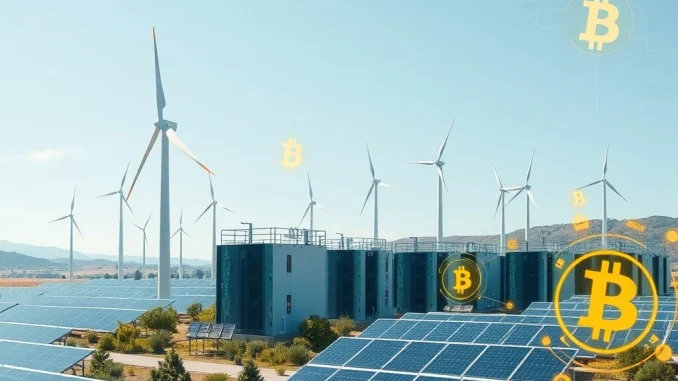
In the dynamic world of digital assets, one question consistently arises: how can Bitcoin mining evolve to be both profitable and responsible? The answer, for many, lies in the innovative strides of companies like CleanSpark. Are you ready to explore how this trailblazer is not just participating in the Bitcoin revolution, but actively shaping its sustainable future?
CleanSpark’s Vision: Pioneering Sustainable Bitcoin Mining
CleanSpark, Inc. (Nasdaq: CLSK) has firmly established itself as a leader in the rapidly expanding landscape of Bitcoin mining. Far from the energy-intensive narratives often associated with the industry, CleanSpark champions a different path—one where profitability harmonizes with environmental stewardship. Their strategic approach combines cutting-edge operational efficiency with a profound commitment to renewable energy, positioning them uniquely in the market.
As global demand for Bitcoin continues its upward trajectory, CleanSpark’s focus on low-cost, sustainable energy and AI-driven optimization gives it a distinct competitive advantage. This strategy is not merely about staying relevant; it’s about setting a new standard for the industry, ensuring the company is poised to outperform its peers and deliver long-term value to investors who prioritize both financial returns and ecological impact.
CleanSpark’s vertically integrated model is a testament to its forward-thinking vision. By controlling key aspects of its operations, from power procurement to mining fleet management, the company ensures a seamless and efficient process. This comprehensive control allows for greater adaptability and responsiveness to market changes, reinforcing its position as a market leader in sustainable Bitcoin mining.
The Renewable Energy Advantage in Bitcoin Mining
At the core of CleanSpark’s competitive edge is its unwavering dedication to renewable energy. The company strategically leverages diverse clean power sources—including wind, solar, nuclear, and hydro—to fuel its Bitcoin mining operations. This deliberate choice to operate in regions abundant with low-carbon energy achieves a dual benefit: it significantly reduces operational costs and minimizes environmental impact, a critical factor in today’s ESG-conscious investment climate.
Consider the scale of their commitment: As of June 2025, CleanSpark had secured an impressive 987 megawatts (MW) of contracted power capacity. Of this, 808 MW is currently utilized to support its robust mining fleet, demonstrating substantial operational scale. Their energy portfolio spans four key U.S. states—Georgia, Mississippi, Tennessee, and Wyoming—each chosen for its favorable energy infrastructure and access to clean power. Furthermore, an additional 179 MW of power is under contract, strategically poised to support over 10 EH/s (Exahashes per second) of incremental hashrate, indicating aggressive growth plans rooted in sustainable power.
CleanSpark’s proactive alignment with global trends toward decarbonization and its responsiveness to regulatory scrutiny of energy-intensive industries are not just about compliance; they are about capitalizing on a growing market segment. By mining Bitcoin at costs well below the market price, thanks to their energy strategy, CleanSpark establishes a durable margin advantage. This financial resilience enables the company to navigate Bitcoin’s inherent price volatility and consistently maintain profitability, offering stability in an otherwise dynamic sector.
How AI Efficiency Supercharges CleanSpark’s Operations
While a robust renewable energy strategy forms the bedrock of CleanSpark’s success, its true differentiator lies in its commitment to AI efficiency and data-driven operational and treasury management initiatives. The company’s Digital Asset Management (DAM) division, currently in its foundational “crawl phase,” employs sophisticated data analytics and algorithmic strategies designed to maximize returns on its Bitcoin treasury. This isn’t just passive holding; it’s active, intelligent management.
A prime example of this effectiveness was seen in June 2025, when CleanSpark achieved an average sale price of $105,860 per Bitcoin. This figure notably surpassed the Volume Weighted Average Price (VWAP) by $446, a clear indicator of the success of their actively managed spot sales program and the strategic application of derivative overlays. This level of precision in treasury management is a direct result of advanced data analysis, demonstrating the practical application of AI-assisted methodologies.
Beyond financial optimization, CleanSpark’s infrastructure-first approach deeply integrates advanced analytics to refine energy utilization and enhance fleet efficiency. By June 2025, the company’s mining fleet had achieved an impressive efficiency rating of 16.15 joules per terahash (J/Th). This metric, a critical indicator of energy efficiency, is optimized through a suite of data-driven techniques:
- Predictive Maintenance: Using data to anticipate equipment failures before they occur, minimizing downtime and maximizing operational uptime.
- Real-time Monitoring: Constant oversight of energy consumption across the entire fleet, allowing for immediate adjustments to optimize power usage.
- Dynamic Load Balancing: Intelligent distribution of computational load to ensure optimal energy allocation, preventing waste and maximizing output.
While not always explicitly labeled as ‘AI’ in everyday discourse, these techniques are inherently data-driven and align perfectly with AI-assisted methodologies. CleanSpark’s leadership, including COO Scott Garrison and CTO Taylor Monnig, consistently emphasizes continuous innovation in engineering and site development. These ongoing efforts ensure that the company’s infrastructure remains highly adaptable to rapid technological advancements, including the full-scale integration of AI for even greater efficiency gains in the future.
CleanSpark’s Strategic Growth: Expanding Bitcoin Mining Capacity
CleanSpark’s impressive growth trajectory is built upon a robust pipeline of power development and strategic infrastructure expansion. The company has already secured 179 MW of additional power capacity under contract, with concrete plans to bring this online. This expansion is projected to support over 10 EH/s of incremental hashrate, significantly boosting their total mining capabilities and solidifying their market position.
This scalability is not just about adding more machines; it’s about smart, efficient growth. CleanSpark’s expansion plans include a strong focus on immersion-cooled data centers and continuous facility upgrades. Immersion cooling, a state-of-the-art technology, involves submerging mining equipment in a dielectric fluid, which dramatically improves cooling efficiency, extends equipment lifespan, and allows for higher density deployments. This technological edge directly contributes to lower operational costs and higher hashrate output per square foot.
By investing in such advanced infrastructure, CleanSpark positions itself to capitalize effectively on Bitcoin’s long-term adoption curve. As more institutions and individuals embrace Bitcoin, the demand for secure, efficient, and sustainable mining operations will only grow. CleanSpark’s proactive investments ensure they are well-equipped to meet this escalating demand, translating into sustained growth and market leadership.
Investment Thesis: A High-Conviction Play in the Bitcoin Era
CleanSpark’s strategic positioning offers a compelling investment case for those seeking exposure to the transformative Bitcoin revolution. The company’s unique blend of operational excellence and sustainable practices presents several key advantages:
- Sustainable Cost Structure: Leveraging renewable energy significantly reduces reliance on volatile energy markets, ensuring more stable and predictable operating margins, even during periods of market fluctuation.
- Operational Excellence: A vertically integrated business model, combined with disciplined capital allocation, drives unparalleled efficiency across all aspects of its mining operations, from energy procurement to Bitcoin production.
- Bitcoin Treasury Management: CleanSpark employs institutional-grade treasury strategies, actively managing its Bitcoin holdings through optimized spot sales and strategic derivative overlays, thereby enhancing shareholder value and mitigating market risks.
- Scalable Infrastructure: A substantial pipeline of contracted power and well-defined expansion plans provide a clear roadmap for long-term hashrate growth, ensuring the company can scale its operations in line with market demand.
While Bitcoin’s price remains a macroeconomic wildcard, CleanSpark’s relentless focus on operational resilience and energy innovation provides a significant buffer against many of the sector’s traditional risks. The company’s proven ability to scale efficiently and adapt swiftly to technological shifts—such as the increasing integration of AI-driven optimization—further strengthens its competitive moat and long-term viability.
Conclusion: A Leader in the Energy-Mining Synergy
As Bitcoin mining continues its evolution from a niche, speculative endeavor to an institutional-grade infrastructure industry, CleanSpark stands out as a pioneering force. It effectively bridges the critical gap between innovative energy solutions and efficient digital asset production. By harnessing the power of renewable energy and pioneering advanced operational efficiencies, CleanSpark is doing more than just mining Bitcoin—it is actively constructing a sustainable, profitable future for the entire industry.
For discerning investors, CleanSpark represents a high-conviction opportunity to participate in the next phase of the cryptocurrency revolution. It offers exposure to a company that is as much about leading energy innovation as it is about producing digital assets, making it a compelling choice for those looking for growth rooted in responsibility and cutting-edge technology.
Frequently Asked Questions (FAQs)
What makes CleanSpark’s Bitcoin mining operations sustainable?
CleanSpark’s sustainability stems from its strategic use of diverse renewable energy sources, including wind, solar, nuclear, and hydro power. By locating its operations in regions with abundant clean energy, the company significantly reduces its carbon footprint and operational costs, aligning with global decarbonization goals and ESG investment trends.
How does CleanSpark use AI to optimize its mining?
CleanSpark utilizes AI-driven methodologies primarily through its Digital Asset Management (DAM) division for treasury optimization, employing data analytics and algorithms for strategic Bitcoin sales and derivative overlays. Operationally, data-driven techniques akin to AI, such as predictive maintenance, real-time energy monitoring, and dynamic load balancing, are used to enhance mining fleet efficiency (J/Th) and energy utilization.
What is CleanSpark’s current power capacity and expansion plan?
As of June 2025, CleanSpark had 987 MW of contracted power capacity, with 808 MW currently in use. An additional 179 MW is under contract, slated to support over 10 EH/s of incremental hashrate, demonstrating a clear path for significant expansion of its Bitcoin mining capabilities.
Why is CleanSpark considered a compelling investment in the Bitcoin sector?
CleanSpark is seen as a compelling investment due to its sustainable cost structure (renewable energy), operational excellence (vertically integrated model, high efficiency), sophisticated Bitcoin treasury management, and scalable infrastructure. These factors combine to offer stable margins and long-term growth potential, insulating it from some traditional sector risks.
What is ‘J/Th’ and why is it important for Bitcoin miners?
J/Th stands for Joules per Terahash, a critical metric reflecting the energy efficiency of a Bitcoin mining operation. A lower J/Th indicates that less energy is consumed to produce one terahash of computing power, leading to lower electricity costs and higher profitability. CleanSpark’s focus on optimizing this metric (achieving 16.15 J/Th by June 2025) highlights its commitment to efficiency.