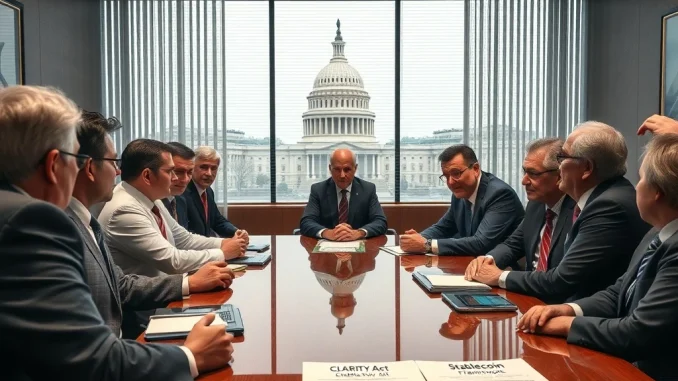
Washington D.C., May 2025: A critical impasse over the landmark CLARITY Act shows signs of potential movement. Cryptocurrency firms are now advancing new, detailed compromises on stablecoin regulation in a concerted effort to break the legislative deadlock that has stalled the comprehensive market structure bill. This development comes as key banking committees and lawmakers resume high-stakes negotiations, signaling a renewed push to establish a federal regulatory framework for digital assets.
CLARITY Act Stalls Over Core Stablecoin Disputes
The Crypto-Asset Liquidity and Accountability for a Transparent and Innovative Economy (CLARITY) Act represents the most significant legislative attempt to date to create a unified regulatory structure for digital assets in the United States. However, progress has been effectively halted for months due to fundamental disagreements over how to regulate stablecoins—digital tokens pegged to stable assets like the U.S. dollar. The central conflict pits the vision of crypto-native firms against the caution of traditional financial institutions and their regulatory champions. Lawmakers have struggled to reconcile these divergent views, leaving the broader market structure provisions in limbo. Industry analysts note that this stalemate has created significant uncertainty, potentially hindering innovation and consumer protection in equal measure.
New Compromises from Crypto Firms Aim to Bridge the Divide
In recent closed-door sessions, a coalition of major cryptocurrency exchanges, stablecoin issuers, and blockchain advocacy groups has presented a refined set of proposals. These new compromises aim to address the primary concerns of banking regulators while preserving the operational integrity of decentralized finance (DeFi) ecosystems. The proposals reportedly focus on three key areas:
- Issuer Requirements: A tiered licensing system based on the size and scope of the stablecoin issuer, with stricter capital and reserve requirements for larger entities.
- Reserve Asset Composition: A clear, auditable framework for the assets backing stablecoins, moving beyond simple “cash and cash equivalents” to include specific, high-quality short-term government securities with strict liquidity mandates.
- Redemption Guarantees: Explicit legal guarantees for user redemption at par value, coupled with detailed wind-down procedures for failing issuers to protect consumers.
These points directly respond to longstanding demands from agencies like the Office of the Comptroller of the Currency (OCC) and the Federal Deposit Insurance Corporation (FDIC) for bank-like safeguards in the stablecoin sector.
The Banking Sector’s Cautious Response
Initial reactions from traditional banking representatives suggest a cautious but open stance. While banks have historically viewed stablecoins as a competitive threat to their deposit base and payment systems, there is a growing recognition that a regulated stablecoin market could integrate with, rather than disrupt, the existing financial infrastructure. A senior lobbyist for a major banking association, speaking on background, indicated that the new proposals “show a maturity and seriousness that was sometimes lacking in earlier discussions.” However, banks continue to insist that any entity issuing payment-focused stablecoins at scale must be subject to federal banking supervision. The negotiation now centers on defining that threshold and the specific supervisory powers involved.
Historical Context and the Path to the Current Deadlock
The struggle to regulate stablecoins is not new. It follows years of regulatory scrutiny that intensified after events like the collapse of the TerraUSD algorithmic stablecoin in 2022, which erased tens of billions in market value. Subsequent legislative efforts, including the earlier Stablecoin Innovation and Protection Act, failed to gain sufficient traction. The CLARITY Act sought to bundle stablecoin rules with broader definitions for digital asset securities and commodities, creating a comprehensive package. This bundling, however, made the bill more complex and politically fraught. The current deadlock stems from a fundamental question: should stablecoins be treated as a new form of banking product, a payment system innovation, or a unique digital asset class? Each classification carries vastly different regulatory consequences.
| Issue | Crypto Industry Position | Banking Regulator Position | Potential Compromise |
|---|---|---|---|
| Primary Regulator | New, specialized office within Treasury or CFTC | Existing banking agencies (OCC, FDIC) | Dual oversight with a lead federal regulator based on issuer type |
| Reserve Assets | Flexible basket including commercial paper | Only cash and U.S. Treasuries | Tiered system: highest quality for large issuers, limited flexibility for smaller ones |
| State vs. Federal Charter | Preserve dual banking system with state options | Prefer a single federal standard | Federal charter required for issuers above a certain size, with state coordination |
Implications for the Broader Crypto Market Structure
The outcome of the stablecoin debate will directly influence the rest of the CLARITY Act. Provisions defining the jurisdictional boundaries between the Securities and Exchange Commission (SEC) and the Commodity Futures Trading Commission (CFTC) for other digital assets are intrinsically linked. A stablecoin framework that satisfies both sides could create a template for cooperation, smoothing the path for agreements on token classification, exchange registration, and custody rules. Conversely, a failure to reach consensus could doom the entire legislative package, likely pushing regulatory action back to individual agencies and perpetuating the current patchwork of state and federal guidance that many argue stifles responsible growth.
What Breaking the Deadlock Means for Consumers and Markets
A successful compromise would have immediate and long-term consequences. For consumers, clear stablecoin rules promise greater protection against issuer insolvency and fraud. For markets, it would provide the legal certainty required for large-scale institutional adoption of digital asset technologies, particularly in payments and settlements. Economists suggest that a well-regulated dollar-denominated digital currency could enhance the efficiency of cross-border payments and financial inclusion. However, they also warn that overly restrictive rules could push innovation offshore to jurisdictions with more lenient regimes. The global dimension is critical; the European Union’s Markets in Crypto-Assets (MiCA) regulation is already in force, and other major economies are advancing their own frameworks, placing pressure on U.S. lawmakers to act.
Conclusion
The renewed push for compromise on the CLARITY Act represents a pivotal moment for the future of cryptocurrency regulation in the United States. The new stablecoin proposals from crypto firms indicate a strategic shift towards pragmatic engagement with traditional financial oversight principles. While significant hurdles remain, the resumption of talks between banks, crypto firms, and lawmakers offers a tangible, if cautious, hope for breaking the deadlock. The establishment of a clear federal framework through the CLARITY Act remains essential for providing market stability, protecting consumers, and determining whether the United States will lead or follow in the evolving global digital economy.
FAQs
Q1: What is the CLARITY Act?
The CLARITY Act is a proposed U.S. federal bill designed to create a comprehensive regulatory framework for digital assets, including definitions for securities and commodities, rules for exchanges, and specific regulations for stablecoins.
Q2: Why is the CLARITY Act stalled?
The bill is stalled primarily due to disagreements between cryptocurrency industry advocates, traditional banks, and regulators over how to specifically regulate stablecoins, including who should oversee them and what rules they must follow.
Q3: What are the new compromises crypto firms are proposing?
Reports indicate new proposals include a tiered licensing system for issuers, a detailed framework for the high-quality assets backing stablecoins, and stronger legal guarantees for user redemptions, aiming to address bank regulator concerns.
Q4: How do traditional banks view stablecoin regulation?
Banks generally believe large-scale stablecoin issuers should be subject to federal banking supervision and adhere to strict reserve and consumer protection standards similar to those for banks, viewing them as a form of payment system.
Q5: What happens if the CLARITY Act deadlock isn’t broken?
Without a legislative breakthrough, digital asset regulation will likely continue through a patchwork of state laws and separate actions by federal agencies like the SEC and CFTC, leading to continued uncertainty for businesses and consumers.
Updated insights and analysis added for better clarity.
This article was produced with AI assistance and reviewed by our editorial team for accuracy and quality.