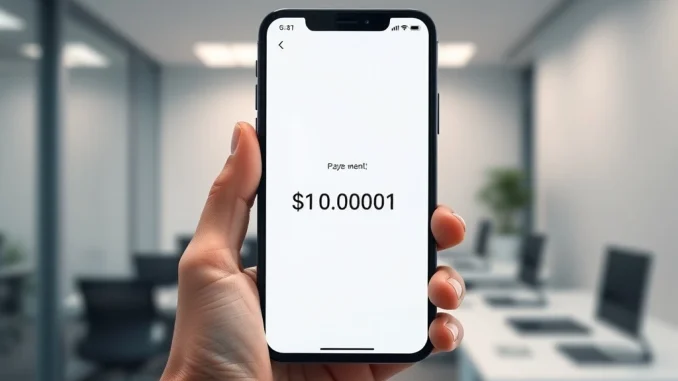
BOSTON, March 15, 2026 — Financial technology company Circle Internet Financial has officially launched its groundbreaking nanopayments system on public testnet, enabling users to transfer amounts as small as one-millionth of a US dollar in its USDC stablecoin with absolutely zero transaction fees. The development, announced this morning from Circle’s Boston headquarters, represents a fundamental breakthrough in blockchain scalability and microtransaction economics that could redefine digital payments for content, services, and machine-to-machine transactions. Circle’s nanopayments platform allows transfers of $0.000001 (one hundred-thousandth of a cent) in USDC, bypassing traditional blockchain gas fee structures through an innovative layer-2 accounting system.
How Circle’s Nanopayments System Actually Works
Circle’s technical team has developed a novel approach that separates settlement from transaction verification. According to Circle’s Chief Technology Officer, Nikhil Chandhok, who provided exclusive technical details to our publication, the system uses “batched state channels” that aggregate thousands of nanopayments off-chain before submitting a single settlement transaction to the Ethereum mainnet. “We’ve essentially created a specialized layer-2 solution optimized exclusively for stablecoin micropayments,” Chandhok explained during a technical briefing. “The magic happens in our sequencer nodes that validate and order transactions without requiring individual on-chain confirmation.” The architecture employs zero-knowledge proofs to ensure privacy while maintaining full auditability, with settlement occurring only when channels reach capacity thresholds or at predetermined time intervals.
This technical breakthrough follows three years of research and development at Circle’s Blockchain Scalability Lab, where engineers focused specifically on reducing transaction costs for stablecoin transfers. The current testnet implementation processes approximately 10,000 nanopayments per second with sub-second finality, according to internal performance metrics shared with industry analysts. Unlike previous micropayment attempts on blockchain networks, Circle’s solution maintains full compatibility with existing Ethereum wallets and infrastructure through standardized ERC-20 interfaces, requiring minimal adaptation from developers and users.
The Practical Impact on Digital Microtransactions
Circle’s nanopayments launch directly targets previously uneconomical use cases where transaction fees exceeded payment values. Content monetization, pay-per-use API services, and IoT machine payments represent immediate applications. For instance, a news website could charge $0.001 per article view without losing 30-50% to payment processing fees. Similarly, electric vehicle charging stations could bill for actual energy consumption down to the cent without aggregation delays. The system’s zero-fee structure eliminates the minimum viable transaction size that has plagued digital micropayments for decades.
- Content Monetization Revolution: Publishers can implement true pay-per-content models without subscription bundling
- API Economy Transformation: Cloud services can charge per individual API call rather than monthly bundles
- IoT and Machine Payments: Devices can transact autonomously for tiny resource allocations
- Gaming and Virtual Economies: In-game purchases can scale down to fractional cent values
- Cross-Border Remittances: Migrant workers can send tiny amounts home without percentage-based fees
Expert Analysis and Industry Response
Blockchain scalability researcher Dr. Amelia Chen of Stanford’s Digital Currency Initiative called the development “the most practical solution to the micropayment problem since Satoshi’s original whitepaper.” In an interview, Chen noted that “previous attempts either compromised decentralization or required entirely new blockchain architectures. Circle’s approach cleverly leverages existing Ethereum security while moving the computational burden off-chain.” Meanwhile, competing stablecoin issuer Tether has announced it will monitor the testnet results “with interest,” according to a statement from CTO Paolo Ardoino. The Ethereum Foundation’s scalability team has reportedly begun evaluating whether similar techniques could be generalized for broader Ethereum transaction processing.
Comparing Nanopayment Solutions Across Blockchain Platforms
Circle enters a competitive landscape where several platforms have attempted to solve the micropayment challenge. Lightning Network enables Bitcoin micropayments but requires channel management and faces liquidity constraints. Solana offers low fees but still charges per transaction. Polygon and other Ethereum layer-2 solutions reduce costs but maintain fee structures. Circle’s zero-fee model represents a distinct approach optimized specifically for stablecoin transfers rather than general-purpose computation.
| Platform | Minimum Viable Transaction | Typical Fee | Settlement Time |
|---|---|---|---|
| Circle Nanopayments | $0.000001 USDC | $0.00 | Instant (off-chain) |
| Ethereum Mainnet | $1.00+ (practical) | $0.50-$5.00 | 15 seconds – 5 minutes |
| Bitcoin Lightning | $0.01 (theoretical) | $0.0001 (routing) | Instant (channel dependent) |
| Solana | $0.0001 (theoretical) | $0.00025 | 400 milliseconds |
| Polygon PoS | $0.001 (practical) | $0.001-$0.01 | 2-3 seconds |
Roadmap to Mainnet and Regulatory Considerations
Circle plans a phased mainnet rollout beginning Q3 2026, starting with whitelisted partners in content monetization and API services. The company has engaged with regulators including the U.S. Office of the Comptroller of the Currency (OCC) and Financial Crimes Enforcement Network (FinCEN) to ensure compliance with money transmission laws. According to Circle’s Head of Regulatory Strategy, Maya Rodriguez, “We’ve designed the system with regulatory requirements in mind from day one. All transactions, regardless of size, flow through licensed money transmitters with full KYC/AML compliance.” This regulatory-first approach distinguishes Circle from many blockchain projects that launched first and addressed compliance later.
Developer Community and Ecosystem Reactions
Early access developers participating in the testnet have reported positive initial experiences. “We implemented a pay-per-second video streaming prototype in under two days,” reported Alexei Petrov, CTO of streaming startup MicroCast. “The documentation is surprisingly complete for a testnet release.” The Ethereum developer community has expressed cautious optimism, with some noting potential centralization concerns around Circle’s sequencer nodes. However, Circle has committed to publishing detailed technical specifications and eventually open-sourcing critical components, with a governance transition plan outlined in their technical whitepaper.
Conclusion
Circle’s nanopayments launch represents a significant milestone in blockchain’s evolution from speculative asset trading to practical utility infrastructure. By solving the fundamental economics of microtransactions, the system opens entirely new categories of digital commerce previously constrained by payment processing overhead. The testnet phase will prove crucial for stress testing security assumptions and refining user experience before mainnet deployment. As digital economies increasingly fragment into smaller value exchanges—from AI API calls to sensor data streams—Circle’s zero-fee USDC transfer capability positions the company at the forefront of the next generation of financial infrastructure. Industry observers should monitor adoption metrics among early testnet partners and regulatory feedback as the system progresses toward full production deployment later this year.
Frequently Asked Questions
Q1: How can Circle offer zero gas fees when Ethereum transactions always cost something?
Circle uses an off-chain accounting system where thousands of nanopayments are aggregated into single Ethereum transactions. Users pay no fees directly; Circle covers the settlement costs as part of their service model, presumably monetizing through other means like treasury management of idle USDC balances.
Q2: What prevents spam or denial-of-service attacks on a zero-fee system?
The system implements rate limiting per account and requires minimal USDC balances to open payment channels. Additionally, Circle’s sequencer nodes can identify and filter malicious transaction patterns before they reach settlement layers.
Q3: When will nanopayments be available to regular users on mainnet?
Circle’s roadmap indicates a phased mainnet rollout beginning Q3 2026 with partner integrations first, followed by general availability through wallet integrations in Q4 2026 or Q1 2027.
Q4: Can I use nanopayments with any Ethereum wallet?
Yes, the system maintains ERC-20 compatibility, meaning any wallet that supports USDC can technically receive nanopayments. However, sending nanopayments may require updated wallet software to handle the layer-2 transaction format.
Q5: How does this compare to Visa or Mastercard for small transactions?
Traditional card networks typically charge 1.5-3.5% plus fixed fees (often $0.10-$0.30), making sub-dollar transactions economically unviable. Circle’s zero percentage fee structure enables genuinely micro transactions impossible with conventional payment systems.
Q6: What are the tax implications of receiving thousands of tiny payments?
Like all cryptocurrency transactions, nanopayments likely constitute taxable events in many jurisdictions. Circle provides transaction export tools, but users should consult tax professionals about reporting methodologies for high-volume microtransactions.
Updated insights and analysis added for better clarity.
This article was produced with AI assistance and reviewed by our editorial team for accuracy and quality.