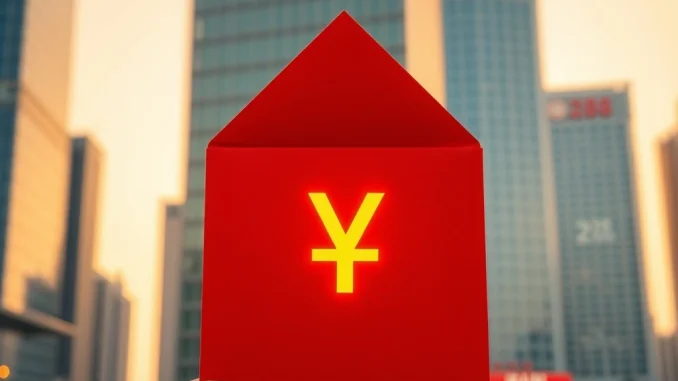
SHANGHAI/SEOUL/TOKYO — February 16, 2026: The 2026 Lunar New Year has catalyzed a pivotal shift in Asia’s digital finance landscape, merging cultural tradition with aggressive financial institutional strategy. This Spring Festival marks the debut of interest-bearing digital yuan red envelopes in mainland China, a move designed to boost consumer spending and CBDC adoption. Simultaneously, major traditional finance (TradFi) conglomerates in South Korea and Japan are finalizing landmark acquisitions of cryptocurrency exchanges, signaling a decisive institutional pivot towards digital assets. These parallel developments underscore a region-wide acceleration in the formal integration of blockchain-based finance, even as regulatory approaches diverge sharply between jurisdictions.
Digital Yuan Evolves: From Digital Cash to Interest-Bearing Deposits
The People’s Bank of China (PBOC) initiated a fundamental change to its central bank digital currency (CBDC) model in late 2025. Consequently, the digital yuan transitioned from a pure digital cash equivalent to a system where wallet balances are treated as digital deposits recorded as commercial bank liabilities. This technical shift unlocked a critical new feature for the 2026 holiday season: digital red packets (hongbao) that can accrue interest. Local financial reports from Shanghai and Beijing indicate this interest-bearing feature has prompted users to maintain significantly larger balances in their e-CNY wallets ahead of the holiday gifting period, directly supporting the government’s goal of stimulating domestic consumption.
Analysts note the strategic timing. The Spring Festival represents China’s peak retail spending season. By integrating the hongbao tradition—a practice where money is gifted in red envelopes for good fortune—with a financial incentive, authorities are driving real-world utility and retention for the digital yuan. However, adoption remains geographically contained. The CBDC is distributed through designated state-owned commercial banks and operates strictly within China’s controlled financial perimeter. It is not freely convertible or transferable across borders, and it does not compete in open, global cryptocurrency markets.
South Korea’s TradFi Rush: A Billion-Dollar Exchange Acquisition Spree
While China promotes its closed-loop CBDC, South Korea’s financial establishment is racing to secure stakes in the open crypto market. The acquisition drive, valued in the billions of dollars, highlights a strategic bet on the institutional future of digital assets. Leading the charge is internet giant Naver Financial, which is pursuing a comprehensive share-swap deal to acquire Dunamu, the operator of the nation’s largest exchange, Upbit. This potential transaction values Dunamu at over $10 billion, though proposed regulatory caps on exchange shareholder ownership could complicate final terms.
Simultaneously, Mirae Asset, a financial behemoth with one of Asia’s largest ETF arms, has agreed to acquire licensed exchange Korbit for nearly $100 million. In a different strategic move, fintech platform Toss—used by 90% of South Koreans in their 20s and 30s—is reportedly reviewing the acquisition of an overseas, institutionally-focused crypto exchange through its U.S. subsidiary. This follows earlier industry moves, including Binance’s reported acquisition of local exchange Gopax in late 2025. The collective action creates a consolidated landscape where major internet and financial groups now control the gateway to crypto for millions of users.
- Market Consolidation: Control of retail crypto access is concentrating in the hands of a few large, regulated financial and tech conglomerates.
- Institutional Product Demand: Acquisitions are driven by high demand from entering institutions for regulated custody, tokenized assets, and stablecoins.
- Regulatory Alignment: Acquiring licensed domestic exchanges is viewed as a faster, more compliant path than building new platforms from scratch.
Expert Analysis: A Calculated Institutional Pivot
“This isn’t speculative FOMO; it’s a calculated portfolio allocation by traditional finance,” explains Dr. Soo-Min Lee, a fintech policy fellow at the Seoul-based Asia Finance Institute. “The acquisitions in Korea and Japan target licensed, compliant infrastructure. These firms aren’t betting on Bitcoin’s price; they’re betting on blockchain becoming the settlement layer for a broad range of digital assets, from tokenized securities to loyalty points. The parallel digital yuan developments in China show a different state-led model, but both trends point to the same conclusion: digital asset infrastructure is becoming mainstream financial plumbing.” This perspective is echoed in statements from the Bank of Korea, which has recently emphasized the need for a robust regulatory framework to harness the “innovative potential” of digital assets while managing systemic risk.
Japan’s Strategic Play: SBI Holdings Moves on Singapore’s Coinhako
The acquisition trend extends beyond the Korean Peninsula. On February 14, 2026, Japan’s financial conglomerate SBI Holdings announced plans to acquire a majority stake in Singapore-based digital asset platform Coinhako. The deal, orchestrated through SBI’s subsidiary SBI Ventures Asset, involves a capital injection and share purchases from existing shareholders. Coinhako operates via a Singapore-licensed payment service and a British Virgin Islands-regulated crypto service provider, giving SBI a strategic foothold in a key Asian crypto hub with a clear regulatory regime.
This move highlights a regional pattern: large financial groups prefer acquiring established, licensed exchanges in strategic jurisdictions rather than navigating the complex and costly process of building and licensing their own platforms. Singapore, with its progressive Payment Services Act, and Hong Kong, which is expected to approve its first stablecoin licenses in Q1 2026, have become preferred gateways for institutional entry. The table below contrasts the recent major acquisitions.
| Acquiring Entity | Target Exchange | Jurisdiction | Reported Value / Status |
|---|---|---|---|
| Naver Financial | Dunamu (Upbit operator) | South Korea | Share-swap deal, valuation >$10B |
| Mirae Asset | Korbit | South Korea | ~$100 million |
| SBI Holdings | Coinhako | Singapore | Majority stake, LOI signed |
| Toss (Viva Republica) | Undisclosed Overseas Exchange | United States | Under review |
Blockchain’s New Role in China: Enabler of Green Energy Goals
Beyond consumer-facing digital currency, China is formally embedding blockchain technology into its national energy strategy. A State Council policy framework released in January 2026 sets a target for a unified national electricity market by 2030, with 70% of power consumption conducted through market-based trading. Crucially, the policy mandates the “full introduction of technologies such as blockchain” to create a national green electricity consumption certification system.
This system aims to provide immutable verification and traceability for renewable power generation and consumption. It could eventually integrate green certificates into carbon accounting mechanisms. This reframes blockchain from a perceived environmental liability—due to its association with energy-intensive mining, now banned in China—to a critical tool for achieving sustainability and transparency in the world’s largest electricity market. The policy underscores Beijing’s continued distinction between permissionless cryptocurrencies (which are banned) and permissioned blockchain infrastructure (which remains a strategic priority).
Industry and Regulatory Reactions: Diverging Paths
The contrast between East Asian adoption and Western regulatory caution is stark. In the United States, major industry players recently withdrew support from a key crypto market structure bill due to disagreements over stablecoin provisions. U.S. banking groups have advocated to ban stablecoin yield, arguing interest-bearing tokens blur regulatory lines with traditional deposits. The crypto industry counters that such prohibitions handicap dollar-backed stablecoins against overseas rivals like the digital yuan, which now bears interest. This regulatory divergence is creating distinct competitive landscapes, with Asia appearing to move more decisively to integrate and control digital asset innovation within its existing financial frameworks.
Conclusion
The Lunar New Year of 2026 has become a symbolic inflection point for digital finance in Asia. China is leveraging deep cultural traditions to advance its sovereign digital currency, adding sophisticated features like interest to drive adoption. Meanwhile, the region’s financial giants are making billion-dollar bets on the future of crypto exchanges, consolidating the market under the umbrella of established TradFi. These parallel tracks—state-led CBDC development and private-sector exchange acquisition—both demonstrate a serious, institutional-grade commitment to building the next generation of financial infrastructure. The key takeaway is one of formalization and integration, not speculation. As these trends develop, they will likely deepen the divide between Asia’s controlled, institutionally-driven digital asset ecosystem and the more fragmented, regulatory-uncertain environment in the West. The race to define the future of money is accelerating, and Asia’s financial powerhouses are now fully in the running.
Frequently Asked Questions
Q1: What is new about the digital yuan during the 2026 Chinese New Year?
For the first time, digital yuan (e-CNY) distributed in virtual red envelopes (hongbao) can accrue interest. This follows a late-2025 policy shift where e-CNY wallet balances were reclassified as bank deposits, enabling this feature to encourage users to hold and spend the CBDC.
Q2: Why are major Korean financial companies buying crypto exchanges?
Companies like Mirae Asset and Naver are acquiring licensed exchanges to quickly gain regulated access to the growing institutional demand for digital asset services—including custody, trading, and tokenized products—without the lengthy process of building and licensing their own platforms from scratch.
Q3: How does China’s green energy policy involve blockchain?
China’s State Council has mandated the use of blockchain to create a national certification system for green electricity consumption. The technology will provide verifiable, tamper-proof tracking of renewable energy generation and use, supporting the country’s 2030 carbon goals.
Q4: Can the digital yuan be used outside of China?
No. The digital yuan is designed for domestic use within China’s controlled financial system. It is distributed by designated Chinese banks, is not freely convertible across borders, and does not operate on open, global cryptocurrency networks.
Q5: What does SBI’s acquisition of Coinhako signify?
It indicates that Japan’s major financial institutions are looking beyond their domestic market, using acquisitions to establish footholds in strategically important, well-regulated crypto hubs like Singapore to serve regional and institutional clients.
Q6: How do these Asian developments affect global crypto competition?
They create a more structured, institutionally-dominated landscape in Asia, potentially giving Asian stablecoins and platforms a competitive advantage if Western regulators continue to move slowly or restrict features like yield-bearing stablecoins.