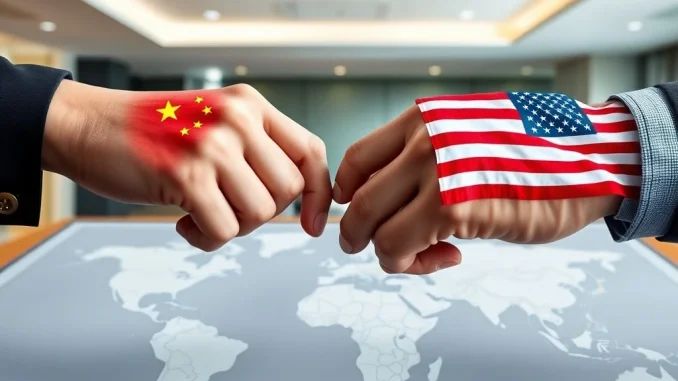
Global markets often react to geopolitical shifts. Investors closely watch economic signals. Recently, a significant development occurred concerning **China US trade** relations. This situation could impact global stability and various asset classes, including cryptocurrencies.
China Blames US for Escalating Trade Tensions
China’s commerce minister has openly attributed the recent surge in trade tensions to the United States. He cited a series of restrictive measures imposed by Washington. These actions have significantly strained the economic relationship between the two global powers. The minister’s comments highlight Beijing’s perspective on the ongoing dispute. They also underscore the seriousness of the current situation. This official statement came through a report by Walter Bloomberg, reaching international audiences quickly.
The minister clearly stated that US policies are directly responsible for the current difficulties. These policies include tariffs and export controls. Such measures have disrupted supply chains. Furthermore, they have created uncertainty for businesses operating in both nations. China views these actions as protectionist. Consequently, they hinder fair competition and free market principles. The rhetoric from Beijing suggests a firm stance. However, it also conveys a desire for dialogue.
Seeking Solutions Amidst US-China Relations
Despite the blame, the Chinese commerce minister expressed a desire for a resolution. He hopes the U.S. will engage constructively with China. This engagement aims to find a mutually acceptable solution to the trade issues. Cooperation is essential for easing the current friction. Both nations stand to benefit from a stable economic environment. Therefore, a path forward involves active discussion and negotiation. Such discussions are crucial for improving **US-China relations**.
Finding common ground requires political will from both sides. Past trade negotiations have seen periods of intense talks. However, they often ended without lasting agreements. The minister’s appeal for cooperation indicates China’s readiness to engage. This readiness could pave the way for future discussions. Global economic stability largely depends on the health of this critical bilateral relationship. Therefore, any move towards de-escalation is closely monitored by markets worldwide.
Impact on Global Trade and Economic Stability
The persistent **trade tensions** between China and the US have far-reaching implications. These effects extend beyond their borders. Many countries rely on smooth trade flows between these two economic giants. Disruptions can cause ripple effects globally. Supply chains become fragmented. Production costs may rise. Consumers might face higher prices for goods. Consequently, this affects overall economic growth.
Moreover, the uncertainty generated by these tensions deters investment. Businesses hesitate to commit capital in unstable environments. This hesitation slows down innovation and job creation. Analysts continually assess the potential for a full-blown trade war. Such a scenario would severely impact the **global trade** system. It would also threaten the fragile post-pandemic economic recovery. Therefore, a swift resolution is in everyone’s best interest. Countries worldwide are watching closely for signs of progress.
Key Measures and Their Consequences
Washington’s restrictive measures have taken various forms. These include:
- Tariffs: Taxes on imported goods from China, making them more expensive.
- Export Controls: Restrictions on selling certain technologies to Chinese companies.
- Investment Screening: Closer scrutiny of Chinese investments in critical US sectors.
These measures aim to address concerns about national security and intellectual property. However, China views them as attempts to curb its economic rise. The result is a cycle of retaliatory actions. This cycle further exacerbates the **trade tensions**. Both economies suffer from reduced trade volumes and increased business costs. Finding a balanced approach is vital for both nations.
Minister’s Meeting with Apple CEO Tim Cook
In a separate development, the Chinese commerce minister reportedly met with Apple CEO Tim Cook. This meeting took place on Thursday. Such high-level engagements are common during periods of economic uncertainty. They allow for direct communication between government officials and major multinational corporations. Apple maintains a significant presence in China. It has extensive manufacturing operations and a large consumer market there. Therefore, these discussions are very important for the company.
Meetings like this offer a platform for dialogue. They allow business leaders to voice concerns. They also enable ministers to convey policy directions. The specific details of their discussion remain undisclosed. However, it likely covered topics relevant to Apple’s operations. These include supply chain stability, market access, and the broader trade environment. Apple’s continued success in China is crucial for its global strategy. Consequently, any shifts in **China US trade** policy directly impact its bottom line.
The Broader Context of US-China Economic Dialogue
The minister’s actions reflect a complex diplomatic strategy. On one hand, China expresses strong opposition to US policies. On the other hand, it seeks engagement. This dual approach aims to protect national interests while keeping channels open. The meeting with Tim Cook exemplifies this strategy. It shows a willingness to discuss issues with key American stakeholders. Such discussions can sometimes bypass official government-to-government stalemates. They can foster understanding at a practical level. Moreover, they underscore the interconnectedness of the two economies.
Ultimately, a sustainable resolution to the current **trade tensions** requires ongoing dialogue. It needs a commitment to finding common ground. Both nations have much to gain from cooperation. They also have much to lose from continued conflict. The global community hopes for a swift and peaceful resolution. This will ensure greater economic stability for everyone.
Frequently Asked Questions (FAQs)
Q1: What is causing the current China US trade tensions?
A1: China’s commerce minister attributes the tensions primarily to restrictive measures imposed by the United States. These measures include tariffs, export controls, and investment screening policies, which Beijing views as protectionist and disruptive.
Q2: What solution is China hoping for in its trade relations with the US?
A2: China’s minister hopes the US will cooperate to find a solution. This suggests a desire for constructive dialogue and negotiations to ease restrictions and achieve a more balanced and stable trade relationship.
Q3: How do these trade tensions affect global trade?
A3: The tensions disrupt global supply chains, increase production costs, and create economic uncertainty. This can lead to higher consumer prices, deter international investment, and slow down overall global economic growth.
Q4: Why was the Chinese commerce minister’s meeting with Apple CEO Tim Cook significant?
A4: This meeting is significant because Apple has extensive operations and a large market in China. Such high-level engagements allow for direct communication, addressing business concerns, and understanding policy directions amidst ongoing trade disputes. It highlights the interdependence of these economies.
Q5: What are the main points of contention in US-China relations regarding trade?
A5: Key points of contention include intellectual property rights, forced technology transfers, market access for foreign companies in China, state subsidies for Chinese industries, and national security concerns related to technology exports.
Updated insights and analysis added for better clarity.
This article was produced with AI assistance and reviewed by our editorial team for accuracy and quality.