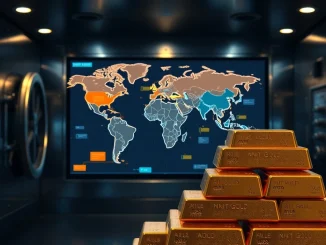
BEIJING, February 11, 2026 — For 15 consecutive months, the People’s Bank of China has added to its official gold reserves, a relentless accumulation that financial analysts now interpret as a direct, long-term challenge to the supremacy of the US dollar. This sustained buying spree, continuing even as gold prices hit record highs, fuels a critical geopolitical question: Is China hoarding gold to engineer a future where the Chinese yuan supplants the greenback as the world’s primary reserve currency? The strategy, if successful, would represent the most significant shift in global financial power since the Bretton Woods agreement in 1944.
The Silent Accumulation: China’s Official and Unofficial Gold Stash
Officially, China reports holding 2,306 tonnes of gold, placing it sixth globally behind the United States, Germany, Italy, France, and Russia. However, a chorus of independent analysts contends the true figure is dramatically higher. Jan Nieuwenhuijs, a gold analyst at Money Metals Exchange, estimates China’s actual reserves exceed 5,400 tonnes. “Covert buying allows the PBoC to buy more gold at lower prices — getting more bang for their buck,” Nieuwenhuijs explains, highlighting a strategy of quiet accumulation to avoid spiking the market. This analysis is supported by China’s dual role as the world’s largest gold producer since 2007 and a massive importer, with over 1,200 tonnes imported in 2024 alone.
Financial writer Dominic Frisby, author of several books on gold and monetary history, suggests the undisclosed reserves could be far greater. “I think it’s the biggest story in world finance — China’s accumulation of gold — and nobody is looking at it,” Frisby stated on the Triggernometry podcast. He posits that China could hold several times its reported amount, a revelation it could deploy strategically to bolster confidence in the yuan at a pivotal moment.
De-Dollarization by Stealth: A Long-Term Monetary Strategy
Unlike aggressive actions such as dumping US Treasury bonds, which could trigger immediate market turmoil, gold accumulation is a subtle, long-game tactic. Charles-Henry Monchau, Chief Investment Officer at Swiss banking group Syz, describes it as a “quiet, cumulative” method to reduce global reliance on the dollar. “By transforming some of its surplus dollars into gold, China reduces global demand for the greenback while building a monetary buffer that reflects real value,” Monchau notes. This approach aligns perfectly with President Xi Jinping’s stated goal, articulated in the state-run Qiushi magazine, to build a “strong currency” with global reserve status.
- Strategic Diversification: Moving from dollar-denominated assets to physical gold insulates China’s reserves from US monetary policy and potential sanctions.
- Building Intrinsic Value: Gold provides a tangible, historically trusted backing that fiat currencies lack, potentially making the yuan more attractive for international trade settlements.
- Exerting Gradual Pressure: Consistent gold buying, especially if emulated by other nations, slowly erodes the dollar’s perceived indispensability in the global system.
Expert Analysis: From Independence to Weaponization
Analysts are divided on China’s endgame. Nieuwenhuijs views the strategy less as an attack and more as a “declaration of independence” from the dollar system. He suggests the People’s Bank of China may reveal its true gold holdings only when China feels confident it can trade and store value without dollar dependency. Conversely, figures like Jeff Currie, formerly of Goldman Sachs, frame it explicitly as a “de-dollarization strategy.” Frisby presents a starker possibility, warning that in a scenario of open conflict, “you can be sure China will use money as a weapon of war just as America does.” The potential to suddenly unveil vast gold reserves could be used to shock markets and undermine trust in dollar-based assets.
Historical Precedent: The Ghost of Bretton Woods and the ‘Money Illusion’
To understand the potential power of a gold-backed yuan, one must revisit the history of the dollar’s own dominance. The 1944 Bretton Woods system anchored global currencies to the US dollar, which was itself convertible to gold at $35 per ounce. This made the dollar “as good as gold.” That system collapsed in 1971 when President Nixon suspended convertibility, untethering the dollar from the metal. Yet, the dollar retained its premier status due to the size of the US economy and network effects—a phenomenon Frisby calls the “money illusion,” where faith in the currency persists even without tangible backing.
| Monetary System | Anchor | Era | Key Weakness |
|---|---|---|---|
| Bretton Woods | US Dollar (Gold-Convertible) | 1944-1971 | US gold supply could not keep pace with dollar printing. |
| Petrodollar System | US Dollar (Oil-Trade Linked) | 1971-Present | Relies on geopolitical alliances and perpetual demand for dollars. |
| Potential Yuan System | Chinese Yuan (Potentially Gold-Backed) | Future | Requires unprecedented trust in Chinese financial transparency and stability. |
A Chinese move to explicitly back the yuan with a newly revealed, massive gold stockpile could shatter the current “money illusion” surrounding the dollar. If China demonstrated it held more gold than the US’s claimed 8,133 tonnes, it could position the yuan as a more stable, asset-backed alternative for central bank reserves.
The Road to 2050: A Multi-Decade Power Transition
Most experts agree any currency transition will be measured in decades, not years. The US dollar’s entrenched position in global trade, financial markets, and commodity pricing creates immense inertia. However, China is building the foundational elements: promoting yuan usage in bilateral trade agreements, expanding its Cross-Border Interbank Payment System (CIPS) as an alternative to SWIFT, and now, potentially, amassing the ultimate monetary credibility tool—gold. The 2050 timeline often cited by economists reflects the slow pace at which global financial architecture changes, but the persistent, 15-month gold-buying streak indicates China is committed to the journey.
Investment Implications: Gold and Bitcoin as Hedges
This macro-monetary struggle has direct implications for investors. Commentators like Robert Kiyosaki and Dominic Frisby have long advocated holding gold and Bitcoin as hedges against currency debasement and systemic shifts. “Both are money in and of themselves: one is the product of nature, the other the product of extraordinary amounts of computer power. Neither relies on anyone else,” Frisby argues. The current gold price rally is partly fueled by this “debasement trade,” where investors seek assets outside the traditional fiat system amidst high debt and geopolitical uncertainty. While a BRICS common currency seems logistically distant, China’s unilateral gold strategy presents a more immediate and credible pathway for de-dollarization.
Conclusion
China’s 15-month public gold accumulation, coupled with likely larger covert purchases, is a clear signal of its strategic intent to reshape the international monetary order. While an immediate overthrow of the US dollar is improbable, the campaign to elevate the yuan is real, patient, and now backed by a deliberate push into history’s most enduring store of value. The ultimate revelation of China’s true gold reserves may serve as the pivotal event that accelerates a global shift away from dollar dominance. For markets and governments, the key takeaway is that the era of unquestioned dollar supremacy is being actively, and quietly, challenged. The world must now watch not just China’s economic growth, but the weight of its gold vaults.
Frequently Asked Questions
Q1: How much gold does China officially hold, and why do analysts think it has more?
China officially reports 2,306 tonnes of gold. Analysts like Jan Nieuwenhuijs estimate holdings over 5,400 tonnes based on China’s massive domestic gold production, consistent imports, and withdrawals from the Shanghai Gold Exchange that far exceed reported official purchases.
Q2: How could a gold-backed yuan actually challenge the US dollar?
By revealing substantial gold reserves, China could position the yuan as a more stable, asset-backed alternative for international trade and central bank reserves. This could attract nations seeking to diversify away from the dollar, especially in bilateral trade with China, gradually reducing global demand for greenbacks.
Q3: What is the ‘money illusion’ mentioned in relation to the US dollar?
The “money illusion” refers to the continued global faith in the US dollar as the primary reserve currency even after it lost its direct convertibility to gold in 1971. Its dominance persists due to habit, network effects, and the lack of a credible alternative, not intrinsic backing.
Q4: Is China’s gold buying causing the current high gold prices?
While China’s sustained purchasing is a significant factor, record gold prices are also driven by broader global uncertainty, inflation concerns, and buying from other central banks and investors—a collective move often called the “debasement trade.”
Q5: What would stop other countries from following China’s lead and hoarding gold?
Many central banks, especially in emerging markets, are already increasing their gold reserves. However, not all nations have China’s trade surpluses to convert into gold. Furthermore, the US and European powers have deep, liquid financial markets that gold cannot replicate, making a full exit from dollar/euro assets difficult.
Q6: How does this affect the average investor or saver?
This macro trend underscores the importance of portfolio diversification. It strengthens the case for holding a portion of assets in non-fiat stores of value like physical gold or decentralized assets like Bitcoin, which are not tied to the monetary policy of any single nation.