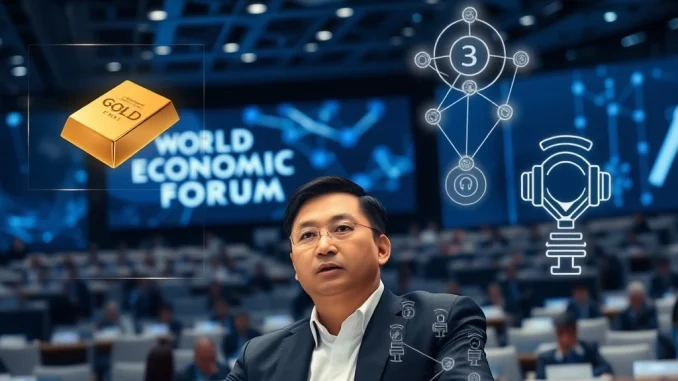
DAVOS, SWITZERLAND – JANUARY 22, 2025: In a pivotal address that captured the attention of global financial leaders, Binance founder Changpeng Zhao outlined the essential cryptocurrency trends poised to redefine digital finance this year. Speaking at the World Economic Forum, Zhao identified three interconnected forces—asset tokenization, payment system convergence, and AI agent applications—as the primary drivers for the next phase of blockchain adoption. His analysis provides a crucial roadmap for understanding how cryptocurrency will integrate with traditional economic systems and emerging technologies.
Changpeng Zhao Identifies Asset Tokenization as a Government Priority
Changpeng Zhao emphasized a significant shift during his Davos appearance. Consequently, national governments are now actively entering the asset tokenization space. This move represents a major evolution from purely private sector experimentation. For instance, tokenization converts rights to a physical or financial asset into a digital token on a blockchain. Traditionally, this process involved commodities like gold or real estate. However, governments are now exploring sovereign debt instruments and central bank digital currencies (CBDCs).
Several nations have launched pilot programs for tokenized treasury bonds and green bonds. These initiatives aim to increase market efficiency and transparency. Furthermore, the European Investment Bank completed a €100 million digital bond issuance on a private blockchain in late 2024. Similarly, the Monetary Authority of Singapore continues its Project Guardian, which tests tokenized asset trading. Zhao’s observation underscores a broader institutional validation of blockchain’s utility for traditional finance.
The Tangible Impact of Tokenized Assets
The real-world impact of this trend is already measurable. Tokenization can reduce settlement times from days to minutes. It also lowers counterparty risk and operational costs. A 2024 report by the Boston Consulting Group projected the tokenized asset market could reach $16 trillion by 2030. This growth potential explains the heightened governmental interest Zhao highlighted. Therefore, this trend is not speculative; it is a practical response to market demands for liquidity and accessibility.
The Convergence of Crypto and Traditional Payment Systems
Regarding payment systems, Changpeng Zhao provided a nuanced assessment. He acknowledged that pure cryptocurrency payments have not yet achieved mass consumer adoption. However, he identified a powerful emerging trend: backend integration. Major payment processors and financial institutions are increasingly embedding blockchain rails into their existing infrastructure. This integration allows for faster cross-border settlements without requiring end-users to directly handle cryptocurrencies.
For example, numerous banks now use stablecoins for internal treasury management and international transfers. This application leverages blockchain’s speed and cost advantages while maintaining regulatory compliance. Moreover, traditional finance giants like Visa and Mastercard have developed protocols to settle transactions using USD Coin (USDC) on their networks. This convergence creates a hybrid model where blockchain technology powers the backend of familiar payment experiences.
- Backend Integration: Traditional systems using blockchain for settlement.
- Stablecoin Utility: Fiat-pegged digital currencies for enterprise finance.
- Regulatory Clarity: Improved frameworks enabling institutional adoption.
This shift addresses previous scalability and volatility concerns associated with crypto payments. Consequently, it paves a more pragmatic path toward broader blockchain utility in global finance.
AI Agent Applications and Their Reliance on Blockchain
Perhaps the most forward-looking trend Zhao discussed involves artificial intelligence. He predicted that as AI agents become more autonomous and capable, their need for reliable, automated payment systems will surge. Blockchain and cryptocurrency provide the ideal infrastructure for these machine-to-machine (M2M) transactions. AI agents require a trustless, global, and programmable monetary layer to function independently.
Consider an AI managing a decentralized supply chain. It must pay for services, data, or computational power across jurisdictions without human intervention. Smart contracts on a blockchain can automate these payments based on pre-defined conditions. Furthermore, blockchain provides an immutable audit trail for all AI-driven transactions. This feature is essential for accountability and regulatory oversight in autonomous systems.
| Application | Blockchain Function | Status |
|---|---|---|
| Autonomous Data Marketplaces | Micropayments for training data | Early Development |
| Decentralized AI Compute | Payment for GPU/CPU power | Live Networks |
| AI-Driven DeFi Strategies | Execution of complex financial trades | Pilot Stage |
Research firms like Gartner have begun including “AI and blockchain convergence” in their top strategic technology trends. This synergy suggests Zhao’s prediction is aligned with broader industry analysis. The performance improvements in AI agents will therefore directly increase their reliance on cryptographic payment systems.
Expert Validation and Market Trajectory
Changpeng Zhao’s perspectives at Davos find support from other industry leaders. For instance, Circle CEO Jeremy Allaire has frequently discussed the role of stablecoins in the new AI economy. Additionally, reports from the Bank for International Settlements (BIS) have examined tokenization’s potential for financial stability. The World Economic Forum itself has published white papers on blockchain’s role in future payment systems. This collective expert focus confirms the trends Zhao highlighted are central to current financial technology discourse.
Conclusion
Changpeng Zhao’s analysis at the 2025 World Economic Forum provides a clear and essential framework for understanding cryptocurrency’s trajectory. The trends of asset tokenization, payment system convergence, and AI agent applications are not isolated phenomena. Instead, they represent a cohesive shift toward the practical, institutional integration of blockchain technology. Governments and corporations are now building the infrastructure for a more efficient, transparent, and automated financial future. Therefore, Zhao’s insights offer a valuable lens through which to view the evolving relationship between cryptocurrency, traditional finance, and artificial intelligence.
FAQs
Q1: What did Changpeng Zhao say about governments and asset tokenization?
Changpeng Zhao stated that various national governments are now actively entering the asset tokenization space, moving beyond private sector experiments to explore tokenized sovereign debt and other instruments.
Q2: How are crypto payments evolving according to Zhao’s Davos comments?
Zhao noted that while direct crypto payments aren’t mainstream, a significant trend involves the backend integration of blockchain technology into traditional payment systems for faster and cheaper settlement.
Q3: Why does AI need blockchain and cryptocurrency?
As AI agents become more autonomous, they require a global, trustless, and programmable payment layer for machine-to-machine transactions, which blockchain-based systems are uniquely suited to provide.
Q4: What is an example of asset tokenization in practice today?
A prominent example is the European Investment Bank’s issuance of a €100 million digital bond on a blockchain, demonstrating how traditional financial instruments can be digitized for efficiency.
Q5: What was the context of Changpeng Zhao’s speech on these crypto trends?
Zhao delivered these insights during an appearance at the World Economic Forum in Davos, Switzerland, on January 22, 2025, a forum focused on global economic cooperation and future trends.
Updated insights and analysis added for better clarity.
This article was produced with AI assistance and reviewed by our editorial team for accuracy and quality.