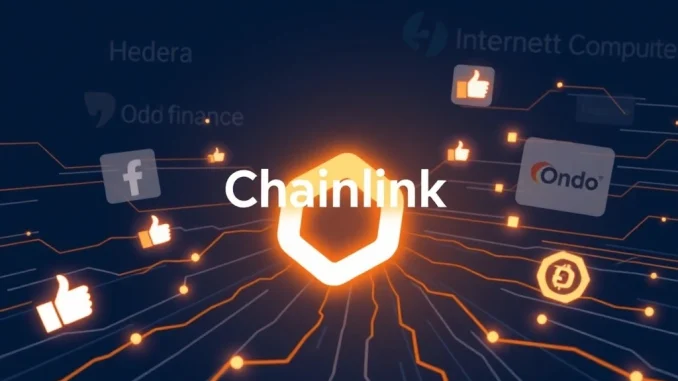
Global, May 2025: Recent data analytics reveal a significant shift in community engagement within the blockchain sector. Chainlink ($LINK), the decentralized oracle network, now commands the highest level of social activity among projects focused on Real World Assets (RWA). This metric, which measures engaged posts, discussions, and interactions across major platforms, shows Chainlink outperforming notable competitors including Hedera ($HBAR), Internet Computer ($ICP), and Ondo Finance ($ONDO). The surge in conversation highlights growing market interest in the infrastructure required to bridge traditional finance with blockchain technology.
Chainlink’s Social Dominance in the RWA Sector
The landscape of Real World Assets is becoming one of the most competitive arenas in cryptocurrency. Tokenizing physical or traditional financial assets—like treasury bonds, real estate, or commodities—requires robust, reliable data feeds. Chainlink’s oracle networks provide this critical infrastructure. Social activity metrics, tracked by platforms like LunarCrush and Santiment, aggregate data from Twitter, Reddit, Telegram, and developer forums. They measure not just volume, but the quality of interactions: replies, shares, and sustained discussion threads. Chainlink’s lead in this area suggests a particularly engaged and expanding community of developers, investors, and enthusiasts focused on its RWA applications. This is not merely hype; it reflects substantive discussion around technical integrations, partnership announcements, and the evolving use cases for secure off-chain data.
Analyzing the Competitive Landscape: Hedera, ICP, and Ondo
To understand Chainlink’s position, a comparative analysis of its closest rivals in the RWA conversation is essential. Each project approaches the sector with a distinct technological and strategic vision.
- Hedera ($HBAR): Utilizing a hashgraph consensus mechanism, Hedera promotes high throughput and low fees for enterprise-grade applications. Its governance model and partnerships with major corporations have positioned it as a contender for RWA tokenization, particularly in supply chain and carbon credit markets. However, its social activity, while strong, currently trails the focused discourse surrounding Chainlink’s oracle solutions.
- Internet Computer ($ICP): This project aims to create a decentralized cloud computing platform. Its ambition to host entire applications and services on-chain makes it a potential host for RWA platforms. Social discussion around ICP often centers on its ambitious technical roadmap and scalability, with RWA-specific conversations forming a significant, but not dominant, subset of its overall community engagement.
- Ondo Finance ($ONDO): As a decentralized finance protocol specifically built for institutional-grade RWAs, Ondo is a direct application-layer player. It focuses on products like tokenized U.S. Treasuries. Its social activity is deeply niche, engaging a dedicated community of DeFi natives interested in yield-bearing assets. Its volume, while highly relevant, is naturally smaller than that of an infrastructure provider like Chainlink, which serves countless applications including Ondo itself.
The table below summarizes the core focus of each project within the RWA ecosystem:
| Project | Primary RWA Role | Key Social Discussion Themes |
|---|---|---|
| Chainlink (LINK) | Data Infrastructure & Oracles | CCIP adoption, new data feeds, cross-chain security, partnership integrations |
| Hedera (HBAR) | Enterprise-Grade Ledger | Governance council news, enterprise partnerships, tokenization standards |
| Internet Computer (ICP) | Decentralized Cloud Platform | Canister scalability, direct integration with traditional web, developer adoption |
| Ondo Finance (ONDO) | DeFi Application for RWAs | Yield products, regulatory developments, institutional onboarding |
The Critical Role of Oracles in Real World Asset Tokenization
The high social activity around Chainlink is not coincidental; it is driven by a fundamental technological requirement. Tokenizing a real-world asset requires a continuous, tamper-proof connection between the blockchain smart contract and external data sources. This includes price feeds for commodities, interest rate data for bonds, and proof-of-reserve attestations. Any failure in this data bridge can lead to massive financial loss. Chainlink’s decentralized oracle networks (DONs) are designed to solve this problem by aggregating data from multiple independent nodes. The intense community discussion reflects the market’s understanding that as RWA projects proliferate, the demand for and scrutiny of oracle solutions intensifies proportionally. Developers actively debate best practices, security audits, and the implications of Chainlink’s Cross-Chain Interoperability Protocol (CCIP) for moving tokenized assets across different blockchains.
Implications for Market Sentiment and Developer Mindshare
Sustained social activity often serves as a leading indicator for developer mindshare and long-term ecosystem health. A vibrant, technical community suggests a growing pool of talent building on a platform. For Chainlink, leading this metric in the RWA sector implies that developers prioritizing real-world asset applications are actively choosing or discussing its infrastructure. This can create a network effect: more discussion attracts more developers, leading to more applications, which in turn generates further discussion and innovation. While social metrics do not directly correlate with short-term price action, they provide insight into the organic, grassroots interest in a project’s underlying technology. It also places pressure on competitors like Hedera and ICP to amplify their own community engagement and clearly communicate their unique value propositions in the RWA space to capture similar attention.
Conclusion
The data clearly shows that Chainlink currently dominates social conversation among key Real World Asset projects. This dominance over peers like Hedera, Internet Computer, and Ondo Finance underscores the market’s recognition of oracles as the indispensable backbone for the tokenization revolution. The high-quality, engaged nature of this social activity points beyond mere speculation toward a deep, community-driven focus on infrastructure, security, and implementation. As the RWA sector continues its rapid expansion, the projects that maintain strong, informed, and active communities will likely be best positioned to navigate the technical and regulatory challenges ahead. Chainlink’s current social lead reflects its pivotal role in this transformative phase of blockchain adoption.
FAQs
Q1: What does “social activity” measure in this context?
It measures the volume and, more importantly, the engagement quality (likes, replies, shares, sustained threads) of discussions about a cryptocurrency project across social media platforms and developer forums, indicating community vitality and interest.
Q2: Why are oracles like Chainlink so important for Real World Assets (RWAs)?
RWAs require reliable, real-world data (like prices, interest rates, or proof of ownership) to be used in blockchain smart contracts. Oracles securely fetch and deliver this off-chain data on-chain, making them a critical trust layer for any RWA application.
Q3: Is Ondo Finance a direct competitor to Chainlink?
Not directly. Ondo Finance is an application that builds products using tokenized RWAs. It is a user of oracle services. Chainlink is an infrastructure provider that could be used by applications like Ondo. They operate at different layers of the technology stack.
Q4: Can high social activity predict the success of a cryptocurrency project?
While not a direct predictor of price, sustained, high-quality social activity is a strong indicator of developer mindshare, community strength, and ongoing interest in a project’s technology, which are crucial for long-term ecosystem growth.
Q5: What is Hedera’s main advantage in the RWA space?
Hedera’s hashgraph consensus offers high speed, low cost, and finality, which is attractive for enterprise use cases. Its governing council of major global companies also provides a perception of stability and governance that some institutional RWA players may prefer.
This article was produced with AI assistance and reviewed by our editorial team for accuracy and quality.