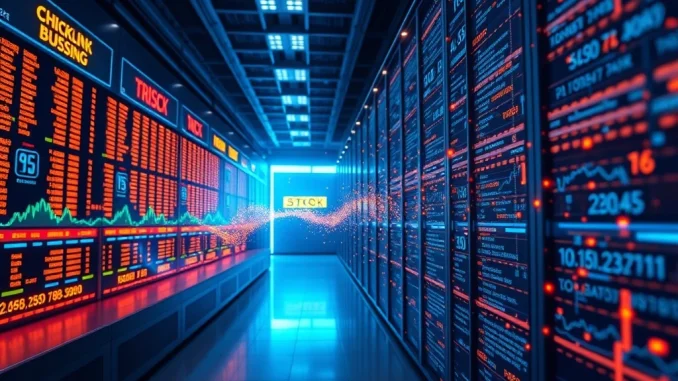
In a landmark move for decentralized finance, Chainlink has officially launched its 24/5 U.S. Equities Streams, a service that transmits real-time U.S. stock and ETF market data directly on-chain. This pivotal development, announced from the project’s global headquarters, effectively creates an always-on stock market infrastructure within the blockchain ecosystem. Consequently, it transcends the traditional limitations of market hours and opens new frontiers for financial applications.
Chainlink Data Streams Bridge Traditional and Decentralized Finance
Chainlink’s new offering represents a significant expansion of its established Data Streams feature. The system now provides fast, low-latency data feeds across all U.S. stock trading sessions. This includes pre-market, regular, and after-hours sessions from Monday to Friday. The technology leverages Chainlink’s decentralized oracle network to fetch, aggregate, and deliver price data from multiple premium financial data providers. Therefore, it ensures both high reliability and robust security for downstream applications.
This launch addresses a core limitation in today’s DeFi landscape. Previously, protocols offering synthetic stocks or equity-based derivatives relied on slower, less frequent price updates. Chainlink’s 24/5 streams deliver data with much higher frequency and lower latency. As a result, developers can now build applications that react to market movements in near real-time. This capability is crucial for creating sophisticated trading platforms, risk management tools, and structured financial products on-chain.
The Technical Architecture Powering On-Chain Equities
The operational backbone of this service is Chainlink’s decentralized oracle network. This network pulls data from multiple authenticated sources, including primary exchanges and licensed data aggregators. A consensus mechanism then validates this data before it is written on-chain. This multi-layered approach is designed to prevent manipulation and ensure data integrity. Furthermore, the system’s architecture supports scalability to accommodate growing demand from various blockchain networks.
Key technical specifications of the U.S. Equities Streams include:
- High Frequency Updates: Data is refreshed multiple times per second during active trading sessions.
- Low-Latency Delivery: Optimized pipelines ensure minimal delay between off-chain market movement and on-chain availability.
- Broad Coverage: Initial support includes major indices like the S&P 500 and NASDAQ-100 constituents, with plans for expansion.
- Cross-Chain Compatibility: Feeds are available on leading Ethereum Virtual Machine (EVM) compatible chains and other major Layer 1 networks.
Expert Analysis: Unlocking New Financial Primitives
Industry analysts view this development as a critical step toward maturity for DeFi. “The availability of high-quality, continuous equity data on-chain is a foundational primitive,” notes a report from a major blockchain research firm. “It allows developers to move beyond crypto-native assets and build bridges to the multi-trillion-dollar traditional equity market.” This infrastructure enables a new class of hybrid financial products. For instance, it can facilitate tokenized stock ETFs, algorithmic trading strategies that execute across both markets, and decentralized prediction markets for corporate earnings.
The timeline for this rollout follows years of development and testing. Chainlink initially introduced its Data Streams product for crypto assets, proving the model’s reliability under volatile conditions. The successful deployment for equities marks a logical and ambitious extension. Market impact is already visible, with several prominent DeFi protocols announcing integration plans to leverage these new feeds for their upcoming products.
Implications for the Future of Trading and DeFi
The introduction of 24/5 on-chain stock data fundamentally alters the landscape for decentralized applications. It enables the creation of markets that operate continuously, without closure for weekends or holidays. This always-on capability is a native advantage of blockchain technology. Moreover, it provides global access to U.S. market data within smart contracts, democratizing information that was previously behind institutional paywalls.
Potential use cases extend far beyond simple price feeds. Developers can program complex conditional logic. For example, a smart contract could automatically rebalance a tokenized portfolio based on real-time price movements of Apple or Tesla stock. Another application could be decentralized insurance products that payout based on specific equity index performance. The table below outlines a comparison between traditional data feeds and Chainlink’s new on-chain solution:
| Feature | Traditional Data Feed | Chainlink 24/5 On-Chain Stream |
|---|---|---|
| Availability | Market Hours Only | 24/5 Continuous |
| Access | Licensed, Often Costly | Permissionless via Smart Contract |
| Integration | Centralized Systems | Directly into Decentralized Apps (dApps) |
| Settlement | T+2 (Trade Date + 2 Days) | Potential for Near-Instant On-Chain Settlement |
| Global Reach | Geographically Restricted | Borderless, Accessible Anywhere |
This technological leap also raises important considerations for regulation and compliance. While the data itself is public, the on-chain financial products built atop it will likely attract scrutiny from bodies like the U.S. Securities and Exchange Commission. Proponents argue that transparent, auditable on-chain activity could actually simplify compliance reporting. Nevertheless, the intersection of TradFi data and DeFi applications represents a new frontier for financial regulators worldwide.
Conclusion
Chainlink’s launch of 24/5 U.S. Equities Streams is a transformative event for blockchain-based finance. It provides the critical, reliable data infrastructure needed to merge traditional markets with decentralized applications. By delivering fast, verified stock and ETF data on-chain, Chainlink data streams empower developers to build the next generation of financial products. This development marks a decisive step toward a more open, accessible, and continuously operating global financial system built on transparent blockchain infrastructure.
FAQs
Q1: What exactly are Chainlink’s 24/5 U.S. Equities Streams?
They are a decentralized oracle service that delivers real-time price data for U.S. stocks and ETFs directly onto blockchain networks. The “24/5” denotes continuous data flow during all U.S. market sessions from Monday to Friday, including pre-market and after-hours trading.
Q2: How does this differ from existing crypto price oracles?
While the underlying oracle technology is similar, this service specifically sources data from traditional equity markets instead of cryptocurrency exchanges. It also operates on a 24/5 schedule aligned with stock market hours, requiring different data providers and reliability mechanisms tailored to TradFi infrastructure.
Q3: What are the primary use cases for this on-chain stock data?
Key use cases include decentralized trading of synthetic stock assets, tokenized equity ETFs, algorithmic trading strategies that reference stock prices, decentralized prediction markets for corporate events, and as a trigger or input for more complex DeFi structured products and insurance protocols.
Q4: Is the data reliable and resistant to manipulation?
Chainlink’s model aggregates data from multiple premium, licensed financial data providers. The network uses decentralized consensus to validate data before it is written on-chain. This multi-source approach is designed to prevent manipulation and ensure the data reflects the genuine, volume-weighted market price.
Q5: Can anyone access this data, and on which blockchains is it available?
The data is accessible permissionlessly by any smart contract deployed on supported blockchains. Initially, the feeds are available on leading Ethereum Virtual Machine (EVM) compatible networks like Ethereum, Arbitrum, and Avalanche, with plans to expand to other major Layer 1 and Layer 2 platforms.
Updated insights and analysis added for better clarity.
This article was produced with AI assistance and reviewed by our editorial team for accuracy and quality.