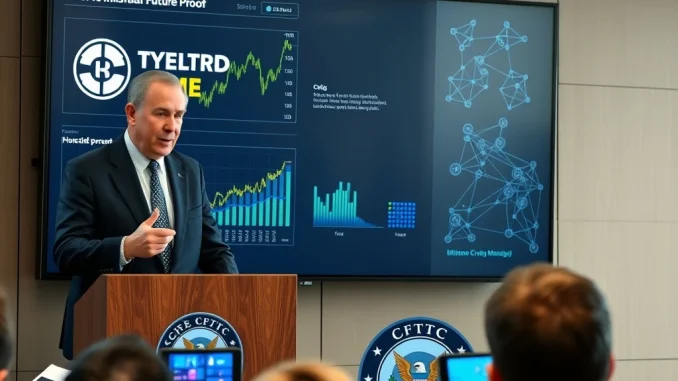
WASHINGTON, D.C., March 2025 – The United States Commodity Futures Trading Commission (CFTC) has embarked on a transformative journey to reshape cryptocurrency oversight. Newly appointed Chairman Mike Selig unveiled the “Future Proof” initiative this week, marking a significant shift toward institutionalized supervision of digital asset markets through formal rulemaking. This development signals a pivotal moment for regulatory clarity in the rapidly evolving financial technology landscape.
CFTC Crypto Oversight Enters New Era with Future Proof
Chairman Mike Selig announced the Future Proof initiative through multiple channels, including social media platform X and a detailed op-ed in The Washington Post. The program represents a structured approach to regulating innovative financial sectors, with cryptocurrency markets receiving immediate priority. Consequently, the CFTC aims to move beyond reactive enforcement toward proactive, framework-based supervision.
The commission oversees derivatives markets, including cryptocurrency futures and swaps. However, its authority over spot markets remains limited without clearer legislative mandates. Selig’s initiative seeks to formalize the agency’s role through established administrative procedures. Furthermore, this approach contrasts with the more fragmented regulatory actions of recent years.
Regulatory experts immediately recognized the announcement’s significance. “This represents institutionalization rather than improvisation,” noted Georgetown University law professor Linda Jeng. “The CFTC is building a durable structure for digital asset supervision.” The initiative follows years of jurisdictional debates between the CFTC and Securities and Exchange Commission (SEC).
Historical Context of Cryptocurrency Regulation
Understanding the Future Proof initiative requires examining the CFTC’s evolving role. The commission first asserted jurisdiction over Bitcoin derivatives in 2015. Subsequently, it pursued numerous enforcement actions against unregistered trading platforms and fraudulent schemes. However, these efforts operated without comprehensive regulatory frameworks specifically designed for digital assets.
Congressional debates about digital asset legislation have continued for several sessions. The Lummis-Gillibrand Responsible Financial Innovation Act proposed clearer jurisdictional lines in 2023. Meanwhile, the SEC has pursued its own enforcement-heavy approach under Chairman Gary Gensler. Selig’s initiative appears designed to demonstrate the CFTC’s capacity for structured oversight ahead of potential legislative action.
The following table illustrates key regulatory milestones leading to the Future Proof announcement:
| Year | Regulatory Development | Impact on CFTC Authority |
|---|---|---|
| 2015 | CFTC classifies Bitcoin as commodity | Established derivatives jurisdiction |
| 2020 | Telegram settlement establishes precedent | Expanded enforcement reach |
| 2022 | FTX collapse prompts congressional hearings | Increased pressure for formal rules |
| 2024 | Selig confirmation as chairman | Set stage for institutional reform |
| 2025 | Future Proof initiative launch | Begins formal rulemaking process |
Expert Analysis of Regulatory Implications
Financial regulation specialists emphasize the initiative’s procedural importance. “Formal rulemaking creates predictability,” explained former CFTC commissioner Jill Sommers. “Market participants can comment on proposals before implementation.” This contrasts with regulation-by-enforcement approaches that provide limited advance guidance.
The initiative likely addresses several critical areas for cryptocurrency markets:
- Exchange Registration: Formal requirements for trading platforms
- Customer Protection: Standards for asset custody and segregation
- Market Integrity: Surveillance and manipulation prevention
- Product Approval: Processes for new derivative instruments
- Reporting Standards: Transparency requirements for large positions
Industry responses have been cautiously optimistic. “Clarity benefits responsible operators,” stated Kraken CEO Dave Ripley. “We welcome engagement with regulators developing practical frameworks.” However, some decentralized finance proponents express concerns about traditional regulations applied to novel technologies.
Comparative Analysis with International Approaches
The Future Proof initiative emerges amid global regulatory developments. The European Union implemented its Markets in Crypto-Assets (MiCA) regulation in 2024. Similarly, the United Kingdom established its cryptoasset regulatory regime through the Financial Services and Markets Act. Meanwhile, Singapore and Japan have developed comprehensive licensing frameworks.
International coordination presents both challenges and opportunities. Global cryptocurrency markets operate across jurisdictions constantly. Consequently, regulatory arbitrage remains a persistent concern. The CFTC initiative may influence international standards through its focus on derivatives markets. Additionally, the commission participates in global regulatory forums including the International Organization of Securities Commissions.
Divergences between U.S. agencies complicate the international landscape. The SEC maintains different classification approaches for many digital assets. However, the CFTC’s commodity classification for Bitcoin and Ethereum provides clearer jurisdictional foundation. Selig’s initiative may prompt renewed efforts for interagency coordination on overlapping issues.
Technological Considerations for Modern Regulation
Effective cryptocurrency oversight requires understanding blockchain technology. The CFTC has invested significantly in technical expertise recently. Its LabCFTC unit, established in 2017, engages directly with fintech innovators. This technical capacity informs the Future Proof initiative’s practical design.
Regulators must balance multiple competing priorities:
- Preventing fraud and manipulation
- Fostering responsible innovation
- Maintaining market stability
- Protecting retail investors
- Ensuring national security compliance
Technological neutrality presents particular challenges. Regulations should address economic functions rather than specific implementations. However, decentralized systems resist traditional regulatory models. The initiative will likely explore graduated approaches based on centralization levels.
Potential Impacts on Market Participants
The Future Proof initiative will affect diverse cryptocurrency market participants differently. Established exchanges with existing compliance programs may face adaptation costs. Meanwhile, new entrants will encounter clearer onboarding requirements. Institutional investors have long cited regulatory uncertainty as a barrier to greater cryptocurrency allocation.
Derivatives markets may experience immediate effects. The CFTC oversees Bitcoin and Ethereum futures traded on CME Group and other regulated exchanges. Expanded rulemaking could introduce new product categories. Additionally, oversight of decentralized derivatives platforms presents complex jurisdictional questions.
Retail investors stand to benefit from enhanced protections. Formal rules typically establish clearer recourse mechanisms. However, excessive regulation might limit access to innovative financial products. The rulemaking process will include public comment periods allowing diverse perspectives.
Conclusion
The CFTC crypto oversight landscape enters a new phase with Chairman Mike Selig’s Future Proof initiative. This structured approach to digital asset regulation represents a significant departure from previous reactive measures. The initiative prioritizes formal rulemaking to institutionalize supervision of cryptocurrency markets. Consequently, market participants can anticipate clearer regulatory frameworks developing through established administrative procedures. The coming months will reveal specific policy changes as the CFTC advances its reform agenda. Ultimately, this development may establish more predictable foundations for cryptocurrency innovation within regulated financial markets.
FAQs
Q1: What is the CFTC’s Future Proof initiative?
The Future Proof initiative is a comprehensive regulatory reform program launched by CFTC Chairman Mike Selig. It aims to establish formal rules for overseeing cryptocurrency and other innovative financial markets through structured rulemaking processes.
Q2: How does this initiative differ from previous CFTC approaches to cryptocurrency?
Previously, the CFTC primarily used enforcement actions based on existing commodities laws. The Future Proof initiative shifts toward proactive rulemaking specifically designed for digital assets, creating clearer frameworks before enforcement.
Q3: What areas of cryptocurrency markets will the CFTC regulate under this initiative?
The initiative will likely address cryptocurrency derivatives markets initially, including futures and swaps. It may also establish standards for trading platforms, customer protections, market surveillance, and new product approvals.
Q4: How will this affect ordinary cryptocurrency investors?
Retail investors may benefit from enhanced protections against fraud and manipulation. However, regulations might also limit access to certain products. The public comment process will allow investor perspectives during rule development.
Q5: When will specific rules be announced?
Chairman Selig indicated further policy changes would come “in the near future.” Formal rulemaking typically involves proposal announcements, public comment periods, and final implementation over several months.
Q6: How does this initiative relate to SEC cryptocurrency regulation?
The CFTC oversees commodities and derivatives, while the SEC regulates securities. The initiatives may address jurisdictional overlaps, but significant coordination between agencies remains necessary for comprehensive digital asset regulation.
Updated insights and analysis added for better clarity.
This article was produced with AI assistance and reviewed by our editorial team for accuracy and quality.