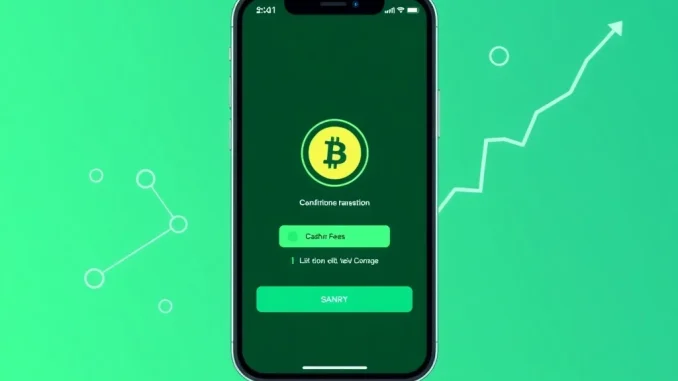
San Francisco, April 2025: In a significant move for retail cryptocurrency access, Jack Dorsey’s financial platform, Cash App, has announced the elimination of fees on qualifying Bitcoin transactions. The policy specifically targets purchases exceeding $2,000 and all scheduled, recurring buys, directly reducing the cost for users employing dollar-cost averaging (DCA) strategies to accumulate Bitcoin—a practice commonly known as “stacking sats.” This update represents a clear strategic expansion of Cash App’s crypto services, aiming to lower barriers for long-term, incremental investment in the flagship digital asset.
Cash App’s Fee Restructuring for Bitcoin Accessibility
The core of the update is a two-tiered approach to fee elimination. First, any single Bitcoin purchase made through the Cash App that totals more than $2,000 will now incur zero transaction fees. Second, and potentially more impactful for regular investors, the platform has removed all fees associated with setting up and executing recurring Bitcoin purchases. This structure incentivizes both lump-sum investments and the disciplined, automated investment strategy of dollar-cost averaging. For context, traditional cryptocurrency exchanges and many brokerages typically charge a spread or a percentage-based fee on every transaction, which can erode returns over time, especially for frequent, small purchases. By removing these costs, Cash App directly addresses a common pain point for retail investors seeking to build a Bitcoin position gradually without being penalized by cumulative fees.
The Mechanics and Motivation Behind Dollar-Cost Averaging
Dollar-cost averaging is a time-tested investment strategy where a fixed dollar amount is invested in an asset at regular intervals, regardless of its price. This method mitigates the risk of investing a large amount at a market peak by spreading purchases over time. In the volatile cryptocurrency market, DCA has become a cornerstone strategy for risk-averse participants aiming for long-term exposure. Historically, platforms charged fees on each of these periodic transactions. Cash App’s new policy effectively supercharges this strategy by removing the recurring cost drag. The move is not merely a promotional tactic but aligns with a broader philosophy, often echoed by Jack Dorsey, of building Bitcoin into a foundational internet-native currency. Reducing friction and cost for regular acquisition is a direct step toward that vision, making systematic saving in Bitcoin as seamless as a traditional automated savings plan.
Contextualizing Cash App’s Evolving Crypto Strategy
This fee change is the latest in a series of calculated steps by Cash App’s parent company, Block, Inc., to deepen its integration with Bitcoin. The timeline is instructive. In 2018, Cash App first introduced Bitcoin buying and selling. Subsequently, it added features like Bitcoin withdrawals to external wallets and, notably, introduced the ability for users to automatically transfer a percentage of their direct deposit into Bitcoin. The new zero-fee structure on recurring and large buys is a logical extension of this automation-focused roadmap. It positions Cash App not just as a payment app with crypto features, but as a dedicated on-ramp for Bitcoin accumulation. This strategy differentiates it from peers and taps directly into the growing demand for simple, integrated financial tools that handle both fiat and digital assets without complex interfaces or prohibitive costs.
Comparative Analysis of Retail Bitcoin Purchase Platforms
To understand the competitive landscape, it is useful to compare fee structures across popular retail platforms. The following table outlines the general approach to fees for standard Bitcoin purchases prior to Cash App’s update. It is important to note that fee structures are dynamic and can vary based on payment method and order size.
| Platform | Typical Fee Structure (Pre-2025) | Notes on Recurring Buys |
|---|---|---|
| Traditional Crypto Exchanges (e.g., Coinbase, Kraken) | Percentage-based trading fee (e.g., 0.5% – 1.5%) + spread. | Recurring buys often available but still subject to standard trading fees per transaction. |
| Brokerage Apps (e.g., Robinhood) | Zero commission, but revenue is earned from spread and order flow. | Recurring investments are typically fee-free but may not allow external wallet withdrawals. |
| Cash App (New Policy) | 0% fee on purchases >$2,000; 0% fee on all recurring buys. | Explicitly removes cost for automated DCA strategies and supports withdrawals. |
This comparison highlights Cash App’s new competitive edge. While some brokerages offer zero-commission trading, they often restrict user sovereignty by not allowing cryptocurrency withdrawals. Traditional exchanges offer full control but charge per trade. Cash App’s model, post-update, appears to blend the user-friendly, low-cost approach of a brokerage with the practical utility of self-custody options, carving out a distinct niche focused on accumulation.
Implications for the Broader Cryptocurrency Adoption Curve
The strategic implications of this move extend beyond Cash App’s user base. By normalizing fee-free, automated Bitcoin purchases, the platform applies downward pressure on industry-wide fee standards for retail services. Furthermore, it educates a massive, mainstream audience—comprised largely of individuals who may not consider themselves “crypto investors”—on the principles of dollar-cost averaging. This demystification and cost reduction can accelerate the transition of Bitcoin from a speculative asset to a regular savings vehicle for millions. From a macroeconomic perspective, easier access to sound money principles through tools like DCA could influence how a generation approaches personal finance, particularly in an era of monetary inflation. The policy also reinforces Bitcoin’s narrative as a long-term store of value rather than a short-term trading instrument, aligning with the foundational beliefs of its proponents.
Conclusion
Jack Dorsey’s Cash App has executed a strategically significant update by removing Bitcoin fees for large and recurring purchases. This decision directly lowers the cost of entry and ongoing accumulation for retail investors, powerfully enabling the dollar-cost averaging strategy central to Bitcoin stacking. The move is a concrete step in Block, Inc.’s long-term vision of Bitcoin integration and positions Cash App as a highly competitive, user-centric gateway for systematic cryptocurrency adoption. By reducing financial friction, the platform not only benefits its existing users but also contributes to shaping a more accessible and pragmatic landscape for mainstream digital asset ownership. The focus on automation and cost-saving reflects a mature phase in consumer crypto, where ease of use and economic efficiency become primary drivers of growth.
FAQs
Q1: What exactly did Cash App change about its Bitcoin fees?
Cash App eliminated its transaction fees for two types of Bitcoin purchases: any single buy over $2,000 and all scheduled, recurring Bitcoin purchases, regardless of amount.
Q2: How does this help with “Bitcoin stacking”?
Bitcoin stacking refers to the regular, incremental accumulation of Bitcoin. By removing fees on recurring buys, Cash App makes the dollar-cost averaging (DCA) strategy—buying a fixed dollar amount at regular intervals—significantly more cost-effective, allowing users to accumulate more Bitcoin for the same amount of money over time.
Q3: Can I still withdraw my Bitcoin from Cash App to my own wallet?
Yes. Cash App continues to support the ability to withdraw purchased Bitcoin to an external, self-custodied wallet. This feature, combined with the new fee structure, provides both low-cost accumulation and user sovereignty over assets.
Q4: How does this compare to buying Bitcoin on an exchange like Coinbase?
Traditional exchanges typically charge a trading fee (a percentage of the order) on every transaction, including recurring buys. Cash App’s new policy offers a clear fee advantage for its specific use cases of large and automated purchases, though exchanges may offer more advanced trading tools for active traders.
Q5: Is there a catch or limitation to the zero-fee offers?
The primary limitations are defined by the offer itself: the zero fee applies only to qualifying purchases (over $2,000 or recurring). Standard fees may still apply for smaller, one-time purchases. Users should always review the latest terms directly in the app for any potential updates or region-specific restrictions.
Updated insights and analysis added for better clarity.
This article was produced with AI assistance and reviewed by our editorial team for accuracy and quality.