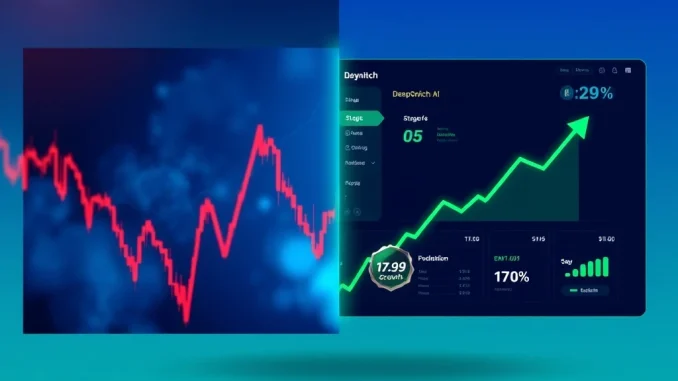
Global Cryptocurrency Markets, April 2025: The Cardano (ADA) network faces a critical technical test as its price encounters significant resistance at the $0.29 level, a development occurring against a backdrop of broader market apprehension. Concurrently, the blockchain ecosystem witnesses a contrasting narrative with the DeepSnitch AI project, which has successfully concluded a $1.66 million presale and entered a rapid-selling ‘Stage 5,’ reportedly generating 170% momentum for its early participants. This divergence highlights the complex and multifaceted nature of current cryptocurrency investment trends, where established assets and emerging technologies can exhibit wildly different trajectories.
Cardano Price Prediction and the $0.29 Resistance Wall
Cardano, a proof-of-stake blockchain platform founded by Charles Hoskinson, has experienced volatile trading conditions throughout the first quarter of 2025. Technical analysts closely monitor the $0.29 price point, which has emerged as a formidable resistance level. A resistance level in trading represents a price point that an asset struggles to surpass due to increased selling pressure. For ADA, breaking through this barrier is viewed by many market observers as essential for establishing a more bullish medium-term trend. The current market sentiment, often measured by the Crypto Fear & Greed Index, has shown signs of shifting toward ‘fear’ or ‘extreme fear’ in recent weeks, contributing to the selling pressure on major cryptocurrencies like ADA and Ethereum (ETH).
Historical context is crucial for understanding this moment. Cardano’s price history shows several key resistance and support levels that have defined its market cycles. The network’s development milestones, such as the rollout of the Alonzo hard fork which introduced smart contract functionality, have historically been catalysts for price movement. However, in the current macro environment, broader factors appear to be exerting more influence. These include:
- Regulatory Developments: Ongoing global discussions about cryptocurrency regulation create uncertainty.
- Macroeconomic Pressures: Interest rate policies and inflation concerns impact risk asset appetites.
- Network Activity: Metrics like daily active addresses, Total Value Locked (TVL) in decentralized applications (dApps), and transaction volume provide fundamental context for ADA’s valuation.
DeepSnitch AI’s Presale Momentum and Interface Strategy
In a stark contrast to the cautious trading in major cryptocurrencies, the presale for DeepSnitch AI has captured significant attention. The project, which focuses on artificial intelligence-driven security and monitoring interfaces for blockchain networks, announced the closure of its funding round, securing $1.66 million. The project’s team described the current phase as a ‘fast-selling Stage 5,’ indicating high demand for its token allocation. The reported 170% gain refers to the increase in the token’s presale price from its initial stage to the final stage, a common mechanism in cryptocurrency project fundraising.
Presale dynamics in the crypto space often follow a specific pattern. Projects release tokens in sequential stages, with the price typically increasing at each stage to reward early participants. A 170% increase from the first to the fifth stage indicates strong initial demand, though it is distinct from post-listing market performance. The reveal of DeepSnitch AI’s user interface is a strategic move common in tech-centric crypto projects. Demonstrating a functional or aesthetically polished interface can build community trust and showcase development progress, which is critical for projects that have not yet launched a mainnet or fully functional product.
Understanding Presale Dynamics and Market Psychology
The simultaneous occurrence of fear in broad markets and enthusiasm for a specific presale is not contradictory but rather illustrative of different investor segments. Established cryptocurrencies like ADA and ETH are held by a wide array of investors, including institutions, and are more sensitive to macroeconomic news. New project presales, however, often attract a dedicated community of early adopters and speculative investors focused on technological narratives and potential high returns, sometimes operating with a shorter time horizon.
It is critical to distinguish between presale price appreciation and secondary market performance. A successful presale does not guarantee success after the token becomes publicly tradable on decentralized or centralized exchanges. Post-listing, the token is subject to market forces, liquidity pressures, and the project’s ability to deliver on its roadmap. The history of cryptocurrency is filled with projects that had booming presales but faltered due to technical failures, lack of adoption, or shifting market conditions.
Comparative Analysis: Established Networks vs. Emerging AI Narratives
The current landscape presents a clear dichotomy. On one side, layer-1 blockchains like Cardano and Ethereum represent foundational infrastructure with proven networks, extensive developer communities, and real-world usage. Their price action is a complex function of technology upgrades, ecosystem growth, and global capital flows. On the other side, AI-integrated blockchain projects represent a powerful and growing narrative within the industry, promising to merge two of the most transformative technologies of the decade.
| Metric | Cardano (ADA) | AI Project Presale Trend (e.g., DeepSnitch AI) |
|---|---|---|
| Primary Driver | Network utility, dApp growth, staking yield | Technological narrative, roadmap promises, community hype |
| Investor Base | Broad (retail, institutional, long-term holders) | Niche (crypto-native, speculative, early adopters) |
| Risk Profile | Moderate to High (relative to traditional assets) | Very High (pre-product, pre-revenue, high volatility expected) |
| Liquidity | High (listed on major exchanges globally) | Low to Nonexistent (pre-listing; depends on future exchange support) |
| Value Proposition | Decentralized computing platform and financial infrastructure | Specialized AI tools for security, data analysis, or automation |
This comparison is not to judge one model as superior but to frame the different risk-return profiles and investment theses they represent. A diversified cryptocurrency portfolio has, in the past, included allocations to both established blue-chip assets and higher-risk, high-potential emerging projects, though the latter requires extensive due diligence.
The Role of AI in Blockchain’s Evolution
The surge of interest in projects like DeepSnitch AI is part of a larger trend. Artificial intelligence has found numerous proposed applications in the Web3 space, including:
- Smart Contract Auditing: AI algorithms that scan code for vulnerabilities before deployment.
- Market Surveillance: Detecting wash trading, pump-and-dump schemes, or other market manipulations on decentralized exchanges.
- On-Chain Analytics: Interpreting vast amounts of blockchain transaction data to identify trends, whale movements, or network health.
- Decentralized AI Models: Training and running machine learning models on decentralized networks, a field separate from security-focused applications.
The long-term success of any AI-blockchain project will depend not on presale momentum, but on its ability to deliver a product that is genuinely useful, secure, and adopted by users or other projects.
Conclusion
The current Cardano price prediction scenario, hinging on the $0.29 resistance level, reflects the cautious and macro-sensitive nature of established cryptocurrency markets. Meanwhile, the 170% presale momentum reported by DeepSnitch AI exemplifies the continued appetite for narrative-driven, high-risk investment within specific corners of the crypto ecosystem. These parallel developments underscore a mature market where different asset classes and project stages coexist, each appealing to distinct investor psychologies and risk tolerances. For observers and participants, the key takeaway is the importance of foundational analysis—whether evaluating the on-chain metrics and development progress of a network like Cardano or scrutinizing the technical whitepaper, team background, and use-case viability of an emerging AI project. The cryptocurrency landscape remains a dynamic interplay of technology, finance, and community, where today’s presale headline is tomorrow’s test of real-world utility.
FAQs
Q1: What does a ‘resistance level’ mean in cryptocurrency trading?
A1: A resistance level is a price point at which an asset, like Cardano (ADA), historically faces significant selling pressure, preventing it from rising further. It acts as a ceiling. Breaking above resistance often requires a strong catalyst or shift in market sentiment and can signal the start of a new upward trend.
Q2: How does a 170% gain in a presale work?
A2: This typically means the price per token in the final stage (e.g., Stage 5) of the presale is 170% higher than the price in the first stage. Early investors buy at a lower price, and the price increases in each subsequent stage to incentivize early participation. This gain is locked until tokens are distributed and tradeable on public markets, where the price is determined by supply and demand.
Q3: Is presale performance an indicator of a project’s future success?
A3: Not necessarily. While strong presale demand can indicate community interest and provide development funding, it is not a reliable predictor of long-term success. The ultimate value depends on the team’s execution, product delivery, market adoption, and competition. Many projects with successful presales have failed post-launch.
Q4: Why might Cardano and Ethereum be struggling while a new AI project’s presale thrives?
A4: They cater to different investors and react to different forces. Major cryptocurrencies like ADA and ETH are influenced by macroeconomic factors, regulatory news, and broad market sentiment. A specific project’s presale is driven by its niche community, marketing, and the perceived novelty of its technology (like AI), often isolated from broader market trends in the short term.
Q5: What should investors research before participating in a cryptocurrency presale?
A5: Critical due diligence includes examining the project’s whitepaper (technical plan), the experience and credibility of the development team, the tokenomics (token supply, distribution, and utility), the problem the project aims to solve, its competitors, and whether a smart contract audit has been conducted. Understanding the lock-up periods and vesting schedules for presale tokens is also essential.