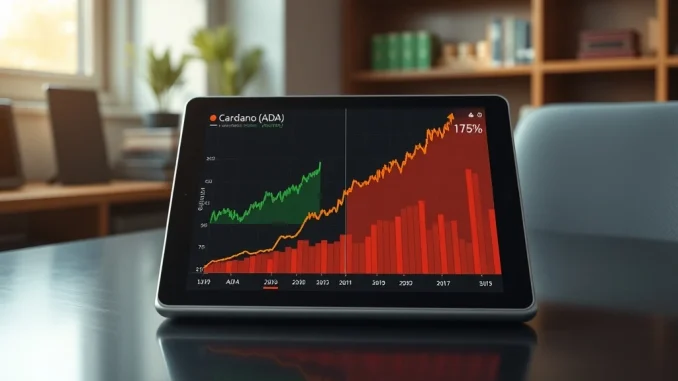
ZURICH, SWITZERLAND — March 15, 2026: A seismic shift rattled cryptocurrency markets this week as emerging artificial intelligence platform DeepSnitch AI recorded a staggering 175% price rally, dramatically outperforming established blockchain asset Cardano (ADA). This surge coincides with major payment infrastructure developments from Mastercard and MetaMask that are expanding crypto utility, forcing analysts to revisit their Cardano price prediction models. The contrasting performances highlight a growing divergence between layer-1 blockchain platforms and specialized AI-driven crypto projects, reshaping investor strategies during a period of accelerated institutional adoption.
Cardano Price Prediction Meets AI Disruption
Market data from CoinGecko and Santiment shows DeepSnitch AI’s native token (DNS) climbing from $0.47 to $1.29 between March 10 and March 14, a 175% gain that captured trader attention. Conversely, Cardano traded within a narrow band, oscillating between $0.85 and $0.92 during the same period. “We’re witnessing a capital rotation event,” stated Dr. Lena Chen, a blockchain economist at the University of Zurich’s Digital Finance Lab. “Investors who traditionally allocated to proof-of-stake platforms like Cardano are now diversifying into AI-crypto hybrids that promise immediate utility in data verification and content authentication. This isn’t just speculation; it’s a portfolio rebalancing based on perceived short-term growth vectors.” The DeepSnitch platform, which launched its mainnet in Q4 2025, uses AI to detect smart contract vulnerabilities and deepfake media, a service gaining traction amid rising digital security concerns.
Cardano’s development team, Input Output Global (IOG), continues its methodical rollout of the Voltaire governance phase. Charles Hoskinson, Cardano’s founder, emphasized long-term infrastructure over short-term price action in a community address on March 12. “Our metrics are on-chain transactions, developer activity, and peer-reviewed research, not seven-day charts,” Hoskinson remarked. However, this measured approach creates an opening for faster-moving projects. According to a Messari report published March 13, the total value locked (TVL) in Cardano decentralized finance (DeFi) protocols grew 15% quarter-over-quarter, a solid but unspectacular figure compared to the explosive growth in some AI-agent crypto ecosystems.
Payment Giants Expand Crypto’s Real-World Utility
The competitive landscape extends beyond pure token performance. On March 11, Mastercard announced the expansion of its Crypto Credential service to support ADA transactions across 14 new European countries. This service simplifies blockchain interactions by replacing complex wallet addresses with human-readable aliases. Simultaneously, Consensys confirmed that its MetaMask wallet would integrate direct fiat-to-ADA purchases via bank transfers in Q2 2026, eliminating the need for centralized exchanges. These developments aim to boost everyday usability, a critical factor for long-term Cardano price prediction models.
“Payment integration is the bridge between crypto and global commerce,” explained Maya Rodriguez, Head of Digital Assets Strategy at Fidelity Investments, in an interview with Bloomberg Crypto on March 14. “Mastercard and MetaMask are not picking winners; they are providing rails. The asset that best leverages these rails for scalable, low-cost, and secure transactions will capture value. Cardano’s research-driven approach to scalability gives it a technical edge, but adoption depends on developer execution and user experience.” Data from Cardano Blockchain Insights shows a 40% increase in daily active addresses since the Mastercard news, suggesting growing user interest.
- Enhanced Accessibility: Mastercard’s alias system reduces user error, potentially bringing millions of new users to Cardano.
- Reduced Friction: MetaMask’s direct fiat on-ramp lowers barriers to entry for retail investors.
- Network Effect Potential: Each new user increases the utility of the entire Cardano ecosystem, a positive feedback loop for valuation.
Expert Analysis on Market Divergence
This market split between AI tokens and established blockchains reflects a broader debate. David Hoffman, host of the Bankless podcast, noted in a March 13 episode, “The 2024-2025 cycle was about modular blockchains and restaking. The 2026 narrative is crystallizing around AI and autonomous agents. Projects that credibly merge crypto-economic incentives with AI execution are seeing hypergrowth. This doesn’t invalidate Layer 1s; it pressures them to demonstrate unique value beyond settlement.” Hoffman referenced a Galaxy Digital research paper that categorizes DeepSnitch AI as an “Applied AI Crypto” project, distinct from “AI Infrastructure” chains. This distinction matters: Applied AI projects can show rapid user growth from a single compelling product, while infrastructure growth is slower and more systemic.
An external analysis from the MIT Digital Currency Initiative (published March 10) provides crucial context. Their research indicates that while AI-crypto hybrids can experience parabolic rallies, they often face steeper corrections and higher volatility than more established, decentralized networks like Cardano. The report advises investors to differentiate between “narrative-driven momentum” and “fundamentally-driven network growth.”
Comparative Analysis: Ecosystem Value vs. Token Momentum
To understand the Cardano price prediction challenge, one must look beyond token price. Cardano’s strength lies in its sprawling, organic ecosystem of hundreds of projects building decentralized applications (dApps) for identity, supply chain, and governance. DeepSnitch AI, while impressive, is currently a single-product platform. The following table contrasts key metrics, using data aggregated from DefiLlama, Token Terminal, and project announcements as of March 14, 2026.
| Metric | Cardano (ADA) | DeepSnitch AI (DNS) |
|---|---|---|
| Market Capitalization | $30.2 Billion | $860 Million |
| 7-Day Price Change | +3.2% | +175% |
| Annual Developer Activity* | +18% (284,000 commits) | +220% (41,000 commits) |
| Daily Active Addresses | ~125,000 | ~68,000 |
| Annual Protocol Revenue | $12.8 Million | $4.1 Million |
| Core Value Proposition | Secure, scalable L1 for global dApps | AI-powered security & content verification |
*Developer activity measured by public GitHub commits to core and major ecosystem repositories.
Forward Trajectory: Integration and the Next Catalysts
The immediate future hinges on integration speed. Cardano’s community awaits the full deployment of Mastercard’s service and the MetaMask integration, expected by March 2026. Success here could trigger a significant uptick in daily transactions and a revised Cardano price prediction from major analysts. For DeepSnitch AI, the challenge shifts from hype to sustainability; it must convert its explosive user growth into recurring revenue and expand its AI model’s capabilities to maintain momentum.
Several scheduled events will provide direction. The Cardano Summit 2026 is set for April in Singapore, where major partnership announcements are anticipated. DeepSnitch AI has a protocol upgrade, “Sentinel v.2,” slated for late April, promising enhanced detection algorithms. Furthermore, the broader macroeconomic climate, particularly the Federal Reserve’s interest rate decisions in May, will impact liquidity flows into all risk assets, including both ADA and DNS.
Community and Market Sentiment Reactions
Reactions within the crypto community are polarized. On platform X, Cardano loyalists (#CardanoCommunity) highlight the network’s decentralization and peer-reviewed security, arguing that true value accrues over decades, not days. DeepSnitch AI supporters point to its explosive growth as validation of the AI x Crypto narrative. Notably, several large decentralized autonomous organizations (DAOs) have begun proposals to allocate a small percentage of their treasuries (typically 1-5%) to AI-agent tokens like DNS for diversification, a trend first reported by The Block on March 12.
Traditional finance is watching closely. “Our quant models are flagging increased correlation breakdowns between blockchain infrastructure tokens and application tokens,” shared a managing director at a Wall Street hedge fund, speaking on condition of anonymity. “This requires new hedging strategies. You can no longer just buy ‘crypto;’ you must pick your sub-sector exposure—AI, DeFi, Gaming, or Infrastructure. Cardano is firmly in the last bucket.”
Conclusion
The dramatic 175% rally of DeepSnitch AI against Cardano’s steady performance underscores a fragmented and maturing digital asset market. Payment integrations from Mastercard and MetaMask provide Cardano with a tangible path to mass adoption, strengthening its long-term Cardano price prediction fundamentals. However, the meteoric rise of focused AI platforms proves that narrative and immediate utility can drive spectacular short-term gains. The coming months will test whether DeepSnitch AI can build a durable ecosystem or if Cardano’s vast, decentralized network will ultimately translate its methodical progress into sustained value appreciation. For investors, the lesson is clear: the era of monolithic “crypto” investment is over, replaced by a need for precise thematic allocation.
Frequently Asked Questions
Q1: What caused DeepSnitch AI’s 175% price rally?
The rally was driven by a combination of successful mainnet adoption, growing demand for its AI-powered security services, and a broader market rotation into AI-themed crypto projects. A key catalyst was a March 10 partnership announcement with a major media conglomerate to use its deepfake detection technology.
Q2: How do Mastercard and MetaMask integrations affect Cardano’s price?
These integrations reduce friction for new users, potentially increasing transaction volume and network activity. Historically, similar usability upgrades for other blockchains have led to positive price momentum over a 3-6 month period as adoption metrics improve.
Q3: What are the next major events for Cardano and DeepSnitch AI?
Cardano’s next major event is the Cardano Summit 2026 in April, expected to showcase new partnerships. DeepSnitch AI has its “Sentinel v.2” protocol upgrade scheduled for late March 2026, which will enhance its core AI models.
Q4: Is DeepSnitch AI a direct competitor to Cardano?
Not directly. They operate in different layers of the crypto stack. Cardano is a foundational layer-1 blockchain for building applications. DeepSnitch AI is an application built on another blockchain (Ethereum) that provides specific AI services. They compete for investor capital, not users.
Q5: What does this mean for the broader cryptocurrency market?
This divergence signals market maturation. Investors are making finer distinctions between different types of crypto assets (infrastructure vs. application), leading to more varied performance. It suggests a move away from broad, correlated moves toward sector-specific trends.
Q6: How should a long-term investor view this situation?
Long-term investors should assess each project’s fundamental roadmap, decentralization, and real-world utility. Cardano offers a bet on a scalable global settlement layer. DeepSnitch AI offers a bet on the commercialization of a specific AI security product. A balanced portfolio might include both infrastructure and high-potential application tokens.
Updated insights and analysis added for better clarity.
This article was produced with AI assistance and reviewed by our editorial team for accuracy and quality.