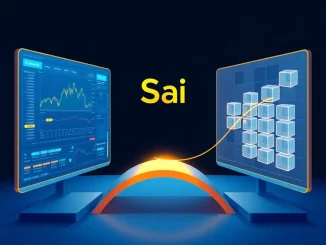
In a significant development for institutional blockchain adoption, the Canton Network has officially integrated Chainlink’s oracle infrastructure and data streams to power regulated real-world asset (RWA) tokenization. Announced on March 26, 2026, from Zug, Switzerland, this technical integration brings Chainlink’s data standard live on Canton’s privacy-enabled blockchain. Consequently, the network now supports real-time market data feeds, Net Asset Value (NAV) and Assets Under Management (AUM) reporting, and Proof of Reserve mechanisms. This move directly addresses a core requirement for large financial institutions: reliable, tamper-proof external data for compliant asset tokenization.
Canton Network and Chainlink Forge Institutional-Grade Data Pipeline
The integration represents a pivotal technical milestone. Chainlink’s decentralized oracle network now serves as the primary data conduit for applications built on the Canton Network. This provides a standardized method for smart contracts to access verified off-chain information. For instance, a tokenized private equity fund on Canton can now automatically pull its daily NAV from a trusted data provider via Chainlink. Similarly, a tokenized real estate platform can verify property valuations and rental income streams in real time. Sergey Nazarov, Co-Founder of Chainlink, stated in the official release that this provides “the critical infrastructure required for institutions to tokenize trillions in assets with confidence.” The deployment follows a six-month testing phase involving several global banks within the Canton consortium.
This development did not occur in a vacuum. The Canton Network, launched in 2023 by Digital Asset and supported by major firms like Goldman Sachs and Deloitte, was designed from inception for regulated financial markets. Its core innovation is “synchronized privacy,” allowing subsets of participants to transact privately while ensuring global consensus. However, a persistent challenge remained: how to bring trusted, real-world data into these private subnets without compromising security or compliance. The Chainlink integration, therefore, solves a fundamental architectural gap. It follows a broader industry trend where oracle solutions have become the linchpin for advanced DeFi and institutional blockchain applications over the past three years.
Impact on Real-World Asset Tokenization and Institutional Adoption
The immediate impact centers on accelerating and de-risking the tokenization of regulated assets. Financial institutions exploring RWAs have consistently cited data reliability and auditability as top concerns. By embedding Chainlink, Canton provides a ready-made solution. This lowers the technical and operational barrier to entry. Analysts at Boston Consulting Group project the tokenized asset market could reach $16 trillion by 2030, but growth depends heavily on institutional participation. The Canton-Chainlink link directly targets this participant group.
- Enhanced Compliance and Audit Trails: Every data point fed via Chainlink creates an immutable, timestamped record on-chain. This provides regulators and auditors with a transparent, verifiable history of the data used in financial decisions and valuations.
- Operational Efficiency for Fund Management: Automated NAV feeds eliminate manual data entry and reconciliation processes for fund administrators. This reduces operational risk and can cut reporting timelines from days to minutes.
- New Product Feasibility: Complex financial products, like dynamically collateralized loans or securitized revenue streams, become technically feasible. Smart contracts can now automatically adjust terms based on real-time oracle data about underlying asset performance.
Expert Analysis on the Strategic Integration
Catherine Wood, CEO of ARK Invest, commented on the strategic implications, noting, “The fusion of Canton’s privacy-focused architecture with Chainlink’s robust data layer creates a powerful substrate for the next generation of financial markets. It’s not just about moving existing assets on-chain; it’s about enabling entirely new asset classes and financial relationships that were previously impractical.” This perspective is echoed in a recent Bank for International Settlements (BIS) report on tokenization, which highlights secure data oracles as a “critical component” for bridging traditional finance and blockchain systems. The report specifically references the need for standards akin to those Chainlink provides. Furthermore, developers within the Canton ecosystem confirm that the integration simplifies building. They no longer need to source and secure their own data feeds, a process that is both costly and fraught with legal and technical complexity.
Broader Context: The Evolving Landscape of Financial Infrastructure
This announcement places Canton in direct competition with other institutional-focused blockchain networks like JPMorgan’s Onyx, Broadridge’s DLR, and the newly formed Regulated Liability Network (RLN) initiative. Each platform is vying to become the dominant settlement layer for tokenized assets. The key differentiator for Canton is its open, interoperable network model combined with synchronized privacy. The Chainlink integration adds a crucial data layer that some competitors are still developing internally. The table below compares key features relevant to RWA tokenization across major institutional platforms.
| Platform | Primary Focus | Data Oracle Solution | Notable Feature |
|---|---|---|---|
| Canton Network | Interoperable Capital Markets | Integrated Chainlink | Synchronized Privacy |
| Onyx (JPMorgan) | Payment & Settlement | Proprietary | Bank-Led Liquidity |
| DLR (Broadridge) | Repo & Money Markets | Third-Party Partnerships | High-Volume Throughput |
| RLN Consortium | Regulated Digital Money | In Development | Central Bank Collaboration |
What Happens Next: Pilot Programs and Regulatory Engagement
The immediate next phase involves scaling live pilot programs. Several Canton participants, including BNP Paribas and Deutsche Börse, have announced plans to launch pilot tokenized funds and structured products using the new oracle capabilities in Q2 2026. These pilots will serve as concrete test cases for regulators, particularly the SEC and ESMA, to evaluate the compliance and risk management frameworks of oracle-dependent smart contracts. Simultaneously, the Canton and Chainlink teams plan joint workshops with regulatory bodies to demonstrate the auditability and control features of the data feeds. The success metric will be the volume and complexity of assets tokenized on the network by year-end, with an industry target of surpassing $50 billion in tokenized RWAs on Canton utilizing Chainlink data.
Market and Competitor Reactions to the News
Reaction from the broader digital asset market has been cautiously optimistic. Competitors acknowledge the move as validation of the oracle-centric approach. However, some question whether a single oracle provider creates a central point of failure or dependency. Chainlink’s team counters this by emphasizing the decentralized nature of its node network and its multi-year track record of reliability. Traditional asset managers not yet part of the Canton consortium are reportedly accelerating their own blockchain evaluations in response. The share prices of publicly traded companies involved in both projects saw modest gains following the announcement, indicating investor confidence in the partnership’s potential to capture a significant share of the burgeoning RWA market.
Conclusion
The integration of Chainlink oracles and data streams into the Canton Network marks a decisive step toward mature, production-ready real-world asset tokenization. By solving the critical data problem, it removes a major obstacle for institutional adoption. The move validates the growing consensus that blockchain’s value in finance hinges not just on ledger technology, but on secure bridges to the existing world of data and assets. Consequently, the focus now shifts to execution. The success of upcoming pilot programs will determine whether this technical integration translates into tangible financial innovation and the movement of significant asset volumes on-chain. Observers should monitor regulatory feedback and the growth of total value locked (TVL) in Canton-based RWA applications throughout 2026.
Frequently Asked Questions
Q1: What exactly does the Canton and Chainlink integration do?
It connects the Canton Network’s blockchain, designed for private institutional transactions, to Chainlink’s decentralized oracle network. This allows smart contracts on Canton to securely and reliably access real-world data like market prices, fund NAVs, and proof of reserves, which is essential for tokenizing real-world assets like bonds or real estate.
Q2: Why is this important for traditional finance?
Traditional financial institutions require high levels of data integrity, audit trails, and compliance. This integration provides a standardized, tamper-proof way to bring verified external data onto a private blockchain, making it feasible for banks and asset managers to tokenize assets while meeting regulatory standards.
Q3: What are the immediate next steps following this announcement?
Participating institutions like BNP Paribas will launch pilot programs in Q2 2026 to test tokenized funds and products using the new data feeds. Concurrently, the teams will engage with regulators like the SEC to demonstrate the compliance features of the system.
Q4: How does this affect the average investor or consumer?
In the near term, the direct impact is minimal. However, in the longer term, successful institutional tokenization could lead to more accessible, liquid, and efficient markets for assets like private equity, real estate, and commodities, potentially offering new investment opportunities.
Q5: How does Canton’s approach compare to other blockchains like Ethereum for RWAs?
Canton is specifically built for privacy and interoperability between regulated institutions, whereas public blockchains like Ethereum are more open and transparent. Canton’s integration with Chainlink is tailored for the private, permissioned subnets that institutions require, focusing on compliance over public accessibility.
Q6: Does relying on Chainlink create a single point of failure?
Chainlink operates a decentralized network of independent node operators. The system is designed so that no single node or data source controls the feed. The reliability of this model has been proven over several years in high-value DeFi applications, though institutions will conduct their own due diligence during pilots.
Updated insights and analysis added for better clarity.
This article was produced with AI assistance and reviewed by our editorial team for accuracy and quality.