
A new study from the California Institute of Technology suggests the timeline for functional quantum computers may have just accelerated dramatically. Researchers theorize that a key breakthrough in error correction could make these powerful machines a reality by 2030, requiring far fewer components than anyone predicted.
Caltech’s Quantum Leap: From Millions to Thousands of Qubits
For years, a major roadblock has stood in the way of practical quantum computers: error correction. Quantum bits, or qubits, are notoriously fragile. Environmental noise can cause computational errors, rendering results useless. The conventional wisdom held that overcoming this would require building a machine with millions of physical qubits to create a smaller number of stable, “logical” qubits.
That assumption has now been challenged. According to research from Caltech and its linked startup, Oratomic, a fault-tolerant quantum computer might need only 10,000 to 20,000 physical qubits. This figure is orders of magnitude lower than previous estimates. “The need for fewer qubits means that quantum computers could, in theory, be operational by the end of the decade,” Caltech stated in its announcement.
This suggests a fundamental shift in resource planning. The implication is that the engineering challenge, while still immense, may be more manageable than the scientific community believed.
Also read: Bitcoin's Drawdown Shows Remarkable Stability in 2026 Cycle, Fidelity Analysis Reveals
The Neutral-Atom Architecture: Moving Atoms with Light
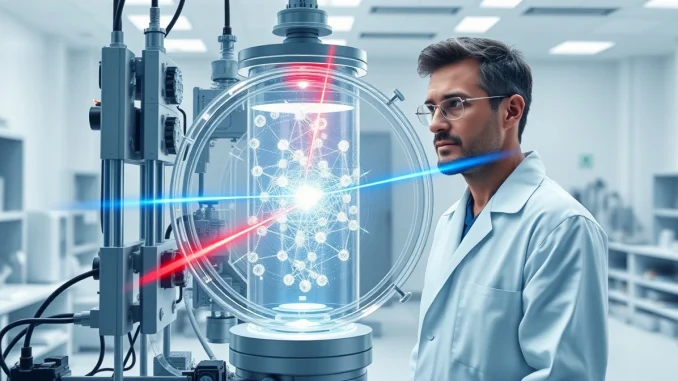
The theoretical innovation centers on a proposed architecture using “neutral-atom” systems. In this approach, individual atoms are suspended and manipulated using highly focused lasers known as “optical tweezers.” This method allows physicists to physically move atoms and connect them over large distances within a processor array.
“Unlike other quantum computing platforms, neutral atom qubits can be directly connected over large distances,” said Manuel Endres, a Caltech professor of physics. “Optical tweezers can shuttle one atom to the other end of the array and directly entangle it with another atom.”
This physical mobility is key to the new error-correction scheme. It allows for a more efficient arrangement and connection of qubits, drastically reducing overhead. The researchers claim this new tech enables each stable logical qubit to be encoded with as few as five physical qubits. Conventional methods might require a thousand.
“It’s actually very surprising how well this works,” Endres said. “It’s what we call ultra-efficient error correction.”
Expert Insight: A Shift in Optimism
The research has altered the outlook of leading figures in the field. John Preskill, a theoretical physicist at Caltech, commented on the progress. “We are developing new architectures for neutral-atom quantum processors that dramatically reduce the resource estimates for fault-tolerant quantum computing,” Preskill said. “This progress makes me optimistic that broadly useful quantum computing will soon be a reality.”
Industry watchers note that Preskill’s optimism carries significant weight. He coined the term “NISQ” (Noisy Intermediate-Scale Quantum) to describe the current generation of quantum devices. His shift in perspective could signal a belief that the field is moving beyond the NISQ era faster than anticipated.
The Race for a Fault-Tolerant Machine
The collaboration between Caltech and Oratomic is formalized through Caltech’s Advanced Quantum Computing Mission. Their stated goal is clear: to build the world’s first utility-scale, fault-tolerant quantum computer. This research provides a potential blueprint.
What this means for investors and the tech industry is a potential compression of the development timeline. Major companies like IBM, Google, and Microsoft are pursuing different quantum architectures. Caltech’s neutral-atom approach now presents a potentially faster route to fault tolerance, which could reshape competitive dynamics.
However, translating theory into a working machine remains a colossal task. The engineering required to reliably control 10,000 atoms with laser tweezers is non-trivial. Scaling manufacturing and maintaining ultra-cold, stable environments are persistent challenges.
Immediate Implications for Cryptography and Security
This theoretical advance arrives amid growing urgency about quantum threats to encryption. Just before this Caltech announcement, Google released a paper analyzing quantum risks to cryptocurrencies like Bitcoin. Google researchers argued that quantum computers could break current cryptographic safeguards faster than previously modeled.
Their warning was stark. Google urged a proactive transition to post-quantum cryptography (PQC) standards. The company has set its own internal deadline to migrate its systems by 2029. The message from both academic and corporate research is consistent: the quantum era’s security challenges are approaching.
The Caltech study adds concrete evidence to that timeline. If fault-tolerant machines with tens of thousands of qubits are feasible by 2030, then the window for updating global digital infrastructure is narrow. This could signal a rapid increase in investment and regulatory focus on PQC in the coming years.
Conclusion
The Caltech research presents a compelling case that quantum computers could be ready by 2030. By proposing an ultra-efficient error-correction method using neutral atoms and optical tweezers, the team has potentially slashed the resource requirements for a functional machine. While significant engineering hurdles remain, this theoretical breakthrough alters the strategic space for technology companies, cybersecurity experts, and policymakers. The race to build and secure systems for the quantum age just entered a new, more urgent phase.
FAQs
Q1: What is the main finding of the Caltech quantum computing study?
The core finding is that a fault-tolerant quantum computer might require only 10,000 to 20,000 physical qubits using a new neutral-atom architecture, not millions. This could make a functional machine feasible by 2030.
Q2: What are “optical tweezers” in quantum computing?
Optical tweezers are highly focused laser beams used to trap, move, and manipulate individual neutral atoms. This allows researchers to position qubits precisely and create connections between them over distance.
Q3: Why is error correction such a big problem for quantum computers?
Qubits are extremely sensitive to interference from their environment, causing calculation errors. Effective error correction requires using many imperfect physical qubits to create one stable logical qubit, which was thought to demand millions of components.
Q4: How does this research affect cryptocurrency security?
It supports warnings that quantum computers capable of breaking current encryption could arrive sooner. This increases pressure to adopt new, quantum-resistant cryptographic standards before such machines are built.
Q5: What is Oratomic’s role in this research?
Oratomic is a startup linked to Caltech working in close collaboration with the university’s Advanced Quantum Computing Mission. The partnership aims to translate this theoretical architecture into a practical, fault-tolerant quantum computer.

This article was produced with AI assistance and reviewed by our editorial team for accuracy and quality.




Be the first to comment