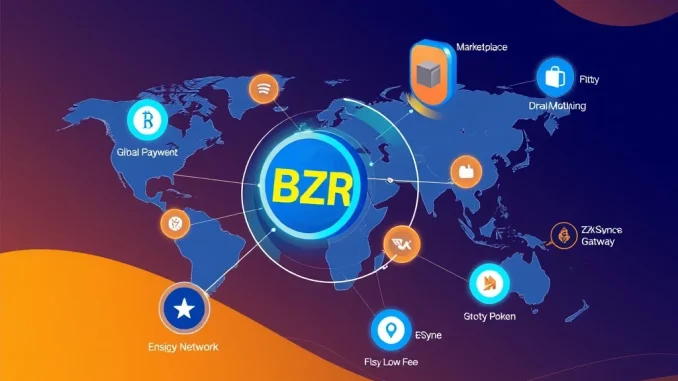
Global, March 2025: The landscape of digital commerce is undergoing a significant shift with the official launch of $BZR, the native token of the Bazaar platform, on the zkSync Era network. This strategic deployment marks a pivotal moment for Web3 commerce, aiming to directly address long-standing barriers to cryptocurrency adoption for everyday payments: high transaction costs and network congestion. By leveraging zkSync’s Layer 2 scaling technology, Bazaar intends to enable faster, more secure, and substantially cheaper crypto transactions for merchants and consumers worldwide.
$BZR and zkSync: A Technical Foundation for Efficient Commerce
The integration of $BZR with zkSync represents a deliberate technical choice within the broader Ethereum ecosystem. zkSync Era is a zero-knowledge rollup, a type of Layer 2 scaling solution. It operates by bundling, or “rolling up,” hundreds of transactions off the main Ethereum chain, processing them, and then submitting a single cryptographic proof—a validity proof—back to Ethereum. This process drastically reduces the data load and associated gas fees while inheriting the security guarantees of the Ethereum mainnet.
For the $BZR token, this means transactions that would typically cost several dollars and take minutes on Ethereum mainnet can now be executed for a fraction of a cent in mere seconds. This technical underpinning is not merely an upgrade; it is a prerequisite for practical, micro-transaction-based commerce. Historical context is important here. Previous attempts to integrate crypto payments for retail often stumbled on these very issues of cost and speed, limiting use to high-value settlements. The move to zkSync directly targets this pain point with proven scaling technology.
Streamlining Global Crypto Payments and Merchant Adoption
The primary implication of this launch is the potential to streamline crypto payment processes on a global scale. For merchants operating within the Bazaar ecosystem or integrating its payment rails, the low-fee environment changes the economic calculus. Traditionally, payment processors charge fees ranging from 1.5% to 3.5% per transaction. While crypto promised lower fees, network volatility often negated that benefit.
- Predictable Costs: Sub-cent fees on zkSync provide merchants with predictable, low-cost payment settlement.
- Faster Settlement: Near-instant finality improves cash flow compared to traditional banking delays or even other blockchain networks.
- Global Access: It lowers the barrier for merchants in regions with underdeveloped financial infrastructure to access global digital commerce.
This operational efficiency is critical for strengthening Web3 commerce. It shifts the narrative from cryptocurrency as a speculative asset to a functional utility for value exchange, aligning with the original vision of digital cash systems proposed decades ago.
The Broader Impact on Web3 Commerce Infrastructure
Bazaar’s move is part of a larger, observable trend where decentralized applications (dApps) are migrating from Ethereum mainnet to Layer 2 solutions to achieve scalability. The success of platforms like zkSync, Arbitrum, and Optimism has created a new playground for developers focused on user experience. For Web3 commerce, this means applications can now be built that rival the speed and cost of Web2 payment giants like PayPal or Stripe, but with the added benefits of censorship resistance and user custody of assets.
The consequence is a more robust and competitive infrastructure. As more projects like Bazaar choose zkSync, it increases the network effect, liquidity, and developer activity on that chain, creating a virtuous cycle. This competition among Layer 2 solutions ultimately benefits end-users through continuous innovation and lower costs. The timeline for this shift has accelerated throughout 2024, with 2025 poised to be the year where Layer 2 transaction volumes consistently surpass those of their parent chains for specific use cases like payments and decentralized finance (DeFi).
Security and Trust in a Layer 2 Environment
A paramount consideration for any financial system is security. A common misconception is that moving to a Layer 2 involves a security trade-off. In the case of zkSync and other zero-knowledge rollups, security is mathematically enforced. The validity proofs ensure that the state transitions posted to Ethereum are correct. If validators attempt to submit fraudulent data, the proof will fail, and the network will reject it.
For $BZR holders and users, this means the substantial security of Ethereum—secured by one of the world’s largest decentralized networks of validators—underpins their transactions. This architecture provides a trustless environment where users do not need to rely on the honesty of a single operator but on cryptographic truth. This element of trustworthiness is fundamental for building authoritative financial systems and is a key differentiator from traditional, permissioned payment networks.
Conclusion
The launch of $BZR on the zkSync network is a significant, experience-driven development in the evolution of cryptocurrency payments. It directly tackles the twin challenges of high fees and slow speeds that have hindered the adoption of crypto for daily commerce. By providing a framework for faster, secure, and low-fee crypto payments, Bazaar is contributing to the strengthening of a more accessible and efficient global Web3 commerce infrastructure. This move reflects a mature phase in blockchain development, where the focus shifts from theoretical potential to solving practical, real-world economic problems for merchants and consumers alike.
FAQs
Q1: What is zkSync, and why did Bazaar choose it for $BZR?
zkSync Era is a Layer 2 scaling solution for Ethereum that uses zero-knowledge rollup technology. Bazaar chose it to enable faster transaction finality and drastically reduce gas fees for $BZR payments, making micro-transactions and everyday commerce economically viable.
Q2: How do lower fees on zkSync actually benefit a merchant?
Lower, predictable transaction fees (often fractions of a cent) increase profit margins for merchants compared to traditional credit card processing fees. They also enable new business models, like pay-per-second or micro-donations, which were previously cost-prohibitive on-chain.
Q3: Are transactions on zkSync as secure as on Ethereum mainnet?
Yes, through the use of cryptographic validity proofs. zkSync batches transactions and posts a single proof to Ethereum. This proof verifies the integrity of all transactions in the batch, meaning security is ultimately anchored by Ethereum’s decentralized consensus.
Q4: What is Web3 commerce, and how does this launch strengthen it?
Web3 commerce refers to decentralized marketplaces and payment systems where users control their assets and identity. Low-fee, fast payments are foundational infrastructure. By solving the cost and speed issue, $BZR on zkSync makes building and using practical Web3 commerce applications more feasible.
Q5: Can users withdraw their $BZR from zkSync back to Ethereum mainnet?
Yes. A core function of Layer 2 networks like zkSync is a secure withdrawal process back to Layer 1 (Ethereum). Users can initiate a withdrawal, which is processed after a standard challenge period, moving their $BZR tokens from the zkSync state back to their Ethereum wallet.
Updated insights and analysis added for better clarity.
This article was produced with AI assistance and reviewed by our editorial team for accuracy and quality.