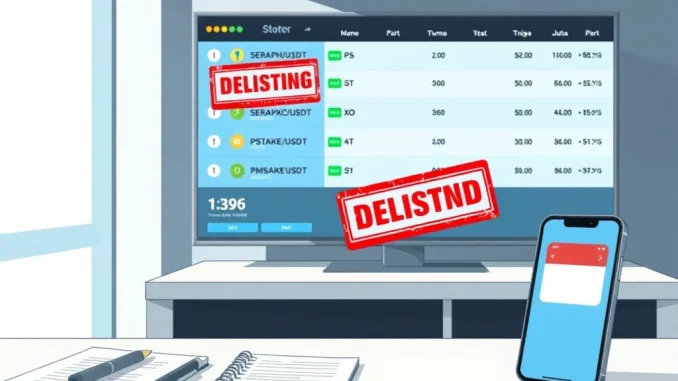
Singapore, January 2025: Major cryptocurrency exchange Bybit has announced a significant delisting action, setting a critical deadline for traders. The platform will remove the SERAPH/USDT, XO/USDT, PSTAKE/USDT, and MASA/USDT spot trading pairs from its marketplace. This move, scheduled for 8:00 a.m. UTC on February 3, requires immediate attention from users holding these assets. Delistings are a standard part of exchange operations but carry important implications for liquidity, asset management, and market perception. We provide a comprehensive, factual breakdown of this announcement, its context, and the necessary steps for affected users.
Bybit Delists Four Spot Trading Pairs: The Official Announcement
Bybit issued a formal notice to its user base regarding the removal of four specific trading pairs. The exchange will halt all spot trading for SERAPH/USDT, XO/USDT, PSTAKE/USDT, and MASA/USDT precisely at 8:00 a.m. UTC on Monday, February 3. Following this time, users will no longer be able to place new buy or sell orders for these pairs on the Bybit spot market. The announcement is part of Bybit’s routine review process, where the exchange assesses listed digital assets against a set of continued listing criteria. Exchanges regularly evaluate trading volume, liquidity depth, project development activity, and network security to ensure a safe and efficient trading environment for all clients.
This process is not unique to Bybit. Major global exchanges like Binance, Coinbase, and Kraken conduct similar periodic reviews. The decision to delist often follows a period of declining market activity or concerns regarding a project’s long-term viability. For traders, the immediate consequence is the loss of a primary trading venue for these specific asset pairs on one of the world’s leading platforms. Consequently, users must manage their positions before the deadline to avoid complications.
Understanding the Delisted Assets: SERAPH, XO, PSTAKE, and MASA
To grasp the scope of this delisting, a brief overview of each affected project is essential. Each token represents a distinct segment of the broader cryptocurrency and blockchain ecosystem.
- SERAPH (SERAPH): SERAPH is the in-game currency and governance token for the Seraph meta-universe, a blockchain-based gaming and virtual world project. It facilitates transactions, rewards, and governance within its digital ecosystem.
- XO (XO): XO is the utility token for the XOXNO platform, a prominent NFT marketplace and aggregator on the MultiversX (formerly Elrond) blockchain. It is used for trading fees, staking, and platform rewards.
- pSTAKE (PSTAKE): pSTAKE is a liquid staking protocol that allows users to stake assets like ATOM, BNB, and others while receiving a liquid staked representation (stkASSET) that can be used in DeFi. It aims to unlock liquidity for staked assets.
- MASA (MASA): MASA is the native token of the Masa Network, a decentralized protocol for personal data. It incentivizes users to share their anonymized data and powers transactions within its data marketplace.
The common thread among these assets is their focus on niche applications within crypto—gaming, NFTs, liquid staking, and decentralized data. Their delisting from a major spot market does not inherently reflect on the technical merit of each project but often correlates with insufficient trading volume or liquidity on the Bybit platform specifically.
The Standard Exchange Delisting Process and Timeline
Bybit’s delisting procedure follows a well-defined timeline designed to give users adequate warning. The announcement serves as the first official step. Between the announcement date and the delisting time, trading continues normally. However, users are strongly advised to close any open spot orders and withdraw the tokens if desired. After the February 3 deadline, all pending spot orders for these pairs will be automatically canceled by the system.
Critically, delisting a spot trading pair does not automatically mean Bybit will disable deposits and withdrawals for the underlying token. The exchange typically maintains token wallets for a separate period, allowing users to withdraw their assets to a private wallet or another exchange. Users must monitor subsequent Bybit announcements for the specific deposit and withdrawal closure dates for SERAPH, XO, PSTAKE, and MASA tokens. Failing to withdraw before that final deadline could result in assets being stranded on the closed Bybit wallet, requiring a lengthy and complex customer support process to recover.
Immediate Actions and Consequences for Traders
For any user holding SERAPH, XO, PSTAKE, or MASA on Bybit, taking prompt action is paramount. The primary risk is loss of liquidity. Once the pairs are delisted, converting these tokens directly to USDT or another cryptocurrency on Bybit becomes impossible. Traders have three main options before the deadline:
- Sell the Tokens: Execute a market or limit order to exchange the tokens for USDT on the Bybit spot market before trading ceases.
- Hold and Withdraw: If believing in the long-term project, users can withdraw the tokens to a compatible self-custody wallet (like MetaMask or a project-specific wallet) for safekeeping or future use on other platforms.
- Transfer to Another Exchange: Research and deposit the tokens to another cryptocurrency exchange that still lists the trading pair, then continue trading there.
Each option carries its own considerations, including transaction fees, price slippage, and the availability of alternative markets. The delisting event itself can often cause increased volatility or selling pressure in the final days of trading as users exit positions. Therefore, monitoring the market closely in the lead-up to February 3 is a prudent strategy.
Broader Market Context and Exchange Governance
This delisting event highlights the dynamic and regulated nature of centralized cryptocurrency exchanges. Platforms like Bybit balance providing access to innovative assets with maintaining market integrity and protecting users. Listing and delisting criteria are central to this balance. Common metrics include:
- Sustained low trading volume and liquidity.
- Lack of development progress or commitment from the project team.
- Responsiveness to the exchange’s due diligence requests.
- Evidence of fraudulent conduct or security vulnerabilities.
- Overall network stability and security of the underlying blockchain.
By conducting these reviews transparently and providing advance notice, exchanges demonstrate a commitment to operational excellence. For the cryptocurrency industry, such practices are a sign of maturation, moving away from the unregulated wild west image toward a more structured financial marketplace. This incident serves as a reminder to all investors about the importance of diversification, understanding the platforms they use, and the non-permanent nature of exchange listings for any asset, especially those with smaller market capitalizations.
Conclusion
Bybit’s decision to delist the SERAPH/USDT, XO/USDT, PSTAKE/USDT, and MASA/USDT spot trading pairs is a procedural action with direct consequences for a subset of its users. The February 3 deadline is firm, and affected traders must decide whether to sell, hold, or transfer their assets. This event underscores the evolving standards within the cryptocurrency exchange landscape, where platforms actively manage their offerings to ensure quality and compliance. While delistings can be disruptive, they are a standard mechanism for maintaining healthy, liquid, and trustworthy markets. All cryptocurrency participants should view such announcements as a cue to review their portfolios and ensure their assets are aligned with their investment strategy and stored on appropriate platforms.
FAQs
Q1: What time exactly will Bybit delist SERAPH, XO, PSTAKE, and MASA?
All spot trading for these pairs will cease at exactly 8:00 a.m. UTC on Monday, February 3.
Q2: Can I still withdraw my SERAPH tokens from Bybit after February 3?
Typically, yes. Delisting a trading pair is separate from closing token wallets. Bybit will announce a later deadline for disabling deposits and withdrawals for each token. You must withdraw before that final date.
Q3: Why is Bybit delisting these specific tokens?
While Bybit has not disclosed specific reasons, exchanges commonly delist tokens due to low trading volume, poor liquidity, or a failure to meet ongoing listing criteria related to project development and network security.
Q4: Will the price of these tokens crash because of the delisting?
It is possible. Delisting from a major exchange often reduces immediate liquidity and can trigger sell-offs. However, the long-term price depends on the project’s fundamentals and its availability on other trading platforms.
Q5: Where can I trade these tokens after Bybit delists them?
You will need to research other cryptocurrency exchanges that list these pairs. Check platforms like Gate.io, KuCoin, or decentralized exchanges (DEXs) that support the tokens’ native blockchains. Always verify the legitimacy of any new platform before depositing funds.