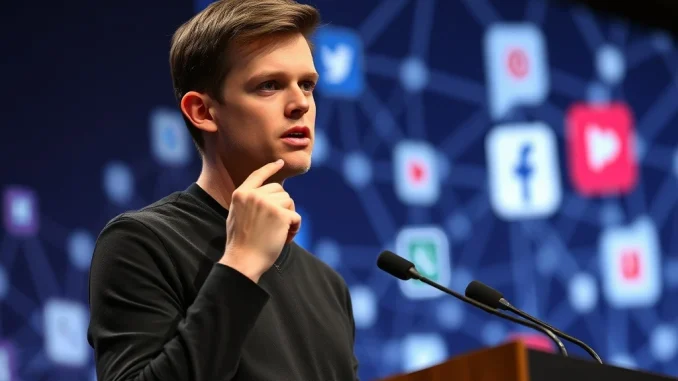
March 26, 2025: In a recent, significant interview, Ethereum co-founder Vitalik Buterin issued a clear directive to the blockchain development community. He emphasized that building decentralized social applications (DeSoc) and more sophisticated smart DAOs is not merely an innovative pursuit but a necessary evolution. According to Buterin, this shift is vital to prevent the cryptocurrency industry from devolving into a purely speculative market, to ensure the continuous technological advancement of the Ethereum ecosystem, and to avert a future dominated by centralized artificial intelligence. His comments arrive at a critical juncture for Web3, as the industry grapples with its identity beyond financial trading.
Vitalik Buterin’s Three-Pronged Argument for Decentralized Social Apps
Buterin’s interview with Foresight News provided a structured critique of the current trajectory. He identified three interconnected risks that decentralized social applications and advanced DAOs are uniquely positioned to address. First, he pointed to the persistent perception of crypto as a casino, where token prices fluctuate based on hype rather than tangible utility. This speculation, he argued, undermines long-term adoption and attracts regulatory scrutiny focused solely on financial risk. Second, he stressed that Ethereum’s technology stack requires real-world, complex use cases to stress-test and improve its scalability, privacy, and security features—something simple token transfers cannot fully achieve. Third, and perhaps most futuristically, Buterin warned of a looming concentration of power in centralized AI systems. He posits that decentralized, user-owned social graphs and community-governed organizations could serve as a crucial counterbalance.
The Historical Context of Crypto’s Speculative Cycle
To understand Buterin’s concern, one must examine the boom-and-bust cycles that have characterized digital assets since Bitcoin’s inception. Each major bull run has been fueled by narratives—from Initial Coin Offerings (ICOs) to Non-Fungible Tokens (NFTs) and Decentralized Finance (DeFi) yield farming. While these innovations brought technical progress, their value was often disproportionately tied to market sentiment. Industry analysts note that for every project solving a genuine problem, dozens emerged solely for price appreciation. This pattern has led to a volatility that deters institutional builders and mainstream users seeking stability. Buterin’s call for DeSoc applications represents a push toward “sticky” utility—platforms where value is derived from persistent social interaction, data ownership, and governance, not just tokenomics.
Defining the Next Generation of Smart DAOs
Buterin’s anticipation of “smart DAOs with more sophisticated structures” hints at moving beyond simple multi-signature treasuries and proposal voting. Experts in decentralized governance suggest this could involve:
- Adaptive Governance: DAOs whose rules automatically adjust based on key performance indicators or external market conditions.
- Sub-DAO Networks: Fractal structures where large DAOs spawn specialized sub-groups for development, marketing, or community support, each with tailored governance.
- AI-Augmented Decision Making: Using transparent, on-chain AI tools to analyze proposal data, simulate outcomes, and surface insights without centralizing control.
- Real-World Legal Integration: Structures that seamlessly interact with traditional legal entities for hiring, contracting, and regulatory compliance.
These complex DAOs would naturally require and foster the development of more robust social coordination tools—the very decentralized social applications Buterin advocates for.
The Technical Imperative: Pushing Ethereum Beyond Finance
From a purely technical standpoint, building social platforms on Ethereum presents a formidable challenge that drives innovation. Social interactions are high-frequency, data-rich, and require low latency—attributes not native to early blockchains. Developing viable DeSoc applications necessitates breakthroughs in several areas:
- Layer-2 Scaling: Mass adoption requires transaction costs of fractions of a cent, pushing rollup technology to its limits.
- Decentralized Storage: Social posts, profiles, and media cannot be stored expensively on-chain, requiring robust integrations with networks like IPFS or Arweave.
- Privacy-Preserving Tech: Zero-knowledge proofs must evolve to allow private social interactions and anonymous voting within DAOs.
- Account Abstraction: To onboard billions, users need seamless, keyless experiences akin to Web2 logins.
Buterin has consistently stated that Ethereum must be “useful for something people do every day.” Social networking is arguably that universal use case, providing a relentless testing ground for core protocol improvements.
The Centralized AI Counter-Narrative
Buterin’s third reason—averting a centralized AI future—connects two of the most transformative technologies of our time. Currently, major AI models are trained on vast datasets scraped from centralized social media platforms, creating a feedback loop where AI power consolidates in the hands of a few corporations. A thriving ecosystem of decentralized social applications could alter this dynamic. If users own their social graphs and content, they could permission its use for training community-governed, open-source AI models. Furthermore, smart DAOs could collectively fund and steer AI development toward public good. This vision positions decentralized social networks not as mere alternatives to Twitter or Facebook, but as foundational infrastructure for a more equitable digital future.
Current State of DeSoc and Market Implications
The market for decentralized social applications is nascent but growing. Protocols like Lens Protocol and Farcaster have built foundational social graph primitives, while applications like Friend.tech and Orbis are experimenting with monetization and community models. However, user bases remain small compared to Web2 giants. Buterin’s public endorsement could accelerate developer mindshare and venture capital flow into the sector. Importantly, if successful, these platforms could create new, less speculative valuation models based on metrics like daily active users, network connectivity, and governance participation rather than just token price. This would represent a fundamental maturation of the crypto asset class.
Conclusion
Vitalik Buterin’s call for a pivot toward decentralized social applications and sophisticated smart DAOs is a strategic intervention aimed at the soul of the cryptocurrency industry. It challenges developers and investors to look beyond the charts and build the durable, utility-driven infrastructure necessary for long-term survival and relevance. By directly tackling the perils of pure speculation, technological stagnation, and centralized AI control, this vision offers a roadmap for Ethereum and the broader Web3 space to evolve into a multifaceted ecosystem that integrates seamlessly with—and improves upon—the social fabric of digital life. The success of this endeavor will likely determine whether crypto is remembered as a revolutionary technological shift or a historical footnote in financial speculation.
FAQs
Q1: What are decentralized social (DeSoc) applications?
A1: Decentralized social applications are platforms for networking, communication, and content sharing built on blockchain technology. Unlike traditional social media, they aim to give users ownership of their identity, data, and social connections, typically through non-custodial accounts and portable social graphs.
Q2: Why does Vitalik Buterin think crypto is too speculative?
A2: Buterin observes that a disproportionate amount of activity and valuation in the crypto space is driven by trading and price speculation on assets with limited real-world utility. He believes this focus attracts the wrong kind of attention and hinders the development of broadly useful, everyday applications that drive sustainable adoption.
Q3: How can smart DAOs be more “sophisticated”?
A3: Beyond basic voting, sophisticated smart DAOs could feature multi-tiered governance, automated treasury management based on predefined rules, delegated expertise, legal entity integration, and the use of verifiable AI tools for data analysis and proposal simulation, all while maintaining transparency on-chain.
Q4: What is the connection between DeSoc and AI that Buterin mentions?
A4: Buterin warns of a future where a few corporations control both major AI models and the social data used to train them. Decentralized social networks, where users own their data, could enable the development of community-governed, open-source AI alternatives, preventing excessive centralization of power.
Q5: Are there any working examples of DeSoc apps today?
A5: Yes, though they are in early stages. Examples include Lens Protocol (a composable social graph), Farcaster (a decentralized social network), and applications like Phaver and Orbis that build on these protocols. They currently have smaller, more tech-oriented user bases compared to mainstream social media.