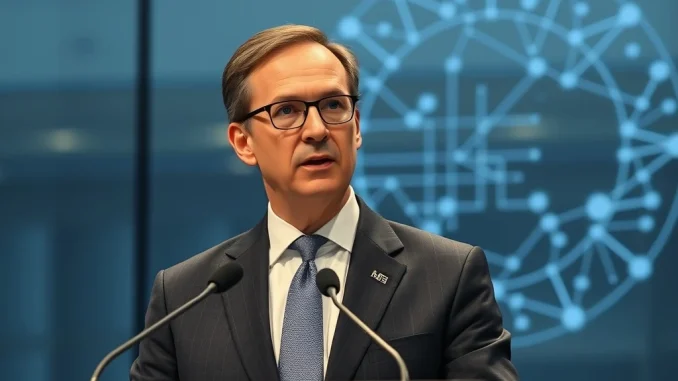
Frankfurt, Germany – April 2025: In a significant development for the future of European finance, Bundesbank President Joachim Nagel has publicly endorsed the development of both private euro-denominated stablecoins and a retail Central Bank Digital Currency (CBDC). This pivotal endorsement from Germany’s central bank chief underscores a strategic and urgent drive within Europe to modernize its payment infrastructure, aiming for greater security, efficiency, and monetary sovereignty in an increasingly digital global economy.
Bundesbank President Backs Euro Stablecoins and Digital Euro
Joachim Nagel’s comments, delivered during a high-level financial conference this week, mark a notable evolution in the official European discourse on digital assets. While the European Central Bank (ECB) has long been researching a digital euro, explicit support from the head of the Bundesbank—the most influential national central bank within the Eurosystem—for private sector euro stablecoins adds a crucial new dimension. Nagel framed these innovations not as threats, but as complementary components of a robust, future-proof financial ecosystem. He emphasized that well-regulated stablecoins, pegged 1:1 to the euro and operating on transparent blockchain networks, could spur private-sector innovation for cross-border payments and smart contracts. Concurrently, a retail CBDC, or digital euro, would provide a risk-free, public digital payment option directly from the central bank, ensuring citizens always have access to sovereign money.
Europe’s Strategic Push for Digital Payment Sovereignty
This endorsement is not an isolated opinion but a calculated move within a broader continental strategy. The context is defined by intense global competition. Other major economies are advancing their own digital currency projects, and large technology firms have previously proposed global private payment networks. Europe’s motivation is clear: to avoid dependence on foreign digital payment systems and to ensure the euro remains competitive. The EU’s Markets in Crypto-Assets (MiCA) regulation, which comes fully into force in 2025, provides the regulatory bedrock for this push. MiCA establishes a comprehensive licensing regime for stablecoin issuers, demanding stringent capital, custody, and redemption rules. Nagel’s support signals that, within this strict regulatory guardrail, private innovation is welcome. The goal is a “two-track” system where a public digital euro ensures stability and a regulated private stablecoin market drives efficiency and novel use cases.
The Technical and Economic Implications of a Dual Approach
Adopting both a retail CBDC and sanctioned stablecoins presents complex technical and economic questions. A key design consideration for the digital euro is privacy; the ECB has repeatedly stated it will not have access to users’ personal transaction data for payments, likely using intermediaries like banks to handle this. For stablecoins, the focus is on interoperability and resilience. How will a private euro stablecoin on one blockchain network interact with a digital euro potentially built on a different ledger? Industry experts suggest the solution lies in standardized application programming interfaces (APIs) and possibly a common settlement layer. Economically, this dual system could:
- Lower Transaction Costs: Streamline cross-border euro payments within and outside the EU.
- Enhance Programmability: Enable automated “smart” payments for things like conditional subsidies or instant trade settlement.
- Strengthen Monetary Policy Transmission: A digital euro could allow for more direct and faster implementation of ECB policies.
- Mitigate Fragmentation: Provide a unified digital currency framework across 20 Eurozone nations.
Historical Context: From Skepticism to Strategic Embrace
The Bundesbank’s position represents a measured shift. Historically, German financial authorities have been among the most conservative and cautious regarding cryptocurrencies, emphasizing risks like volatility, money laundering, and energy consumption. The pivot towards endorsing specific, regulated digital asset forms reflects a pragmatic reassessment. The catalyst is the undeniable digitization of all value exchange and the strategic necessity of controlling the monetary architecture of that exchange. This journey mirrors the broader EU path: from initial caution, to regulatory action with MiCA, to now proactively shaping the market. It is a move from defense to offense, aiming to set global standards for how major fiat currencies transition into the digital age.
Global Reactions and the Road Ahead for Implementation
International observers view Nagel’s statement as a bellwether. It increases pressure on other major central banks, like the U.S. Federal Reserve and the Bank of England, to clarify their positions on private stablecoins alongside their CBDC work. Within Europe, the next steps are operational. The ECB’s digital euro investigation phase has concluded, and a decision on whether to proceed to a realization phase is imminent. Parallel to this, financial institutions and fintech companies will now accelerate plans for MiCA-compliant euro stablecoins, knowing they have a receptive, if demanding, regulatory audience. The timeline for a live digital euro is estimated for the latter part of this decade, with the first regulated euro stablecoins likely appearing sooner.
Conclusion
The endorsement of euro stablecoins and a retail CBDC by Bundesbank President Joachim Nagel is a definitive signal that Europe is committing to a leadership role in the future of money. This is not merely about technological adoption but about preserving economic sovereignty, enhancing financial inclusion, and fostering secure innovation. By championing a hybrid model of public and private digital euro instruments, Europe is crafting a nuanced blueprint that others may follow. The success of this ambitious vision will depend on seamless execution, continued public trust, and the ability to balance innovation with the unwavering stability that defines the euro.
FAQs
Q1: What exactly did the Bundesbank President say about euro stablecoins?
Joachim Nagel expressed support for the development of private, euro-denominated stablecoins that operate within the EU’s strict MiCA regulatory framework, viewing them as tools for innovation in payments and financial services.
Q2: How is a retail CBDC (digital euro) different from a euro stablecoin?
A retail CBDC is a digital form of cash directly issued by the European Central Bank, representing a direct claim on the central bank. A euro stablecoin is a private digital asset issued by a licensed company, backed by reserves of euros and other assets, representing a claim on that issuer.
Q3: Why is Europe pushing for these digital payment systems now?
The push is driven by strategic competition, the need for faster/cheaper payment systems, and the desire to maintain monetary sovereignty and the international role of the euro against other digital currency initiatives from nations and tech corporations.
Q4: What is the MiCA regulation and why is it important here?
MiCA (Markets in Crypto-Assets) is the EU’s comprehensive regulatory framework for crypto-assets. It sets binding rules for stablecoin issuers on licensing, reserve backing, and consumer protection, creating the legal certainty needed for Nagel’s endorsement.
Q5: When can we expect to use a digital euro or EU-regulated stablecoin?
The ECB could decide to move to the next phase of developing a digital euro in 2025, with a potential launch in the late 2020s. MiCA-compliant euro stablecoins from licensed entities could begin appearing in the European market sooner, potentially within the next 1-2 years.