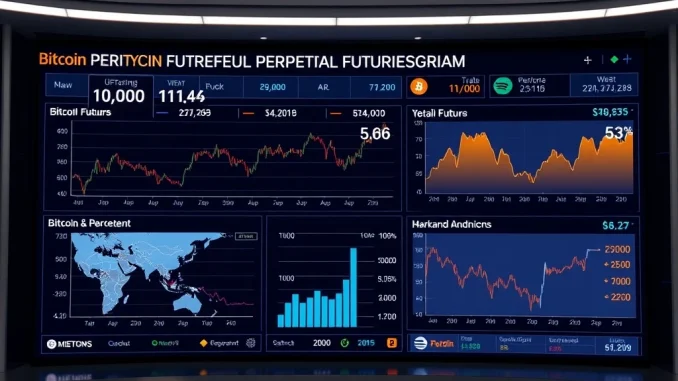
Global, May 2025: The BTC perpetual futures long/short ratio, a critical gauge of trader sentiment in the cryptocurrency derivatives market, has entered a state of remarkable equilibrium. Data from the world’s three largest crypto futures exchanges by open interest—Binance, OKX, and Bybit—shows a collective positioning that is almost perfectly balanced between bullish and bearish bets. This precise balance offers a fascinating snapshot of a market in a moment of indecision, where neither bulls nor bears hold a decisive advantage. For traders and analysts, understanding this data provides crucial insight into the underlying psychology and potential future direction of Bitcoin’s price.
Decoding the BTC Perpetual Futures Long/Short Ratio
The long/short ratio for BTC perpetual futures is more than just a simple percentage. It represents the aggregate positioning of traders on a given platform, calculated by comparing the total value of open long positions (bets that the price will rise) to the total value of open short positions (bets that the price will fall). A ratio above 50% indicates a majority of traders are long, suggesting bullish sentiment. Conversely, a ratio below 50% points to a bearish majority. The data from the last 24 hours presents a compelling picture of near-perfect parity. The overall ratio across the three major exchanges stands at 49.84% long versus 50.16% short. This razor-thin margin indicates a market in a state of equilibrium, where buying and selling pressure from derivatives traders is virtually offsetting.
A Detailed Breakdown by Exchange
While the overall market appears balanced, subtle differences emerge when examining each exchange individually. These variations can reflect the unique user demographics and trading styles prevalent on each platform. The data reveals a fascinating microcosm of global crypto trading behavior.
| Exchange | Long Positions | Short Positions | Net Sentiment |
|---|---|---|---|
| Binance | 49.98% | 50.02% | Neutral, Slightly Bearish |
| OKX | 49.65% | 50.35% | Neutral, Slightly Bearish |
| Bybit | 50.10% | 49.90% | Neutral, Slightly Bullish |
| Overall Aggregate | 49.84% | 50.16% | Neutral, Slightly Bearish |
This table highlights the exceptional balance. Binance, the world’s largest exchange by volume, shows a near 50/50 split, tilted by a mere 0.04 percentage points toward shorts. OKX exhibits a slightly more pronounced bearish tilt, with shorts outweighing longs by 0.70 percentage points. Interestingly, Bybit is the only platform of the three where long positions marginally exceed shorts, by 0.20 percentage points. These minor divergences are typical in healthy, liquid markets and often precede significant price movements as one side eventually gains conviction.
The Mechanics and Importance of Perpetual Futures
To fully appreciate this data, one must understand the instrument it measures. Perpetual futures, or “perps,” are a cornerstone of crypto derivatives. Unlike traditional futures with set expiry dates, perpetual contracts have no expiration. They maintain their price alignment with the underlying spot market through a funding rate mechanism, where longs pay shorts or vice versa periodically. This structure makes them immensely popular for both short-term speculation and longer-term leveraged positions. Consequently, the aggregate long/short ratio on these contracts is considered one of the most real-time indicators of leveraged trader sentiment available. When this indicator shows extreme readings—such as 70% long or 70% short—it can signal a crowded trade and potential for a sharp reversal. The current neutral reading suggests no such extreme positioning exists.
Historical Context and Market Implications
Periods of equilibrium in the BTC perpetual futures long/short ratio are not uncommon, but they are often inflection points. Historically, extended periods of balance like this have preceded strong directional moves. The data implies a few key scenarios for the market. First, it indicates a lack of consensus among sophisticated, leveraged traders about Bitcoin’s immediate direction. This can occur during consolidation after a significant price move or ahead of a major macroeconomic event. Second, the slight aggregate bearish tilt (50.16% short) could be interpreted as a cautious stance, perhaps reflecting concerns about broader financial conditions or profit-taking after a rally. However, with the margin so thin, it would be inaccurate to label the market as overtly bearish. Instead, it reflects a waiting game.
For retail investors and long-term holders, this data is a useful sentiment tool but should not be used in isolation. A balanced derivatives market can reduce the risk of a violent liquidation cascade, which often occurs when too many traders are positioned on one side of the market with high leverage. The current environment suggests a healthier, more stable foundation for price discovery. Market analysts often watch for a sustained break from this equilibrium, as a persistent move above 52% long or below 48% short can signal the beginning of a new trend fueled by derivatives trading.
Conclusion
The latest BTC perpetual futures long/short ratio data paints a picture of a cryptocurrency derivatives market in a state of precise balance. With an overall split of 49.84% long to 50.16% short across Binance, OKX, and Bybit, neither bullish nor bearish traders hold a decisive edge. This equilibrium suggests a market pause, where participants are assessing fundamentals, technical levels, and external macro factors before committing to a stronger directional bias. For anyone engaged in the crypto markets, monitoring this key sentiment indicator provides invaluable context, highlighting moments of consensus, extreme greed or fear, and—as seen now—perfect equilibrium. The next major move in Bitcoin’s price will likely coincide with a decisive shift in this critical ratio.
FAQs
Q1: What does a 50/50 long/short ratio mean for Bitcoin’s price?
A perfectly balanced ratio, as seen currently, typically indicates market indecision and consolidation. It does not predict direction but suggests that a breakout in either direction could be significant, as it would represent a shift in sentiment among leveraged traders.
Q2: Why is the ratio different on each exchange?
Each exchange has a different user base with varying risk appetites, geographic focuses, and trading strategies. Minor differences are normal and reflect the diverse perspectives within the global crypto ecosystem.
Q3: Is a high long ratio always bullish for the price?
Not necessarily. While it shows bullish sentiment, an extremely high long ratio (e.g., over 70%) can be a contrarian indicator. It signals that the market may be over-leveraged to the long side, increasing the risk of a sharp downturn if those positions are liquidated.
Q4: How often is the BTC perpetual futures long/short ratio updated?
The data is typically updated in real-time or at very short intervals (e.g., every few minutes) by data analytics platforms and the exchanges themselves. The 24-hour snapshot provides a smoothed-out view of the prevailing sentiment.
Q5: Should retail traders make decisions based solely on this ratio?
No. The long/short ratio is a powerful sentiment indicator, but it should be used in conjunction with other forms of analysis, including technical charts, on-chain data, and fundamental news. It is one piece of a much larger puzzle.