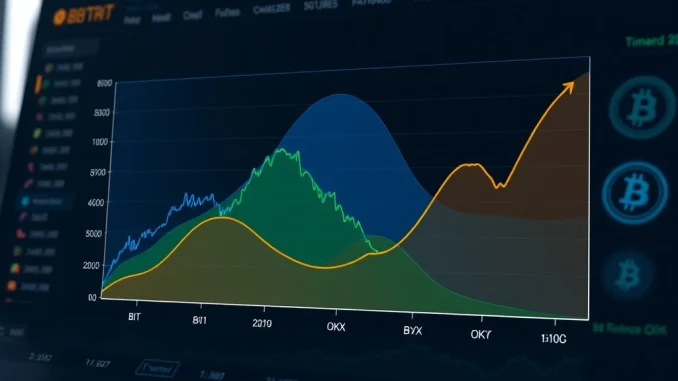
Global, May 2025: The BTC perpetual futures long/short ratio serves as a critical barometer for institutional and retail trader sentiment. Over the last 24 hours, data from the world’s three largest crypto futures exchanges by open interest—Binance, OKX, and Bybit—paints a picture of a remarkably balanced market. The aggregate ratio shows 49.58% of positions are long, betting on a price increase, while 50.42% are short, anticipating a decline. This near-equilibrium suggests a period of consolidation and indecision, offering a fascinating snapshot of the current psychological state of the Bitcoin derivatives market.
Decoding the BTC Perpetual Futures Long/Short Ratio
For newcomers and seasoned traders alike, understanding the long/short ratio is fundamental. A perpetual futures contract, unlike a traditional future, has no expiry date. Traders can hold positions indefinitely, provided they can fund the ongoing ‘funding rate’ payments that tether the contract’s price to the underlying spot market. The long/short ratio measures the proportion of open positions that are betting the price will go up (long) versus those betting it will go down (short). It is a pure sentiment indicator, derived from the collective actions of thousands of traders. When the ratio skews heavily long, it can signal excessive optimism or ‘overcrowded’ trades. Conversely, a heavily short-skewed market might indicate pervasive fear or a setup for a potential short squeeze, where rising prices force short sellers to buy back, accelerating the upward move.
A Detailed Breakdown of Exchange-Specific Data
The provided 24-hour data reveals subtle nuances between the major trading venues. While the overall market is almost perfectly balanced, each exchange has its own micro-climate of sentiment. The following table presents the clear, verifiable data for analysis:
| Exchange | Long Positions | Short Positions | Net Sentiment |
|---|---|---|---|
| Overall Aggregate | 49.58% | 50.42% | Marginally Bearish |
| 1. Binance | 50.1% | 49.9% | Neutral to Slightly Bullish |
| 2. OKX | 50.1% | 49.9% | Neutral to Slightly Bullish |
| 3. Bybit | 50.49% | 49.51% | Slightly Bullish |
Binance and OKX show identical figures, with longs outnumbering shorts by a mere 0.2 percentage points. This is statistical noise, indicating a true neutral stance among their vast user bases. Bybit displays a slightly more pronounced bullish tilt, with longs holding a 0.98 percentage point advantage. The critical takeaway is the absence of extreme positioning. None of the major platforms show a ratio exceeding 51% in either direction, which historically precedes strong directional moves when such extremes are reached and then reverse.
The Historical Context of Market Sentiment Indicators
To appreciate the current balance, one must look at historical extremes. During the bull market peak in late 2021, aggregate long/short ratios on these exchanges frequently exceeded 70% long, reflecting rampant FOMO (Fear Of Missing Out). Conversely, in the depths of the 2022 bear market, short ratios often dominated, sometimes surpassing 65% as pessimism peaked. The current data sits far from those emotional extremes. This equilibrium often occurs during periods of:
- Price Consolidation: When Bitcoin trades in a tight range, directional conviction wanes.
- Macroeconomic Uncertainty: Traders await key economic data or central bank decisions.
- Technical Analysis Standoffs: Price approaches a major support or resistance level, leaving both bulls and bears hesitant.
This context transforms raw percentages into a narrative about market psychology and potential future volatility.
Implications for Traders and the Broader Market
A balanced long/short ratio has several practical implications. First, it suggests a lower immediate risk of a violent ‘long squeeze’ or ‘short squeeze.’ These events require one-sided positioning to become overly crowded. Second, it indicates that the market is likely being driven by spot market flows or external macro factors rather than self-reinforcing leverage from the derivatives side. For risk managers, a neutral sentiment gauge can signal a time for caution, as the next major move might be triggered by an unexpected catalyst, catching a balanced market off guard. Furthermore, the funding rates on these perpetual contracts—the mechanism that balances long and short demand—are likely to be very low or fluctuating around zero in such an environment, reducing the cost of carrying a position for both sides.
Why Exchange Data Matters: Understanding the Player Base
The consistency across Binance, OKX, and Bybit is notable because these exchanges cater to slightly different demographics. Binance has the broadest global retail and institutional user base. OKX has a strong presence in Asia and among more sophisticated derivatives traders. Bybit is also popular with retail traders, particularly for its user-friendly interface. The fact that all three show similar, balanced sentiment reinforces the idea that this is a widespread market view, not an anomaly confined to one platform. It represents a consensus of hesitation across the spectrum of crypto traders.
Conclusion
The latest BTC perpetual futures long/short ratio data from Binance, OKX, and Bybit reveals a market in a state of careful balance. With an aggregate of 49.58% long versus 50.42% short, the collective sentiment of the derivatives market is neutral, hovering at an equilibrium point. This data point is a powerful, real-time reflection of trader psychology, showing neither greed nor fear is dominating the landscape. For analysts and participants, such periods of balance are not signs of stagnation but of potential energy, often preceding the market’s next decisive move. Monitoring these ratios, alongside price action and volume, remains an essential practice for understanding the underlying forces in the dynamic Bitcoin futures market.
FAQs
Q1: What does a 50/50 long/short ratio actually mean?
A perfectly balanced 50/50 ratio means the total value of bets on a price increase equals the total value of bets on a price decrease. It indicates a lack of consensus on future direction and often coincides with low volatility and sideways price movement.
Q2: Is the long/short ratio a reliable predictor of Bitcoin’s price?
Not as a standalone tool. It is a sentiment indicator, not a crystal ball. Extreme readings (very high long or short percentages) can signal potential reversals, but timing is impossible to gauge from the ratio alone. It is best used in conjunction with technical and fundamental analysis.
Q3: Why are Binance, OKX, and Bybit specifically highlighted?
These three platforms consistently rank as the largest cryptocurrency futures exchanges by open interest, a measure of total active contracts. Their data represents a significant majority of the global BTC perpetual futures trading volume, making their aggregate sentiment highly representative.
Q4: How frequently does this long/short ratio data update?
The data typically updates in real-time or on very short intervals (e.g., every few minutes). The 24-hour snapshot provides a smoothed-out view that reduces noise and shows the prevailing sentiment trend over a full trading day.
Q5: Can retail traders access this long/short ratio data themselves?
Yes. Most major crypto data analytics websites (like Coinglass, TradingView, or the exchanges’ own data pages) provide real-time and historical long/short ratio data for multiple exchanges, often for free. It is a publicly available metric.
This article was produced with AI assistance and reviewed by our editorial team for accuracy and quality.