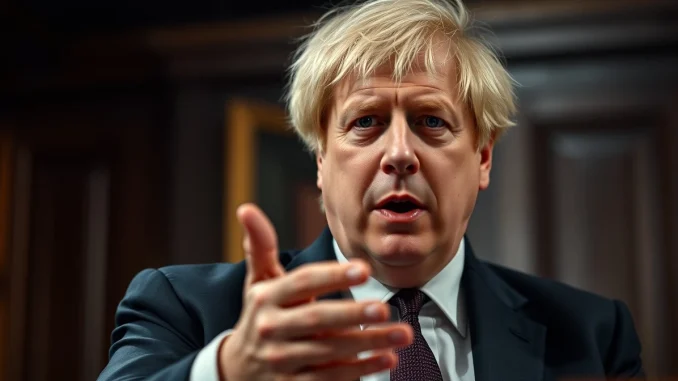
Former UK Prime Minister Boris Johnson has publicly labeled Bitcoin a “Ponzi scheme,” drawing immediate criticism from prominent figures within the cryptocurrency industry. The comments were made in a recent opinion article where Johnson contrasted the digital asset with traditional collectibles.
Johnson’s Critique and Comparison
In his article, Johnson recounted a story of a friend who lost significant funds to a fraudulent investment promoter claiming to deal in Bitcoin. He argued that while he could understand the enduring appeal of assets like gold or even Pokémon cards, Bitcoin lacked similar fundamental value.
“These curious little Japanese cartoon beasties seem to exercise the same fascination over the five-year-old mind as they did 30 years ago,” Johnson wrote, referring to Pokémon. “Even if you remain pretty impervious to the charm of Pikachu, you can just about see why a decades-old Pikachu card is still a tradeable asset.”
He characterized Bitcoin itself as a scam, suggesting its value proposition was fundamentally flawed compared to physical collectibles with long-standing cultural recognition.
Industry Leaders Push Back
The opinion piece prompted swift rebuttals from cryptocurrency executives and advocates. They challenged Johnson’s characterization by explaining Bitcoin’s core technological and economic properties.
Michael Saylor, co-founder of Strategy, directly addressed the Ponzi scheme allegation. “Bitcoin is not a Ponzi scheme,” Saylor stated. “A Ponzi requires a central operator promising returns and paying early investors with funds from later ones. Bitcoin has no issuer, no promoter, and no guaranteed return, just an open, decentralized monetary network driven by code and market demand.”
Other critics turned the argument toward traditional financial systems. Pierre Rochard, CEO of The Bitcoin Bond Company, argued that the UK’s own debt-based fiat currency system could be viewed as a “giant Ponzi scheme.”
Context of Political Commentary on Crypto
Johnson’s remarks add to a long history of skeptical statements about cryptocurrency from high-profile political figures globally. These comments often spark intense debate between proponents of decentralized digital assets and critics who question their stability and utility.
Market data from sources like CoinGecko shows Bitcoin’s price and adoption have continued to evolve despite periodic criticism from officials. The network recently produced its 20 millionth coin, a milestone celebrated by supporters as evidence of its resilient and predictable monetary policy.
Regulatory bodies, including the UK’s Financial Conduct Authority, continue to develop frameworks for digital assets, focusing on consumer protection and market integrity. Official statements and consultations from these institutions provide the primary guidance for the sector’s legal standing.
What’s Next
The public clash highlights the ongoing divide between some traditional political perspectives and the cryptocurrency industry’s narrative. While Johnson’s comments reflect a particular viewpoint, they are unlikely to impact Bitcoin’s underlying protocol or its global network of users and developers. The debate instead underscores the continued challenge of fitting novel digital assets into conventional financial and regulatory paradigms. Future political discourse will likely continue to engage with the technology as its integration into the broader economy progresses.
Updated insights and analysis added for better clarity.
This article was produced with AI assistance and reviewed by our editorial team for accuracy and quality.