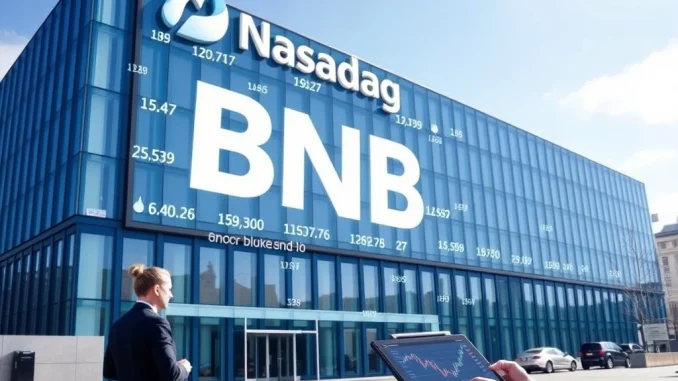
Stockholm, Sweden – March 2025: In a significant development for the convergence of traditional finance and digital assets, Swedish asset manager Virtune has successfully listed an exchange-traded product (ETP) tracking Binance Coin (BNB) on Nasdaq Stockholm. This landmark move, confirmed by regulatory filings and financial reports, provides Swedish and broader Nordic investors with their first direct, regulated pathway to gain exposure to the BNB cryptocurrency through a major European stock exchange. The listing represents a calculated step in the institutional adoption of digital assets within a stringent regulatory framework.
BNB ETP Listing: A Detailed Breakdown of the Nasdaq Stockholm Move
The newly listed product, structured as a physically-backed ETP, is now tradable under a specific ticker symbol on Nasdaq Stockholm, the largest securities market in Northern Europe. Unlike an exchange-traded fund (ETF), an ETP is a debt instrument, but it functions similarly for investors by tracking the price of an underlying asset—in this case, BNB. Virtune, as the issuer, is responsible for the product’s creation, redemption, and ensuring it holds the corresponding BNB tokens in secure, regulated custody. This structure is crucial, as it directly ties the ETP’s value to the live market price of BNB, minus the management fee. The listing follows a period of rigorous scrutiny by Nasdaq’s listing committee and Swedish financial regulators, who assess products for market stability, investor protection, and compliance with EU financial legislation.
This event did not occur in a vacuum. It follows a broader, multi-year trend of European financial hubs embracing crypto-based financial products. Germany’s Xetra exchange, for instance, has listed multiple Bitcoin and Ethereum ETPs for years. However, the listing of a BNB-specific product on a premier Nordic exchange marks a distinct evolution. It signals a growing institutional appetite for exposure to assets beyond the two largest cryptocurrencies, focusing on the utility token of the world’s largest cryptocurrency exchange by volume. The move provides a template for how other altcoins might eventually access regulated capital markets.
The Role of Virtune and the Swedish Regulatory Landscape
Virtune has positioned itself as a specialist in bringing digital asset investment vehicles to the Nordic market. The firm’s expertise lies in navigating the complex web of Swedish and European Union financial regulations, particularly the Markets in Financial Instruments Directive (MiFID II) and the upcoming Markets in Crypto-Assets (MiCA) regulation. By choosing the ETP wrapper, Virtune leverages a familiar and well-understood structure for European investors and regulators. The product is aimed squarely at professional investors, wealth managers, and sophisticated retail investors who seek crypto exposure but prefer the safety, transparency, and tax-reporting simplicity of a traditional brokerage account over holding tokens on a crypto exchange.
The Swedish Financial Supervisory Authority (Finansinspektionen) maintains a cautious but evolving stance on cryptocurrencies. The approval of this ETP suggests a regulatory comfort level with products that offer clear custody solutions, daily liquidity, and full transparency—standards that Virtune’s offering is designed to meet. This regulatory green light is perhaps as significant as the listing itself, setting a precedent for future digital asset products in the region. The table below outlines the key specifications of this new investment vehicle:
| Feature | Detail |
|---|---|
| Product Type | Physically-Backed Exchange-Traded Product (ETP) |
| Underlying Asset | Binance Coin (BNB) |
| Listing Exchange | Nasdaq Stockholm |
| Issuer | Virtune AB |
| Primary Audience | Swedish & Nordic Institutional & Sophisticated Investors |
| Custody Solution | Regulated, third-party institutional custody |
| Investment Thesis | Direct price exposure to BNB within a regulated framework |
Contextualizing BNB’s Journey from Utility Token to Listed Asset
BNB’s path to a Nasdaq listing is a case study in the maturation of a crypto asset. Initially launched in 2017 as an ERC-20 token on the Ethereum blockchain to power fee discounts on the Binance exchange, BNB has undergone several fundamental transformations. It migrated to its own blockchain, the BNB Chain, and expanded its utility far beyond a simple exchange token. Today, BNB is used for:
- Transaction Fees: Paying fees on the BNB Chain and within the broader Binance ecosystem.
- Governance: Participating in voting for the decentralized autonomous organization (DAO) that guides BNB Chain development.
- Staking and Rewards: Earning yields through various staking and launchpad programs.
- Payment Method: Accepted by a growing number of merchants and service providers.
This evolution from a single-use token to a multi-faceted asset with a robust ecosystem is a key factor that likely made it an attractive candidate for a regulated ETP. For investors, the product offers a way to gain financial exposure to the growth and adoption of the entire BNB Chain ecosystem without the technical complexities of direct token ownership, wallet management, or private key security.
Implications for Investors and the Nordic Financial Market
The immediate consequence of this listing is the democratization of access. Swedish investors can now buy and sell shares of the BNB ETP using their existing brokerage accounts, with trades settling in Swedish Krona (SEK) during standard market hours. This eliminates barriers like setting up accounts on crypto exchanges, navigating know-your-customer (KYC) processes on new platforms, and managing self-custody. Furthermore, gains or losses from the ETP will be integrated into standard annual tax statements (the kapitel 1 income declaration in Sweden), simplifying a notoriously complex aspect of cryptocurrency ownership.
For the Nordic financial market, this listing reinforces Stockholm’s ambition to be a fintech and digital assets hub in Europe. It attracts capital and attention from international investors looking for regulated crypto exposure. It also pressures other asset managers and exchanges in the region to develop competing or complementary products, potentially leading to a richer ecosystem of digital asset investment options for Nordic savers. The move can be seen as a strategic response to similar developments in Germany, Switzerland, and France, ensuring the region does not fall behind in the financial innovation race.
Conclusion
The listing of a BNB ETP on Nasdaq Stockholm is a landmark event that bridges the worlds of decentralized cryptocurrency and traditional, regulated finance. It is a testament to the growing institutionalization of digital assets and the increasing demand from investors for familiar, secure avenues to gain exposure. While the product carries the inherent volatility and risk of its underlying crypto asset, its structure within the regulated confines of a major stock exchange provides a layer of oversight, security, and accessibility previously unavailable to many in the Nordic region. This BNB ETP listing is not just about one token; it is a significant step in the ongoing narrative of cryptocurrency’s integration into the global financial mainstream.
FAQs
Q1: What is the difference between this BNB ETP and buying BNB on Binance?
Buying the ETP on Nasdaq Stockholm is done through a traditional stock brokerage, offers regulatory protections, simplifies tax reporting, and involves holding a security. Buying BNB directly on an exchange like Binance involves holding the actual cryptocurrency token, requiring personal wallet security and different tax handling.
Q2: Who is the target investor for this product?
The product is primarily targeted at professional investors, institutional funds, and sophisticated retail investors in Sweden and across the Nordic region who are already active in traditional markets but seek regulated exposure to cryptocurrency assets.
Q3: How does this ETP actually hold the BNB tokens?
The issuer, Virtune, uses a regulated, institutional-grade third-party custodian to securely store the underlying BNB tokens. This custodian is separate from the exchange and is audited to ensure the tokens are safely held and fully backed.
Q4: Does this mean BNB is now a regulated security in Sweden?
No. The ETP itself is a regulated financial instrument listed on a regulated exchange. The underlying asset, BNB, remains a cryptocurrency. The ETP structure is the regulated wrapper that provides exposure to it.
Q5: What are the main risks of investing in this BNB ETP?
The primary risk is the price volatility of the underlying BNB asset. Other risks include counterparty risk with the issuer and custodian, liquidity risk (though mitigated by the Nasdaq listing), and the regulatory risk associated with the evolving landscape for cryptocurrencies globally.