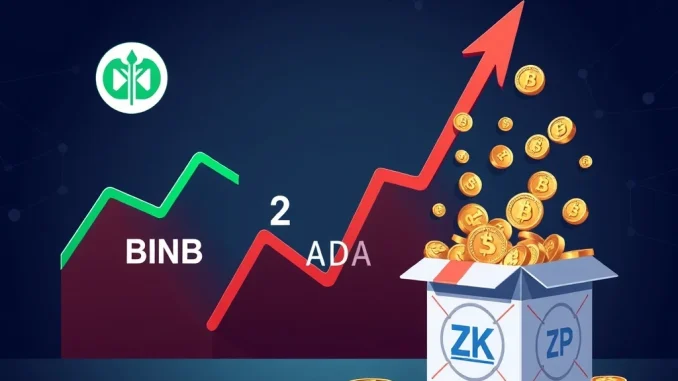
Global, March 2025: The cryptocurrency market presents a mixed picture this week, with distinct narratives emerging across different digital assets. While Binance Coin (BNB) demonstrates notable trading activity increases, Cardano (ADA) shows concerning technical signals. Simultaneously, a substantial $5 million giveaway campaign from the ZKP project, coupled with its unique hybrid architecture, has become a significant topic of discussion among market participants and analysts.
BNB Trading Activity Shows Significant Momentum
Binance Coin, the native token of the world’s largest cryptocurrency exchange by trading volume, has experienced a measurable increase in market activity throughout early 2025. Data from multiple blockchain analytics platforms confirms a consistent uptick in daily trading volume across both centralized and decentralized exchanges. This movement coincides with several ecosystem developments, including ongoing enhancements to the BNB Chain’s infrastructure and increased utility within the Binance ecosystem.
Market analysts point to several contributing factors for this increased activity. The broader recovery in cryptocurrency markets from late 2024 lows has naturally benefited major exchange tokens. Furthermore, specific on-chain metrics, such as the number of active addresses and transaction count on the BNB Smart Chain, have shown resilience. It is crucial to distinguish between trading volume, which measures the total value of tokens changing hands, and price appreciation, which has been more moderate. The volume surge suggests heightened interest and liquidity, factors that market technicians often view as precursors to potential price movement, though never a guarantee.
Cardano’s ADA Faces Critical Technical Juncture
Conversely, Cardano’s ADA token is navigating a period of technical uncertainty. Chart analysis indicates that ADA has been testing key support levels that have held for several months. A sustained break below these levels could signal a shift in market structure from consolidation to a potential downtrend, what technical analysts often term a “breakdown.” This price action occurs despite continued progress in Cardano’s development roadmap, including recent upgrades to its Plutus smart contract platform and growth in its decentralized application ecosystem.
The divergence between fundamental development and short-term price action is not uncommon in cryptocurrency markets. Several factors may be influencing ADA’s current weakness. Broader market sentiment toward proof-of-stake assets, competitive pressures from other smart contract platforms, and macroeconomic conditions affecting risk assets all play a role. Historical data shows that ADA has experienced similar periods of technical pressure followed by recovery when development milestones translate into increased network usage and adoption. Market participants are closely monitoring whether current support levels will hold or if a new trading range will be established.
Understanding Market Structure and Support Levels
In technical analysis, a “breakdown” refers to the price of an asset falling below a previously established support level, typically on significant volume. This event is interpreted by analysts as a shift in the supply-demand balance, with selling pressure overwhelming buying interest at that price point. For ADA, the relevant support zones have been identified through historical price action where buying has consistently emerged. A breach does not predetermine future price but does alter the probabilistic framework used by many traders, often leading to revised risk assessments and portfolio allocations.
ZKP’s $5 Million Giveaway and Hybrid Model Generate Discussion
Amid these established asset movements, a newer entrant, the ZKP project, has captured market attention through a substantial incentive program. The project has initiated a $5 million token giveaway, accompanied by a 20% referral reward structure. This strategy is designed to accelerate user acquisition and network participation. Beyond the marketing campaign, discussion among crypto communities has focused on ZKP’s described “hybrid design,” which reportedly seeks to merge elements of zero-knowledge proof technology with other scalability solutions.
Large-scale giveaways and referral programs have a mixed history in cryptocurrency. They can effectively bootstrap a community and distribute tokens widely, but their long-term impact depends entirely on the underlying utility and sustainability of the project. Experts caution that participants should look beyond the promotional campaign to evaluate the project’s technical whitepaper, development team, roadmap, and actual blockchain infrastructure. The 20% referral mechanism creates a viral growth incentive, but sustainable networks are typically built on genuine utility, not just referral rewards.
The Role of Incentives in Network Adoption
Token distribution mechanisms are a critical design choice for any new cryptographic network. Airdrops and giveaways aim to achieve decentralization by placing tokens in many hands, hoping some will become active users or stakeholders. The referral component adds a layer of grassroots marketing. The success of such campaigns is ultimately measured not by the number of initial claimants, but by the retention of active, engaged participants who contribute to the network’s security, governance, or usage over the medium to long term.
Comparative Market Dynamics and Investor Considerations
The simultaneous occurrence of these three scenarios—BNB’s volume surge, ADA’s technical test, and ZKP’s promotional launch—highlights the multifaceted nature of the cryptocurrency sector. These assets represent different stages of maturity and carry distinct risk-return profiles.
- BNB functions as a utility token for a massive, established ecosystem. Its value is closely tied to the health and activity of the Binance exchange and BNB Chain.
- ADA represents a fully launched, proof-of-stake smart contract platform competing in a crowded field. Its value proposition hinges on technological differentiation and developer adoption.
- ZKP represents an early-stage project utilizing aggressive growth tactics. Its valuation at this stage is highly speculative and tied to future execution of its technical roadmap.
For market observers, this period underscores the importance of differentiated analysis. Trading volume, technical chart levels, and community growth campaigns are all useful data points, but they must be contextualized within each project’s unique fundamentals and the broader macroeconomic environment for digital assets.
Conclusion
The current cryptocurrency market landscape is characterized by divergent asset performances and strategic initiatives. BNB’s rising trading volume indicates robust ecosystem activity, while ADA’s price action requires careful monitoring of key technical levels. The ZKP project’s substantial giveaway brings attention to the ongoing competition for user mindshare and network effects. This crypto analysis demonstrates that the market remains a complex interplay of technology, economics, and participant psychology. Informed participation requires separating signal from noise, understanding the distinct drivers for each asset, and maintaining a focus on long-term fundamentals rather than short-term promotional events or isolated technical signals.
FAQs
Q1: What does increased trading volume for BNB typically indicate?
Increased trading volume generally signifies higher liquidity and market interest. It can result from new ecosystem developments, broader market trends, or specific utility demands within the Binance exchange and BNB Chain. Volume alone does not predict price direction but confirms the significance of price movements that do occur.
Q2: What is a technical “breakdown” for a cryptocurrency like ADA?
A breakdown occurs when an asset’s price falls decisively below a previously reliable level of support, often accompanied by elevated trading volume. In technical analysis, this suggests selling pressure has overcome buying interest at that level, potentially leading to a new, lower trading range. It is a change in observed market structure, not a fundamental judgment on the project.
Q3: Are large cryptocurrency giveaways like ZKP’s $5M campaign effective?
Giveaways can be effective for initial user acquisition and token distribution. Their long-term success depends entirely on whether recipients become active, long-term participants in the network. Projects must eventually transition from promotional incentives to organic utility and value creation to sustain growth.
Q4: How should investors evaluate projects with aggressive referral programs?
Investors should look beyond the referral mechanism. Key evaluation points include the project’s technical merits (whitepaper, code, innovation), the experience and transparency of the development team, the tokenomics and distribution schedule, the roadmap, and the actual problem the network aims to solve. A referral program is a marketing tactic, not a fundamental value driver.
Q5: Why can a project’s technical progress (like Cardano’s) sometimes disconnect from its short-term price?
Cryptocurrency prices are influenced by a complex mix of factors: fundamental development, broader market sentiment, macroeconomic conditions, regulatory news, and trader psychology. Short-term price action often reflects sentiment and liquidity flows, while long-term value is more closely correlated with fundamental adoption and utility. This disconnect creates both risk and opportunity for market participants.
Updated insights and analysis added for better clarity.
This article was produced with AI assistance and reviewed by our editorial team for accuracy and quality.