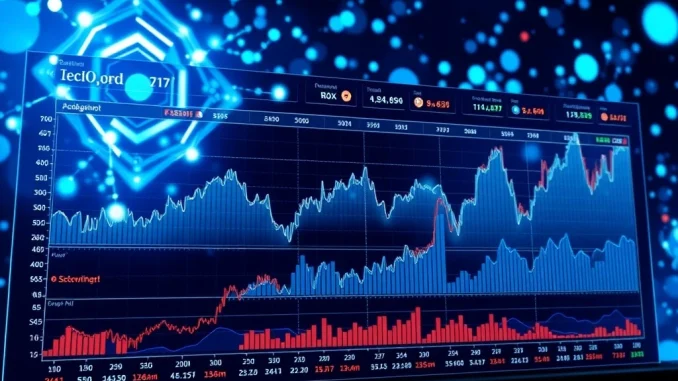
The decentralized finance (DeFi) landscape consistently showcases remarkable innovation and growth. One platform making significant waves is Bluefin, a prominent decentralized derivatives exchange built on the high-performance Sui network. This innovative platform recently announced a staggering achievement: its cumulative Bluefin trading volume has soared past an impressive $78 billion. This milestone underscores its growing influence within the crypto derivatives market and signals robust user adoption.
Bluefin’s Ascent: Dominating Decentralized Derivatives
Bluefin, known by its token symbol BLUE, operates as a leading decentralized exchange focused on derivatives trading. This means users can trade contracts that derive their value from an underlying asset, such as cryptocurrencies, without needing a centralized intermediary. The platform’s success is not just limited to its trading volume; it has also reported substantial growth in other key metrics. Total deposits on Bluefin have exceeded $220 million, demonstrating significant user trust and capital inflow. Furthermore, the number of unique wallets interacting with the platform has surpassed 2.2 million. These figures collectively paint a clear picture of a thriving and expanding ecosystem.
The core appeal of a decentralized exchange like Bluefin lies in its commitment to transparency, security, and user control. Traders maintain custody of their assets, mitigating risks associated with centralized platforms. This self-custody model resonates strongly with the ethos of the broader cryptocurrency community. Consequently, many users prefer these platforms for their trading activities.
Leveraging the Power of the Sui Network
Bluefin’s foundation on the Sui network is a critical component of its success. Sui, a Layer 1 blockchain, is celebrated for its high throughput, low latency, and developer-friendly environment. These technical advantages directly translate into a superior trading experience for Bluefin users. Transactions process quickly, which is essential for derivatives trading where market conditions can change in milliseconds. Moreover, the network’s efficient architecture often results in lower transaction fees, making trading more cost-effective for participants. Therefore, the choice of Sui as its underlying blockchain has been instrumental in enabling Bluefin to handle its massive trading volume and user base.
The integration with Sui ensures that Bluefin can scale effectively to meet increasing demand. As more traders flock to decentralized derivatives, the ability of the underlying blockchain to support high transaction loads without compromising performance becomes paramount. Sui’s innovative object-centric model and parallel execution capabilities provide the necessary infrastructure for Bluefin to thrive and expand further.
Unpacking the Significance of Crypto Derivatives
Crypto derivatives are advanced financial instruments that allow traders to speculate on the future price movements of cryptocurrencies without owning the underlying assets directly. This includes futures, options, and perpetual contracts. These tools offer several advantages, such as hedging against price volatility, amplifying potential returns through leverage, and diversifying investment strategies. The decentralized nature of Bluefin’s offerings provides an added layer of security and transparency to this complex trading sector.
The increasing popularity of decentralized crypto derivatives exchanges highlights a maturation of the DeFi space. As the market evolves, sophisticated financial products become more accessible to a broader audience. Bluefin’s substantial trading volume indicates a strong appetite for these instruments within a decentralized framework. It suggests that users are increasingly comfortable engaging with complex financial products on blockchain-based platforms.
Future Outlook: The Bluefin BLUE Token Buyback Program
Looking ahead, Bluefin has announced a strategic buyback program scheduled to commence in October. A token buyback program typically involves a company repurchasing its own tokens from the open market. This action can potentially reduce the circulating supply of the token, which, under certain market conditions, may lead to increased scarcity and potentially positively impact the token’s value. For the Bluefin BLUE token holders, this upcoming event is a significant development.
Buybacks are often viewed as a sign of confidence from the platform in its own future prospects and financial health. It can signal to the community that the project is committed to delivering value to its token holders. This move could further strengthen community engagement and investor confidence in Bluefin’s long-term vision. The execution of this program will be closely watched by the market and the Bluefin community alike.
Conclusion: A New Benchmark in Decentralized Trading
Bluefin’s achievement of over $78 billion in cumulative trading volume, alongside robust growth in deposits and unique wallets, sets a new benchmark for decentralized derivatives exchanges. Its strategic integration with the high-performance Sui network provides a solid foundation for continued expansion. As the platform prepares for its BLUE token buyback program, Bluefin continues to solidify its position as a key player in the evolving DeFi landscape. This impressive performance underscores the growing demand for secure, transparent, and efficient decentralized trading solutions.
Frequently Asked Questions (FAQs)
Q1: What is Bluefin (BLUE)?
Bluefin (BLUE) is a decentralized derivatives exchange. It allows users to trade financial contracts that derive their value from an underlying asset, such as cryptocurrencies, without the need for a centralized intermediary.
Q2: What is the significance of Bluefin’s $78 billion trading volume?
The $78 billion cumulative trading volume signifies Bluefin’s substantial growth and strong adoption within the decentralized finance (DeFi) sector. It demonstrates significant user activity and confidence in the platform’s ability to facilitate large-scale crypto derivatives trading.
Q3: How does the Sui network contribute to Bluefin’s success?
The Sui network, a high-performance Layer 1 blockchain, provides Bluefin with essential infrastructure. This includes high transaction throughput, low latency, and cost-effective operations, which are crucial for efficient derivatives trading and a superior user experience.
Q4: What are crypto derivatives, and why are they important?
Crypto derivatives are financial instruments like futures and options that allow traders to speculate on cryptocurrency price movements without directly owning the assets. They are important for hedging risks, leveraging positions, and diversifying investment strategies in the volatile crypto market.
Q5: What is the Bluefin (BLUE) token buyback program?
Bluefin announced a buyback program set to begin in October. This involves the platform repurchasing its own BLUE tokens from the open market. Such programs can potentially reduce the circulating supply, signaling confidence and potentially impacting token value.
Q6: How many unique wallets have interacted with Bluefin?
Bluefin has reported that over 2.2 million unique wallets have interacted with its platform. This metric highlights the broad user base and extensive engagement Bluefin has achieved within the DeFi community.
This article was produced with AI assistance and reviewed by our editorial team for accuracy and quality.