Global, February 13, 2025: The cryptocurrency market presents a contrasting landscape this week. Established assets like Shiba Inu (SHIB) and Solana (SOL) are navigating significant bearish pressure, while the concluding private sale for the upcoming BlockDAG network draws focused attention from traders seeking new ecosystem entry points ahead of its scheduled exchange debuts.
Market Context: Volatility and Shifting Sentiment
The digital asset sector remains characterized by high volatility. Broader macroeconomic factors, including shifting interest rate expectations and regulatory developments, continue to influence trader behavior across major and minor cryptocurrencies. This environment often leads to capital rotation, where funds move from underperforming assets toward new protocols or those demonstrating strong developmental milestones. The current price action of Shiba Inu and Solana must be viewed within this wider framework of risk assessment and portfolio rebalancing common in cryptocurrency markets.
Shiba Inu Coin Faces Sustained Selling Pressure
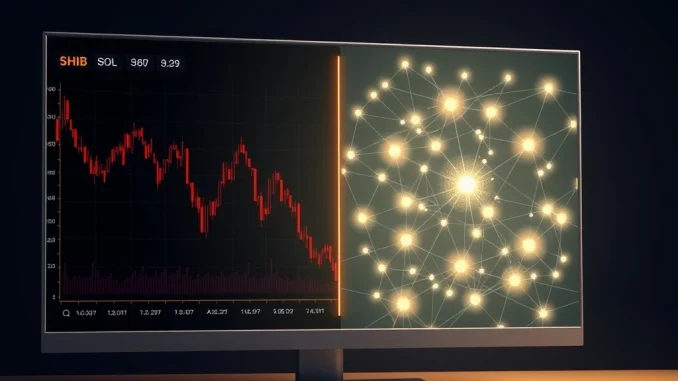
Shiba Inu (SHIB), the Ethereum-based meme cryptocurrency, has seen its value decline over recent trading sessions. Data from major exchanges shows a consistent downward trend, with the asset testing key support levels that have not been visited for several months.
- Price Action: SHIB’s decline correlates with a decrease in its trading volume and social media engagement metrics, a common pattern for assets in its category.
- On-Chain Data: Analysis of blockchain explorers indicates an increase in token movement from longer-term holding wallets to exchanges, often interpreted as a precursor to selling.
- Ecosystem Developments: Despite the price drop, the Shiba Inu development team continues to work on its layer-2 solution, Shibarium. Market analysts note that the success of such underlying technology is typically a long-term value driver, distinct from short-term speculative price movements.
The bearish trend for SHIB underscores the inherent volatility of meme-based cryptocurrencies, which can be disproportionately affected by shifts in market sentiment compared to projects with extensive utility-focused roadmaps.
Solana Network Grapples with Technical and Market Hurdles
Solana (SOL), a high-throughput blockchain platform, is also experiencing a corrective phase. After a period of strong performance driven by its growing decentralized finance (DeFi) and non-fungible token (NFT) ecosystems, the network faces a combination of challenges.
- Price Correction: SOL has retreated from its recent highs. This aligns with a cooling-off period observed across several major altcoins following a previous bullish cycle.
- Network Performance: While Solana’s transaction speed remains a key advantage, the community and developers remain vigilant about network stability. Past instances of congestion have highlighted the scaling challenges even for advanced blockchains.
- Competitive Landscape: The blockchain space is fiercely competitive. The emergence of new, scalable networks like Aptos and Sui, alongside continued development on Ethereum’s layer-2 solutions, presents an ongoing challenge for Solana to maintain its market position and developer mindshare.
Analysts emphasize that corrections are a normal part of market cycles, especially for assets that have appreciated rapidly. The fundamental assessment of Solana hinges on its ability to maintain developer activity and user adoption through this phase.
Understanding Private Sales and Exchange Listings
In blockchain fundraising, a private sale is an early investment round typically accessible to venture capital firms, angel investors, and sometimes, through specific platforms, to the public. It precedes a project’s listing on public cryptocurrency exchanges. The period between a sale closing and the first exchange listing (often referred to as the Token Generation Event or TGE) is a critical phase where the project’s initial circulating supply is established and early distribution occurs. Investors participate in these early rounds anticipating that the public listing price will be higher, though this carries significant risk as the project is often in its earliest stages.
BlockDAG Approaches a Key Fundraising Milestone
Amid the turbulence affecting SHIB and SOL, significant attention has turned to the final phase of BlockDAG’s private sale. BlockDAG is a proposed blockchain protocol that utilizes a Directed Acyclic Graph (DAG) structure combined with traditional blockchain elements, aiming to address scalability limitations. The project’s fundraising event is scheduled to conclude imminently, with its first public exchange listings announced for February 16, 2025.
| Phase | Status | Key Date |
|---|---|---|
| Private Sale Rounds | Final Stage | Closing Imminently |
| Token Distribution (TGE) | Pending | On or before Feb 16 |
| Initial Exchange Listings | Scheduled | February 16, 2025 |
The technical premise of BlockDAG involves processing multiple transactions concurrently through its DAG architecture, theoretically allowing for higher throughput than linear blockchains. It is crucial for readers to understand that such projects are highly speculative. While the architecture presents interesting theoretical advantages, its real-world performance, security, and adoption are unproven at launch. The “200× ROI” figure cited in some communications is a forward-looking, hypothetical projection based on optimistic scenarios and should not be considered a guarantee or prediction of future performance.
The Role of Market Cycles in Capital Allocation
The concurrent bearish trends for SHIB/SOL and the interest in BlockDAG’s sale exemplify a recurring pattern in crypto markets. During periods of consolidation or downturn for major assets, a segment of traders actively seeks exposure to new, early-stage projects. This strategy is based on the premise that nascent protocols have higher growth potential, albeit with substantially higher risk. This capital rotation is a double-edged sword; it can provide vital funding for innovation but also fuels a market cycle where many new projects fail to deliver on their promises after listing.
Conclusion: A Market of Contrasts and Calculated Risks
The current cryptocurrency landscape highlights the diverse strategies and risk profiles present within the asset class. The downward pressure on Shiba Inu and Solana reflects both asset-specific challenges and broader market recalibration. Simultaneously, the closing window for BlockDAG’s private sale represents the high-risk, high-potential-reward end of the spectrum, attracting capital looking for the next growth narrative ahead of its exchange debut. For any market participant, navigating this environment requires rigorous research, a clear understanding of a project’s underlying technology and team, and a disciplined approach to risk management, far removed from the influence of hype or fear of missing out.
FAQs
Q1: What is causing the current price decline for Shiba Inu (SHIB)?
The decline is likely due to a combination of broader market sentiment, decreased trading volume, and profit-taking after previous gains. Meme coins like SHIB are particularly sensitive to shifts in social sentiment and overall crypto market risk appetite.
Q2: Are Solana’s technical problems the main reason for its price drop?
While past network congestion issues remain a consideration for long-term investors, the current price action is more aligned with a market-wide correction. Solana’s fundamental value proposition still rests on its high speed and low costs, but it faces increasing competition.
Q3: What is a private sale in cryptocurrency?
A private sale is an early funding round where a project sells its tokens to selected investors before they are available to the general public on exchanges. It carries high risk as the project is often in a very early stage of development.
Q4: What does “BlockDAG” refer to, technically?
BlockDAG is a hybrid architecture that combines elements of a blockchain (a linear chain of blocks) with a Directed Acyclic Graph (DAG), which allows for multiple chains of transactions to be processed in parallel. The goal is to achieve greater scalability and transaction speed.
Q5: Should the “200× ROI” projection for BlockDAG be taken as financial advice?
Absolutely not. Any projected return on investment, especially one as high as 200x, is a speculative forecast, not a guarantee. Investing in early-stage cryptocurrency projects is extremely risky and carries a high probability of loss. Always conduct your own independent research and consult with a qualified financial advisor.
Updated insights and analysis added for better clarity.
This article was produced with AI assistance and reviewed by our editorial team for accuracy and quality.