Global, June 2025: The blockchain sector witnesses a significant shift as BlockDAG successfully launches its mainnet, reporting a transaction throughput of 5,000 TPS (transactions per second). This development coincides with a period of notable price stability for major altcoins Tron (TRX) and Chainlink (LINK), presenting a contrasting narrative of technological breakthrough alongside market consolidation. The event prompts a fresh evaluation of scalability solutions and asset performance in the current crypto cycle.
BlockDAG Mainnet Launch: A Scalability Milestone
The launch of BlockDAG’s mainnet represents a practical attempt to address one of blockchain’s most persistent challenges: scalability. Unlike traditional linear blockchains like Bitcoin or Ethereum, a Directed Acyclic Graph (DAG) structure allows for multiple chains to exist concurrently, enabling parallel transaction processing. The reported 5,000 TPS figure, if sustained under real-world load, positions BlockDAG’s theoretical capacity far above Ethereum’s current base layer performance and closer to the realm of high-performance payment networks. Network validators have begun processing the first live transactions, marking the transition from testnet to a fully operational, decentralized network. The mainnet release typically includes the full suite of core functionalities: smart contract execution, token transfers, and consensus mechanism operation, inviting developers to build decentralized applications (dApps) on the new infrastructure.
Tron Price Rebound and Market Steadiness
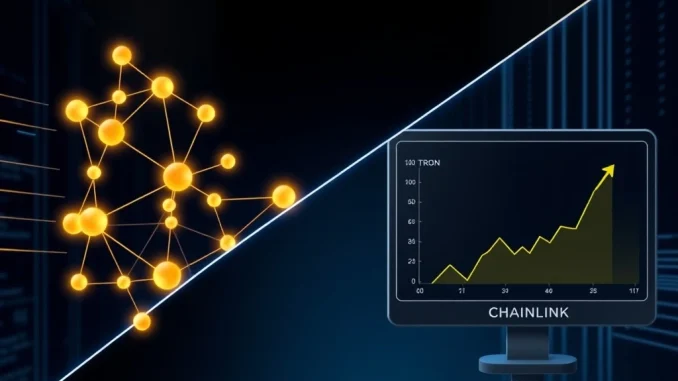
Concurrent with this technological launch, the Tron network’s native token, TRX, has demonstrated a resilient price trajectory. After a period of volatility common to the broader digital asset market, TRX has shown a consistent rebound, stabilizing around key support levels identified by market analysts. This stability is often attributed to several fundamental factors. The Tron network continues to maintain high activity in its core use cases, particularly in decentralized finance (DeFi) and the stablecoin sector, with significant volumes of USDT settled on its chain. Furthermore, consistent staking yields and ongoing development updates from the Tron DAO contribute to holder confidence. This price steadiness, amidst a flurry of new launches, suggests a maturation phase where established networks with clear utility are evaluated differently by the market compared to emerging, unproven technologies.
The Technical Underpinnings of DAG Architecture
To understand the significance of BlockDAG’s claim, one must examine the DAG framework. In a blockchain, transactions are grouped into blocks that are added to a single, sequential chain. In a DAG, individual transactions can reference multiple previous transactions, weaving a web-like structure. This design aims to eliminate bottlenecks inherent in block creation times and size limits. However, it introduces new complexities in achieving consensus and preventing conflicts. Projects like IOTA and Hedera Hashgraph have previously explored DAG-like structures, with varying degrees of adoption and decentralization. BlockDAG’s implementation will be scrutinized for its security model, degree of decentralization, and ability to handle smart contracts as effectively as it promises to handle simple transactions.
Chainlink Price Stability Amidst Oracle Reliability
Similarly, Chainlink’s LINK token has entered a phase of pronounced price stability. As the leading decentralized oracle network, Chainlink’s value proposition is directly tied to the reliability and security of its data feeds, which connect off-chain information to on-chain smart contracts. The steady price action reflects a market perception of Chainlink as essential, infrastructural middleware. Its performance is less dependent on speculative narratives about scalability and more on the continued growth of the smart contract economy that requires external data. The stability indicates that the market prices LINK based on measurable metrics like the number of secure data feeds, integration partnerships with other blockchains (including potential newcomers like BlockDAG), and total value secured (TVS) by its oracles. This creates a distinct investment thesis separate from pure throughput claims.
Comparative Analysis: Throughput vs. Ecosystem Value
The simultaneous occurrence of a high-TPS mainnet launch and stable prices for established assets highlights a bifurcation in market drivers. The table below outlines the core contrasts:
| Metric | BlockDAG (New Mainnet) | Tron & Chainlink (Established) |
|---|---|---|
| Primary Focus | Technical Scalability (5,000 TPS) | Ecosystem Utility & Network Security |
| Market Signal | Speculation on Future Potential | Valuation Based on Current Usage |
| Key Risk | Unproven Security & Adoption | Competition & Technological Disruption |
| Key Strength | Novel Architecture for Speed | Proven Track Record & Developer Base |
This divergence suggests that the cryptocurrency market in 2025 is developing more nuanced evaluation criteria. While raw throughput remains a powerful headline, sustained value is increasingly associated with demonstrable utility, security audits, and a robust, active community of builders and users.
Historical Context and the Scalability Race
The pursuit of higher transaction throughput is a constant in blockchain history. Ethereum’s own roadmap, through its rollup-centric scaling strategy, aims to achieve massive TPS at the Layer 2 level. Solana has built its reputation on high throughput, though not without network congestion events. BlockDAG’s entry is the latest chapter in this ongoing race. Its success will not be determined by a single benchmark but by its ability to maintain decentralization, security, and developer-friendliness at scale—a challenge known as the “blockchain trilemma.” Historical precedents show that networks which solve for all three aspects sustainably tend to achieve long-term viability, regardless of their peak theoretical TPS.
Implications for Developers and the Broader Ecosystem
For blockchain developers, the launch of a new mainnet with high-throughput claims presents both an opportunity and a dilemma. The opportunity lies in potentially lower transaction costs and faster execution times for applications requiring high frequency, such as gaming or micro-transactions. The dilemma involves platform risk: committing resources to a new, unproven chain versus building on established ecosystems with larger user bases. The stability of tokens like LINK and TRX, underpinned by their networks’ proven utility, offers a counter-argument for conservative development. The health of the overall ecosystem may depend on whether new architectures like BlockDAG’s can interoperate effectively with existing oracle solutions and decentralized finance legos, rather than seeking to replace them entirely.
Conclusion
The BlockDAG mainnet launch, achieving a reported 5,000 TPS, marks a bold technical experiment in blockchain scalability. Its long-term impact, however, will be measured over months and years, not in its inaugural performance figures. The simultaneous Tron price rebound and Chainlink price steadiness provide a crucial counterpoint, demonstrating that market maturity increasingly rewards proven utility and reliable infrastructure alongside raw innovation. The evolving narrative is no longer solely about who can process the most transactions, but about which networks can provide secure, stable, and useful environments for global value exchange and application development. The stability of established assets amidst this innovation suggests a market growing more sophisticated in its assessment of fundamental value.
FAQs
Q1: What does 5,000 TPS mean for a blockchain like BlockDAG?
A1: TPS stands for Transactions Per Second. A claim of 5,000 TPS suggests the BlockDAG network can theoretically process that many transactions in one second, which is significantly higher than many legacy blockchains. This metric targets scalability for mass adoption but must be validated under real-world, adversarial conditions with full decentralization.
Q2: Why are Tron and Chainlink prices stable during a new mainnet launch?
A2: Price stability for TRX and LINK likely reflects their established utility. Tron has high usage in stablecoin transfers and DeFi, while Chainlink provides critical oracle services to many blockchains. Their value is tied to ongoing network usage and proven track records, making them less susceptible to hype cycles around new technological launches.
Q3: What is the main difference between a blockchain and a DAG?
A3: A traditional blockchain orders transactions in sequential, linear blocks. A Directed Acyclic Graph (DAG) structures transactions in a web-like format where each new transaction can confirm multiple previous ones, allowing for parallel processing. This aims to increase speed but requires different consensus mechanisms.
Q4: Could BlockDAG’s technology impact Ethereum?
A4: In the short term, they target different market segments. Ethereum focuses on security and decentralization, scaling via Layer 2 solutions. BlockDAG presents an alternative Layer 1 architecture. Impact would depend on BlockDAG achieving significant developer adoption, security, and successful interoperability with the broader ecosystem, including Ethereum itself.
Q5: What should investors watch regarding these developments?
A5: For BlockDAG, monitor network activity, security audits, and the growth of its dApp ecosystem post-launch. For Tron and Chainlink, watch key fundamental metrics like Total Value Locked (TVL), partnership announcements, and the stability of their core services. The critical factor is the sustained delivery of utility, not just technical specifications.
Updated insights and analysis added for better clarity.
This article was produced with AI assistance and reviewed by our editorial team for accuracy and quality.