Global, May 2025: The cryptocurrency landscape is undergoing a significant recalibration. The imminent Mainnet and Token Generation Event (TGE) launch for BlockDAG, a project employing a novel directed acyclic graph architecture, arrives during a period of notable market share redistribution among established giants Ethereum, Solana, and Binance Coin. This convergence of a new network launch and shifting dominance among incumbents presents a complex picture for analysts evaluating potential return on investment (ROI) in the digital asset space. This analysis examines the technical developments, staking economics, and broader market context defining this moment.
Understanding the Current Highest-ROI Crypto Landscape
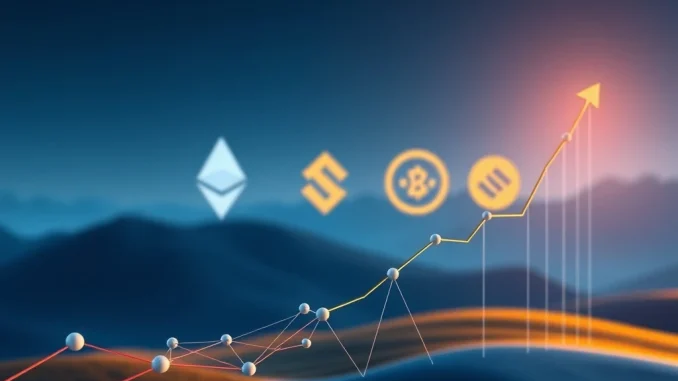
Evaluating return on investment in cryptocurrency requires a multi-faceted approach beyond simple price appreciation. Analysts now consistently weigh network utility, developer activity, staking yield sustainability, and technological roadmap execution. The first quarter of 2025 has been characterized by a maturation of this framework. Ethereum continues to solidify its position as the foundational settlement layer for decentralized finance and institutional applications, but its market share in key metrics like daily active addresses and non-fungible token volume has seen gradual erosion. Simultaneously, Solana has demonstrated resilience and regained throughput stability after past network challenges, capturing a larger portion of the retail and high-frequency transaction market. Binance Coin’s valuation remains closely tied to the expansive Binance ecosystem, including its centralized exchange volume and the growth of the BNB Chain.
The BlockDAG Mainnet and TGE: A New Architectural Entry
The launch of a mainnet represents the transition from a test network to a fully operational, public blockchain. BlockDAG’s approach utilizes a Directed Acyclic Graph structure, which differs from the traditional linear blockchain model used by Bitcoin and, in a hybrid form, Ethereum. Proponents of DAG architectures argue they can potentially offer higher transaction throughput and lower fees by allowing multiple blocks to be confirmed simultaneously. The success of this launch hinges on several technical and community factors.
- Network Stability: The primary metric post-launch will be consistent uptime and the absence of critical consensus failures.
- Developer Adoption: The migration of projects from the testnet and the attraction of new developers to build decentralized applications will be crucial for long-term value.
- Decentralization Metrics: The distribution of nodes and the prevention of early centralization in mining or validation will be closely watched by the community.
The accompanying Token Generation Event distributes the network’s native token, which will be used for transaction fees, staking, and governance. The market’s valuation of this token will initially reflect speculation on the network’s future utility rather than proven use.
Staking Trends and Yield Economics in 2025
Staking, the process of locking tokens to participate in network security and consensus, has become a central component of crypto ROI. Yields are not static and adjust based on network participation and tokenomics. Ethereum’s transition to Proof-of-Stake has created a massive staking market, with yields currently derived from transaction fees and new issuance, often ranging between 3-5% annually. Solana staking offers higher nominal yields, sometimes exceeding 7%, but carries different technical risks and inflation schedules. BNB staking is multifaceted, offering rewards through the Binance exchange, the BNB Chain, and various launchpad programs. For any new entrant like BlockDAG, establishing a secure, attractive, and sustainable staking model is essential to attract and retain capital, moving beyond mere speculative trading.
Ethereum, Solana, and BNB: Analyzing the Market Share Shift
The term “market share” in crypto applies across several dimensions: total value locked in DeFi, daily transaction volume, developer mindshare, and overall capitalization. Recent data indicates a subtle but important shift.
| Network | Primary Driver | Current Challenge | Growth Vector |
|---|---|---|---|
| Ethereum (ETH) | Institutional adoption, Layer-2 ecosystem scale | High base-layer fees, competition for scalable execution | Full realization of rollup-centric roadmap, account abstraction |
| Solana (SOL) | Retail engagement, high-throughput applications | Past reliability concerns, need for diversified client software | Firedancer client deployment, expansion into decentralized physical infrastructure |
| Binance Coin (BNB) | Centralized exchange utility, BNB Chain activity | Regulatory scrutiny of affiliated entities, ecosystem dependence | Growth of opBNB and Greenfield for data storage |
This dynamic creates openings and challenges. Ethereum’s scaling efforts benefit the entire industry but allow other chains to compete for specific use cases. Solana’s recovery has validated its core technology thesis for a segment of the market. BNB’s trajectory remains uniquely linked to the fortunes of its parent ecosystem. This fluidity is the context into which new networks launch.
Evaluating Growth Potential: A Framework Beyond Hype
Discussions of exponential growth potential, such as references to “300x” returns, often stem from comparing a low initial market capitalization to the established size of incumbents. This is a purely mathematical, speculative exercise. A more substantive framework for evaluating a new network’s potential involves:
- Technical Differentiation: Does the new technology solve a clear, painful problem for users or developers that existing chains do not?
- Ecosystem Funding: Is there a substantial, well-managed treasury or grant program to incentivize high-quality project development?
- Community Governance: Are there clear, fair, and transparent pathways for token holders to influence the project’s future direction?
- Market Timing: Does the launch address a current market need or developer demand, or is it simply adding another similar option?
For investors and observers, applying this framework provides a more grounded analysis than projections based on historical hype cycles. The real growth potential of any crypto asset, new or old, is inextricably linked to the tangible utility and security it provides to a growing user base.
Conclusion
The launch of the BlockDAG Mainnet and its TGE represents a significant milestone for its project and community, introducing a different architectural approach to the market. Its long-term success and position among highest-ROI crypto assets will depend entirely on its execution in the coming months—specifically, its technical stability, its ability to attract developers, and the real-world utility of its applications. This launch occurs not in a vacuum, but amidst the ongoing and gradual market share shifts between Ethereum, Solana, and BNB, each of which is evolving to address its own challenges and opportunities. For the informed observer, this period is less about picking a single winner and more about understanding how the interplay of technological innovation, economic incentives, and market dynamics continues to reshape the blockchain ecosystem.
FAQs
Q1: What is a Mainnet launch in cryptocurrency?
A Mainnet launch is the deployment of a fully functional, public, and live blockchain network. It marks the end of the testing phase, allowing real transactions and the hosting of actual decentralized applications using the native cryptocurrency.
Q2: How does a Directed Acyclic Graph (DAG) differ from a blockchain?
While a traditional blockchain orders transactions in a single, linear chain of blocks, a DAG structure allows multiple blocks to be created and confirmed concurrently in a web-like formation. This aims to improve scalability and transaction speed, though it presents different consensus and security design challenges.
Q3: What factors are causing market share shifts between Ethereum, Solana, and BNB?
The shifts are driven by several factors: the scaling progress and fee dynamics of Ethereum’s Layer 2 networks, the technical performance and developer adoption on Solana, and the regulatory and ecosystem developments surrounding the Binance exchange and BNB Chain. Different chains are capturing different segments of user activity.
Q4: What does ROI in crypto typically include beyond price gain?
Modern crypto ROI analysis often includes staking yields, participation in decentralized finance lending protocols, rewards from liquidity provision, and governance rights that may provide future value. It is a measure of total return on capital deployed within the ecosystem.
Q5: Why is staking important for a new network like BlockDAG?
Staking is critical for network security in Proof-of-Stake systems. A healthy staking environment with sufficient participation helps prevent attacks, ensures smooth consensus, and can attract long-term holders interested in yield, which reduces volatile selling pressure on the native token.