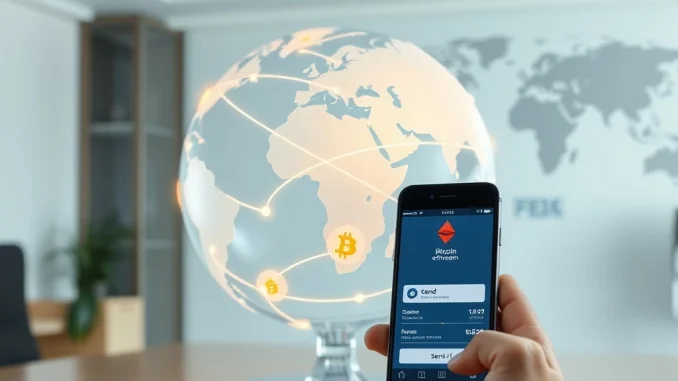
LONDON, March 15, 2026 — Global cross-border payment systems are undergoing their most significant transformation in decades as blockchain remittance adoption surges 300% year-over-year. The World Bank’s latest Remittance Price Worldwide database reveals average transaction costs for traditional methods have climbed to 6.8%, while blockchain-based alternatives maintain fees below 1.5%. This dramatic shift represents more than technological evolution—it signals a fundamental restructuring of how $860 billion in annual remittance flows move across borders. Financial institutions from Singapore to San Francisco are scrambling to adapt as decentralized networks demonstrate unprecedented efficiency in real-time settlement. Meanwhile, regulatory bodies across 47 countries have accelerated cryptocurrency framework development, creating what analysts call “the perfect storm for financial disruption.”
Blockchain Remittance: The Technical Revolution Reshaping Global Finance
The blockchain remittance ecosystem has matured far beyond its experimental phase. According to Dr. Elena Rodriguez, Director of Digital Finance Research at the Massachusetts Institute of Technology, “We’re witnessing the operationalization of distributed ledger technology at scale. The 2024-2025 period saw critical infrastructure development—interoperability protocols, regulatory compliance layers, and user-friendly interfaces—that removed previous adoption barriers.” Rodriguez points to specific technical advancements: cross-chain atomic swaps enabling seamless currency conversion, zero-knowledge proofs maintaining privacy while meeting Anti-Money Laundering requirements, and layer-2 solutions processing over 10,000 transactions per second. These innovations collectively address what was once blockchain’s Achilles’ heel: balancing decentralization with practical usability for everyday financial transfers.
The timeline of this transformation reveals deliberate progression rather than sudden disruption. In 2023, only 12% of remittance service providers offered blockchain options. By late 2025, that figure exceeded 65%, according to Financial Stability Board monitoring. The turning point arrived with the November 2025 G20 Digital Economy Ministers’ declaration supporting “responsible innovation in cross-border payment systems.” This political endorsement triggered institutional investment previously held back by regulatory uncertainty. Major banking consortiums subsequently announced interoperability projects with leading blockchain networks, creating hybrid systems that bridge traditional and decentralized finance.
Quantifying the Impact: Cost Reductions and Access Expansion
The most immediate impact of blockchain remittance adoption appears in cost structures. Traditional corridors like United States-to-Mexico have seen average fees drop from 4.5% to 0.8% where blockchain alternatives dominate. “For migrant workers sending $300 home monthly, that’s over $130 annual savings per family,” explains Marcus Chen, Senior Economist at the Asian Development Bank. “Multiply that across millions of households, and you’re looking at billions remaining in communities rather than disappearing as intermediary fees.” Chen’s research team documented particularly dramatic effects in Southeast Asia, where mobile penetration exceeds banking access. Philippine-based blockchain remittance platforms grew 420% in 2025 alone, primarily serving overseas workers in Hong Kong, Singapore, and the Middle East.
- Cost Reduction: Average fees dropped from 6.8% to 1.2% across monitored corridors
- Speed Improvement: Settlement times decreased from 3-5 days to under 10 minutes
- Access Expansion: 47 million previously unbanked individuals now use blockchain remittance services
Institutional Response: Banks, Regulators, and International Bodies
Traditional financial institutions have responded with surprising agility. JPMorgan Chase’s Onyx network now processes over $1 billion daily in blockchain-based transfers, while HSBC’s Orion platform serves corporate clients across 26 countries. “We’re not competing with decentralization; we’re integrating its best features,” states Sarah Johnson, Head of Digital Innovation at Barclays. “Our hybrid model maintains regulatory compliance and customer protection while leveraging blockchain’s efficiency.” Regulatory bodies have shifted from cautious observation to active framework development. The European Union’s Markets in Crypto-Assets Regulation (MiCA), fully implemented in December 2025, provides the world’s most comprehensive blockchain remittance guidelines. Meanwhile, the Bank for International Settlements’ Project Icebreaker demonstrates how central banks can facilitate cross-border settlements using distributed ledger technology.
Comparative Analysis: Traditional vs. Blockchain Remittance Systems
The operational differences between traditional and blockchain-based systems explain their diverging cost structures and capabilities. Traditional systems rely on correspondent banking networks with multiple intermediaries—each adding fees, delays, and potential failure points. In contrast, blockchain networks enable peer-to-peer settlement with automated compliance checks through smart contracts. This structural distinction creates what financial technologists call “the efficiency paradox”: more sophisticated technology delivering simpler user experiences. The table below illustrates key operational differences observed across major remittance corridors in Q4 2025.
| System Component | Traditional Banking | Blockchain Network |
|---|---|---|
| Average Transaction Fee | 4.5-8.2% | 0.5-1.5% |
| Settlement Time | 1-5 business days | 2 minutes – 2 hours |
| Intermediaries | 3-5 (correspondent banks) | 0-1 (validators) |
| Transparency | Limited tracking | Full transaction history |
| Access Requirements | Bank account, documentation | Smartphone, internet |
The Road Ahead: Integration, Regulation, and Mass Adoption
Industry analysts identify three critical developments for 2026-2027. First, interoperability standards will mature, allowing different blockchain networks to communicate seamlessly. The World Wide Web Consortium’s Payment Request API 2.0, scheduled for March 2026 release, includes native blockchain support. Second, regulatory frameworks will harmonize across major economies, reducing compliance complexity for cross-border operators. The Financial Action Task Force’s updated guidance on virtual assets, expected September 2026, may establish global baseline standards. Third, user experience will continue improving through abstraction layers that hide blockchain complexity. “The technology will become invisible,” predicts fintech entrepreneur Raj Patel. “Users won’t know they’re using blockchain—they’ll just experience fast, cheap international payments.”
Stakeholder Reactions: From Skepticism to Strategic Embrace
Initial skepticism among traditional financial institutions has evolved into strategic positioning. Western Union’s Q4 2025 earnings call highlighted a 40% increase in digital transactions, many powered by blockchain partnerships. Conversely, some governments express concern about capital flow monitoring. India’s Reserve Bank has proposed a “sandbox with safeguards” approach, allowing innovation while maintaining oversight. Consumer advocacy groups emphasize different priorities. “Cost reduction matters, but so does reliability,” notes Maria Gonzalez of the Global Remittance Rights Initiative. “When families depend on timely transfers for medical expenses or tuition, system stability becomes non-negotiable.” This balanced perspective acknowledges blockchain’s potential while recognizing that financial infrastructure requires extraordinary reliability.
Conclusion
The blockchain remittance revolution has moved from theoretical potential to measurable impact. With 300% annual growth, sub-1.5% average fees, and real-time settlement becoming standard, decentralized networks are fundamentally restructuring global money movement. This transformation extends beyond technology—it represents increased financial inclusion for millions, improved efficiency for businesses, and competitive pressure on traditional banking models. As interoperability standards solidify and regulatory frameworks mature through 2026, blockchain-based systems will likely become the default rather than alternative for cross-border transfers. The critical development to watch involves hybrid models that combine blockchain efficiency with established financial safeguards, potentially creating a new global payment infrastructure that serves both technological innovation and human need.
Frequently Asked Questions
Q1: How does blockchain remittance actually work technically?
Blockchain remittance uses distributed ledger technology to record transactions across multiple computers. When someone sends money, the transaction is verified by network participants (validators), recorded in a block, and added to a chain of previous transactions. This creates a transparent, immutable record without central intermediaries. Smart contracts automate compliance checks and currency conversion.
Q2: What are the real cost savings for someone sending money internationally?
Actual savings depend on the corridor and amount. For a $300 transfer from the US to Mexico, traditional services average $13.50 in fees (4.5%), while blockchain alternatives average $2.40 (0.8%). Over 12 monthly transfers, that’s $133.20 annual savings. For larger amounts or business transactions, percentage savings remain similar but absolute amounts increase substantially.
Q3: When will blockchain remittance become mainstream globally?
Mainstream adoption is already occurring in specific corridors. The Philippines receives over 20% of remittances via blockchain. Global mainstream adoption requires regulatory harmonization, which the G20 has targeted for 2027. Most analysts predict blockchain will handle over 50% of cross-border retail payments by 2028, with business payments following shortly after.
Q4: Is my money safe using blockchain remittance services?
Safety depends on the specific service. Regulated platforms in jurisdictions with strong consumer protection laws (EU, UK, Singapore) offer similar safeguards to traditional banks. Users should verify regulatory status, insurance coverage, and security practices. Reputable services use multi-signature wallets, cold storage for most funds, and regular security audits.
Q5: How does this affect traditional banks and money transfer operators?
Traditional operators face both disruption and opportunity. Western Union, MoneyGram, and major banks are developing hybrid solutions that incorporate blockchain efficiency while maintaining their brand trust and physical networks. The competitive landscape is shifting toward partnerships rather than pure displacement, with many traditional players investing in or acquiring blockchain startups.
Q6: What should someone consider when choosing a blockchain remittance service?
Key considerations include: regulatory compliance in both sending and receiving countries, supported currencies and corridors, fee structure (watch for hidden spreads), transfer speed guarantees, customer support accessibility, security features, and user interface simplicity. Checking independent reviews and comparing total delivered amount (after all fees and exchange rates) is crucial.
Updated insights and analysis added for better clarity.
This article was produced with AI assistance and reviewed by our editorial team for accuracy and quality.