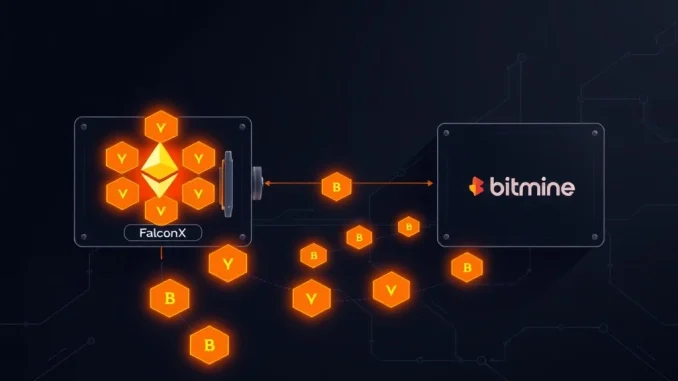
In a significant institutional cryptocurrency transaction, blockchain infrastructure firm Bitmine has reportedly acquired a substantial 24,000 Ethereum (ETH) from institutional trading platform FalconX, a move valued at approximately $80.57 million that signals growing confidence in Ethereum’s long-term infrastructure role. This transaction, identified by blockchain analytics firm Lookonchain on April 10, 2025, represents one of the most notable over-the-counter (OTC) Ethereum transfers of the quarter, immediately drawing analysis from market observers regarding its potential implications for both corporate treasury strategies and broader market sentiment.
Analyzing the Bitmine Ethereum Acquisition Details
Blockchain data confirms the transfer of exactly 24,000 ETH from a wallet associated with FalconX to an address controlled by Bitmine. At the time of the transaction, Ethereum traded around $3,357 per token, resulting in the reported $80.57 million valuation. Consequently, this acquisition represents a substantial capital allocation. Furthermore, the use of an OTC desk like FalconX suggests a desire to execute a large order without causing immediate market slippage on public exchanges. Typically, institutional entities prefer OTC markets for sizable transactions to minimize price impact and ensure settlement efficiency.
Bitmine, known for its mining operations and blockchain node infrastructure services, has increasingly diversified into digital asset management and staking. This acquisition likely serves multiple strategic purposes. Primarily, it may function as a long-term treasury reserve asset, similar to strategies adopted by companies like MicroStrategy with Bitcoin. Alternatively, the Ethereum could be earmarked for staking to generate yield, given Ethereum’s proof-of-stake consensus mechanism. Additionally, the tokens might support operational needs within Bitmine’s infrastructure ecosystem, such as paying network gas fees or participating in governance.
Institutional Crypto Adoption and Market Context
The transaction occurs within a broader context of accelerating institutional adoption of digital assets. Notably, 2024 and 2025 have witnessed a maturation in regulatory frameworks and financial product offerings, such as spot Ethereum ETFs. Institutional players now demonstrate more sophisticated approaches to cryptocurrency allocation, moving beyond simple speculation to integrated treasury and operational use cases. For instance, many firms now treat crypto assets as a legitimate component of a diversified corporate balance sheet.
FalconX’s role as the counterparty highlights the critical function of regulated crypto prime brokers in facilitating large-scale, institutional-grade transactions. These platforms provide essential services like custody, liquidity, and settlement that traditional financial institutions require. The seamless execution of an $80+ million transfer underscores the growing infrastructure maturity supporting the digital asset class. Moreover, it reflects a deepening liquidity pool that can absorb significant transfers without destabilizing spot markets.
Expert Analysis on Treasury Strategy and Market Impact
Financial analysts specializing in digital assets often interpret such large acquisitions as a strong vote of confidence in the underlying asset’s value proposition. “When an infrastructure company like Bitmine allocates a significant portion of capital to Ethereum, it’s not merely a trade; it’s a strategic alignment with the network’s utility,” notes a report from a leading crypto research firm. Experts point to Ethereum’s upcoming protocol upgrades, known as “The Surge” and “The Scourge,” which aim to significantly enhance scalability and reduce costs. These improvements could increase Ethereum’s utility and, by extension, its valuation over time.
The immediate market impact of such an OTC trade is typically muted, as the transaction occurs off public order books. However, the psychological impact and signaling effect can be substantial. It demonstrates to other institutional investors that sizable Ethereum positions are being accumulated by credible industry players. Historically, public disclosure of large acquisitions has sometimes preceded periods of increased institutional interest, as seen with corporate Bitcoin purchases in previous cycles. The transaction also reduces the circulating supply of ETH held on exchanges, a metric often watched by analysts as a precursor to reduced selling pressure.
Comparative Analysis of Major Crypto Acquisitions
To understand the scale of Bitmine’s move, it is useful to compare it with other notable institutional acquisitions. The following table outlines several key transactions from the past two years, highlighting the evolving trend.
| Entity | Asset | Amount Acquired | Approx. Value at Time | Year |
|---|---|---|---|---|
| Bitmine | Ethereum (ETH) | 24,000 ETH | $80.6 Million | 2025 |
| MicroStrategy | Bitcoin (BTC) | ~12,000 BTC | $820 Million | 2024 |
| A Corporate Treasury (Anonymous) | Ethereum (ETH) | 15,000 ETH | $48 Million | 2024 |
| A Sovereign Wealth Fund | Bitcoin (BTC) | ~4,000 BTC | $275 Million | 2023 |
This comparison reveals that while Bitcoin purchases often capture larger headline values, strategic Ethereum acquisitions by operational companies like Bitmine are becoming more frequent. The key differentiators for Ethereum include its programmability through smart contracts and its yield-generating potential via staking, which Bitcoin does not natively offer. These features make ETH uniquely attractive to companies whose business models are intertwined with blockchain functionality.
Potential Strategic Rationales for Bitmine
Several plausible strategic motives underpin this acquisition. Industry observers have outlined the following potential objectives, based on Bitmine’s business model and industry trends:
- Treasry Diversification: Holding ETH as a non-correlated asset to hedge against traditional market volatility and inflation.
- Staking for Yield: Validating on the Ethereum network to earn staking rewards, creating a revenue stream from the asset itself.
- Operational Utility: Using ETH to pay for transaction fees (gas) across various Ethereum-based services and client solutions.
- Ecosystem Participation: Gaining influence or voting power in key Ethereum governance decisions or supporting specific Layer 2 networks.
- Long-Term Appreciation Bet: A straightforward investment based on a bullish fundamental thesis for Ethereum’s future adoption and price.
Each rationale carries different implications. A staking-focused strategy, for example, would indicate a long-term, low-turnover holding period. An operational utility focus suggests deeper integration of Ethereum into Bitmine’s core services. The specific rationale may become clearer through subsequent on-chain activity, such as whether the ETH is moved to a staking contract or remains in a custodial wallet.
Conclusion
The reported acquisition of 24,000 ETH by Bitmine from FalconX stands as a definitive marker of sophisticated institutional engagement with the Ethereum ecosystem. Valued at over $80 million, this transaction underscores a strategic shift where industry-native firms are deploying significant capital into the very networks they help operate. More than a simple investment, this Bitmine Ethereum acquisition reflects a confluence of treasury management, yield generation, and operational strategy. As blockchain analytics continue to provide transparency into these major movements, they offer valuable insights into the evolving confidence levels and tactical approaches of leading companies within the digital asset space. The move reinforces Ethereum’s position as a core holding for institutions seeking both financial exposure and utility within the decentralized web.
FAQs
Q1: What was the exact value of the Ethereum acquired by Bitmine?
The acquisition was for 24,000 ETH. At the transaction time, with Ethereum priced around $3,357, the total value was approximately $80.57 million.
Q2: Why would Bitmine use FalconX for this transaction?
FalconX is an institutional-grade cryptocurrency prime broker. Using an OTC (over-the-counter) desk like FalconX allows for the execution of large orders without causing significant price movement on public exchanges, ensuring better execution and minimal market impact.
Q3: How does this acquisition affect the price of Ethereum?
Because it was likely an OTC transaction, the direct immediate impact on the public spot market price is negligible. However, it signals strong institutional demand and reduces readily available supply on exchanges, which can be a positive long-term sentiment indicator.
Q4: What could Bitmine do with 24,000 Ethereum?
Potential uses include holding it as a treasury asset, staking it to earn network rewards (currently ~3-4% APR), using it to pay for operational costs on the Ethereum network (gas fees), or a combination of these strategies.
Q5: Is this the largest institutional Ethereum purchase on record?
While substantial, it is not the largest. Larger acquisitions have occurred, often by anonymous entities. However, it is one of the most significant publicly identifiable transactions by a known infrastructure company in recent months, highlighting a clear trend.
This article was produced with AI assistance and reviewed by our editorial team for accuracy and quality.