United States, March 2025: Google searches for the phrase “bitcoin to zero” reached their highest possible score of 100 on Google Trends in February 2025, coinciding with Bitcoin’s price decline toward the $60,000 level. This data point, while dramatic, reveals a complex narrative about regional market psychology, the maturity of cryptocurrency adoption, and the perennial tension between fear and opportunity in volatile asset classes. The record search volume from U.S.-based users presents a stark contrast to broader global cryptocurrency metrics, which continue to show institutional integration and regulatory progress. This article examines the context behind the search data, its historical precedents, and what it genuinely signals about the state of the digital asset market.
Bitcoin to Zero Searches: Understanding the Google Trends Data
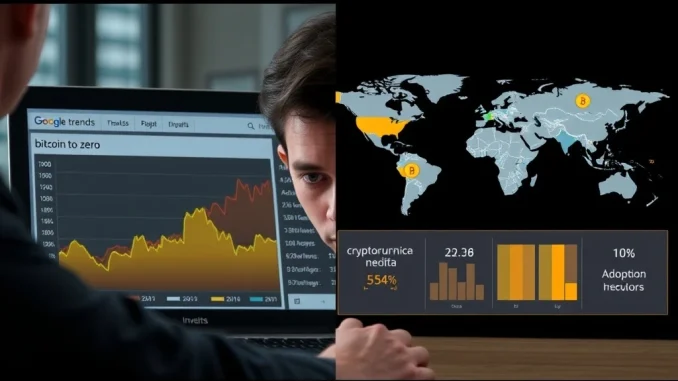
Google Trends does not measure absolute search volume. Instead, it assigns a relative score from 0 to 100, where 100 represents the peak popularity for a term within a specified region and time frame. A score of 100 for “bitcoin to zero” in the United States during February 2025 indicates that search interest for that specific phrase reached its highest point since data tracking began. This peak occurred as Bitcoin’s price, after a strong rally, experienced a corrective pullback. It is critical to interpret this data correctly: it reflects a surge in curiosity or concern, not a prediction or consensus. Historically, similar spikes in fear-based searches have coincided with local price bottoms, as retail investor panic often peaks during sell-offs. Analysts note that search trends are a lagging sentiment indicator, often reflecting price action that has already occurred rather than forecasting future moves.
The Psychology of Market Fear and Retail Investor Behavior
The “to zero” narrative taps into a deep-seated fear of total loss, a powerful psychological trigger in investing. For U.S. retail investors, many of whom entered the cryptocurrency market during the bull runs of 2021 and 2024, sharp corrections can be unnerving. This behavior pattern is not unique to cryptocurrency. Similar fear-based search spikes have been observed during stock market corrections, gold price volatility, and real estate downturns. The cryptocurrency market, with its 24/7 trading and amplified volatility, tends to accelerate these emotional reactions. Several behavioral finance principles are at play:
- Loss Aversion: The pain of a loss is psychologically twice as powerful as the pleasure of an equivalent gain.
- Recency Bias: Investors overweight recent events (a price drop) when making decisions.
- Herding: Searching for a popular phrase like “bitcoin to zero” can be a social signal, as investors seek to understand if others share their concerns.
This search data, therefore, is less a fundamental analysis of Bitcoin and more a real-time gauge of U.S. retail investor anxiety.
A Global Perspective: Diverging Sentiment and Adoption Trends
While U.S. searches for “bitcoin to zero” hit a record, the global story for cryptocurrency is markedly different. Data from other regions and broader market metrics paint a picture of continued integration. In regions like Southeast Asia, Latin America, and parts of Africa, search trends for “bitcoin adoption” and “cryptocurrency remittances” remain strong, driven by practical use cases like cross-border payments and inflation hedging. On-chain data—information recorded on the Bitcoin blockchain—provides a more substantive counterpoint to search trends. Metrics such as the number of active addresses, the volume of large transactions (often indicative of institutional activity), and the holding behavior of long-term investors did not show commensurate panic. Furthermore, developments in the institutional space continued unabated, with announcements regarding cryptocurrency ETFs, custody solutions, and regulatory frameworks in jurisdictions like the European Union and the United Kingdom.
Historical Context: Fear Spikes as Contrarian Indicators
Examining past correlations between extreme fear indicators and market bottoms offers crucial context. Following previous Bitcoin price corrections of 30% or more, similar spikes in negative sentiment—measured by search trends, social media fear, and the Crypto Fear & Greed Index—have often marked short-term capitulation points. For instance, during the market downturn in mid-2022, searches for “crypto winter” and “bitcoin crash” peaked near what was later identified as a significant market low. This pattern aligns with a classic market axiom: “The time of maximum pessimism is the best time to buy.” It is essential to state that past performance does not guarantee future results, and this is not investment advice. However, from a data analysis perspective, extreme retail fear has frequently been a poor timing signal for selling and has sometimes preceded periods of consolidation or recovery. The table below illustrates this historical relationship.
| Period | Fear/Search Spike Event | Bitcoin Price Approx. (USD) | Subsequent 90-Day Price Action |
|---|---|---|---|
| Q1 2020 | “Bitcoin Crash” searches peak | ~$5,000 | +150% |
| Q2 2022 | “Crypto Winter” searches peak | ~$20,000 | Sideways consolidation |
| Q1 2023 | High Fear & Greed Index readings | ~$16,000 | +70% |
Fundamental Factors Versus Sentiment Noise
To separate signal from noise, investors and analysts distinguish between transient sentiment and long-term fundamental drivers. The fundamental case for Bitcoin and digital assets rests on several pillars that were unchanged during the February 2025 search spike:
- Monetary Policy Context: Macroeconomic factors like interest rate trajectories and inflation remain primary drivers for all scarce assets.
- Network Security and Hash Rate: Bitcoin’s computational security continued to operate at record-high levels, indicating robust miner commitment.
- Institutional Infrastructure: The rollout and growth of spot Bitcoin ETFs in multiple countries created a new, regulated avenue for investment.
- Developer Activity: Progress on underlying protocol upgrades and Layer-2 scaling solutions (like the Lightning Network) persisted independently of short-term price action.
These factors suggest that while retail sentiment in one region may waver, the foundational trajectory of the asset class is influenced by a broader, more complex set of variables.
Conclusion
The record high for “bitcoin to zero” searches in the United States serves as a powerful snapshot of retail investor psychology during a period of market volatility. It highlights the emotional rollercoaster inherent in cryptocurrency investing and the regional disparities in market maturity and perception. However, this single data point must be weighed against a global backdrop of continued adoption, resilient on-chain fundamentals, and steady institutional progress. For observers, the key takeaway is the importance of differentiating between sentiment-driven noise and substantive market developments. Extreme fear, as quantified by search trends, often represents a peak in pessimism rather than a prophecy of doom, a pattern observed across financial markets throughout history. The journey of Bitcoin and cryptocurrency remains characterized by high volatility, making an understanding of both data and human emotion essential for a complete market picture.
FAQs
Q1: What does a Google Trends score of 100 for “bitcoin to zero” actually mean?
A score of 100 means the search term reached its peak relative popularity within the selected region and time frame. It does not mean everyone is searching for it, but that interest is at its highest recorded level compared to its own history.
Q2: Does a spike in “bitcoin to zero” searches predict a price crash?
Historically, extreme spikes in fear-based searches have more often coincided with or followed price declines, sometimes marking periods of peak pessimism. They are a sentiment indicator, not a reliable predictive tool for future price direction.
Q3: Why was the search spike primarily in the United States?
The U.S. has a large retail investor base that is highly sensitive to short-term price movements and has widespread access to platforms that amplify fear-based narratives. Other regions may be focused on different use cases or have a longer-term investment horizon.
Q4: What are better indicators of Bitcoin’s health than search trends?
Analysts often look to on-chain metrics (active addresses, hash rate, holder behavior), institutional flow data (into ETFs), liquidity measures, and long-term adoption trends for a more fundamental view.
Q5: Has Bitcoin ever come close to going to zero?
No. Despite numerous corrections exceeding 80% from prior highs, Bitcoin’s network has continued to operate, its price has recovered to new highs in subsequent cycles, and its user base and infrastructure have grown significantly since its inception in 2009.
This article was produced with AI assistance and reviewed by our editorial team for accuracy and quality.