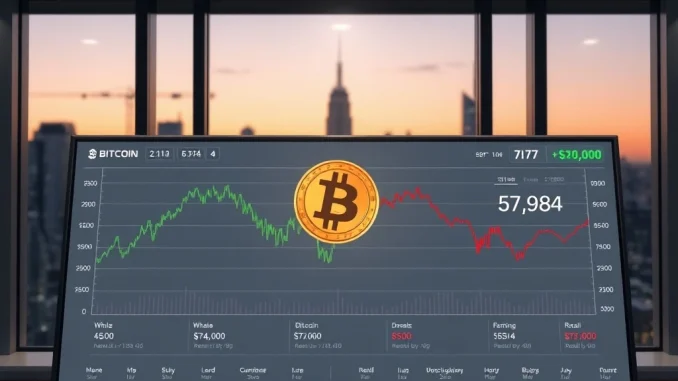
NEW YORK, March 9, 2026 — A significant divergence in Bitcoin investor behavior is flashing warning signals for the cryptocurrency’s near-term price trajectory. According to fresh data from the blockchain analytics platform Santiment, large-scale Bitcoin holders, known as “whales,” have rapidly sold approximately 66% of the Bitcoin they accumulated just weeks ago. Meanwhile, retail investors have aggressively increased their purchases as the price dipped below the psychologically important $70,000 level. This classic pattern of whale distribution coinciding with retail accumulation historically precedes further market corrections, analysts caution. Bitcoin’s price currently hovers at $67,984, reflecting the ongoing tension between these opposing market forces.
Santiment Data Reveals Stark Whale Exodus
The analytics firm Santiment provided a detailed timeline of the recent whale activity that is now roiling markets. Between February 23 and March 3, 2026, whales—entities holding between 10 and 10,000 BTC—engaged in heavy accumulation. They bought aggressively while Bitcoin traded in a range between $62,900 and $69,600. However, the sentiment shifted dramatically last Wednesday, March 5, when Bitcoin briefly surged past $70,000 and touched a local high of $74,000. “The moment Bitcoin hit $74k, these key stakeholders began taking profit,” Santiment stated in its Friday market report. Since that peak, this cohort has offloaded about two-thirds of their recently purchased holdings, creating substantial selling pressure.
This rapid profit-taking represents a strategic pivot by the market’s most influential players. The sell-off contributed directly to Bitcoin’s retreat from its weekly highs, pushing it back into the high $60,000 range. Consequently, the coordinated exit of whales, who often move markets with their large orders, suggests a lack of conviction in immediate further upside. Their actions provide a crucial data point for understanding the current market structure and potential support levels.
Retail Investors Counter with Aggressive Buying
In a contrasting move, retail investors—defined by Santiment as addresses holding less than 0.01 BTC—have been steadily increasing their exposure. Their buying accelerated precisely as Bitcoin’s price slipped below the $70,000 threshold. This behavior creates a clear narrative split: sophisticated, large-scale capital is exiting, while smaller, individual investors are entering. “When retail buys while whales sell, it typically signals that the correction is not yet over,” Santiment analysts warned. This axiom stems from the historical tendency for retail investors to buy emotional tops and fearful dips, often before larger market moves have fully played out.
- Sentiment Indicator Plunge: The buying spree failed to prevent a sharp drop in market sentiment. The widely watched Crypto Fear & Greed Index fell 6 points in a single day, landing deep in “Extreme Fear” territory with a score of 12 on Saturday.
- ETF Outflows Compound Pressure: The retail inflow also contrasted with institutional movement. U.S. spot Bitcoin ETFs recorded their largest daily outflow in three weeks, with a net $348.9 million leaving the products, according to Farside Investors data.
- Support Test Critical: The convergence of whale selling and ETF outflows places immense focus on the $67,000-$68,000 support zone. A breach could trigger a deeper liquidation event.
Expert Analysis: A Cautious Outlook Prevails
Market analysts are aligning with Santiment’s cautious interpretation. Michael van de Poppe, founder of MN Trading Capital, shared a technical perspective on social media platform X. “If Bitcoin doesn’t find support in this $67-68K region, then we’re likely going to retest the lows for liquidity before bouncing back upwards,” he posted on Friday. His analysis suggests the market is probing for a true bottom, and the current retail buying may not be sufficient to establish it without whale participation. Meanwhile, economist Timothy Peterson offered a longer-term floor, referencing his Bitcoin Price to Metcalfe Value model. “This valuation level has always marked a bottom for Bitcoin. About 99.5% chance it stays above $60k,” Peterson stated, pointing to the February 6 low of $60,000 as a likely ultimate support level in the current cycle.
Historical Context and Market Cycle Analysis
The current whale-retail divergence is not an isolated event but fits a recurring pattern in Bitcoin’s volatile history. Major market cycles often see early accumulation by informed players (whales and institutions), followed by a distribution phase to retail during hype peaks, and finally a capitulation phase where retail sells at a loss. The data suggests the market may be in the late stages of distribution before a potential capitulation. This cycle has been amplified by the new dynamics of spot Bitcoin ETFs, which provide whales with an additional, highly liquid off-ramp.
| Investor Cohort | Recent Activity (Post-$74K) | BTC Holdings Range | Typical Market Role |
|---|---|---|---|
| Whales | Sold ~66% of recent buys | 10 – 10,000 BTC | Trend setters, liquidity providers |
| Retail Investors | Increased buying below $70K | < 0.01 BTC | Often follow trends, provide final liquidity |
| ETFs (Institutional Proxy) | $348.9M net daily outflow | N/A | Large-scale, regulated capital flows |
What Happens Next: Key Levels to Watch
The immediate future of Bitcoin’s price hinges on several technical and psychological factors. First, the $67,000-$68,000 support band must hold to prevent a swift drop toward the $60,000 area referenced by Peterson. Second, market participants will watch for a slowdown in whale selling or a resumption of accumulation, which would be the first sign of a potential reversal. Finally, ETF flow data will be scrutinized daily; a return to net inflows could help stabilize prices. The coming week will test whether retail conviction can outweigh the selling pressure from larger entities.
Broader Ecosystem and Regulatory Backdrop
This price action occurs within a complex regulatory and macroeconomic environment. Recent political statements, including renewed pledges to support crypto and blockchain development in various national strategies, provide a supportive long-term narrative. However, short-term price discovery remains dominated by technicals and on-chain metrics like those from Santiment. The market is also digesting the aftermath of Bitcoin’s rally from its October 2025 all-time high of $126,000, working through a natural correction within a larger, arguably still-bullish, macro trend.
Conclusion
The current Bitcoin price correction is being defined by a clear power struggle between investor classes. Santiment’s data reveals that whales are capitalizing on recent gains, while retail investors see the dip as a buying opportunity. Historically, this divergence suggests further downside potential before a durable bottom is found. Traders should monitor the $67K support level and whale wallet activity closely. For long-term holders, the analysis from experts like Peterson indicates that while volatility may continue, fundamental valuation models suggest a strong floor exists near $60,000. The market’s next major move will likely depend on which group—prudent whales or optimistic retail—ultimately proves correct in their current strategy.
Frequently Asked Questions
Q1: What does Santiment’s data specifically show about Bitcoin whales?
Santiment reports that Bitcoin whales (holders of 10-10,000 BTC) sold approximately 66% of the Bitcoin they accumulated between February 23 and March 3. This selling began when Bitcoin’s price reached $74,000 last Wednesday.
Q2: Why is it significant that retail is buying while whales are selling?
This pattern often indicates a market correction is not complete. Whales are typically more informed and strategic; their selling into retail buying pressure suggests they believe prices may go lower before rising again, allowing them to re-accumulate cheaper.
Q3: What is the key price level to watch according to analysts?
Analysts like Michael van de Poppe highlight the $67,000-$68,000 region as critical short-term support. If Bitcoin fails to hold this level, a retest of the $60,000 area from early February becomes likely.
Q4: How do spot Bitcoin ETFs factor into this market move?
Spot Bitcoin ETFs posted a net outflow of $348.9 million on the same day Santiment highlighted the whale selling. This indicates institutional capital is also stepping back temporarily, compounding the selling pressure from large individual holders.
Q5: What is the long-term outlook despite this short-term volatility?
Economist Timothy Peterson’s model suggests a 99.5% probability Bitcoin stays above $60,000, which he identifies as a historical valuation floor. This implies a strong long-term foundation despite near-term corrective pressure.
Q6: How should a typical retail investor interpret this news?
Retail investors should view this as a reminder of market cycles and the importance of risk management. The data suggests avoiding emotional buying during clear distribution phases and considering dollar-cost averaging if believing in the long-term thesis.