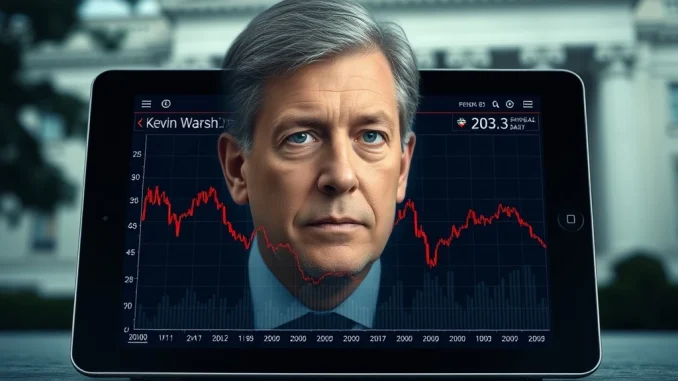
New York, March 15, 2025: Bitcoin faces significant downward pressure as financial markets react to the growing likelihood that former Federal Reserve Governor Kevin Warsh could be nominated as the next Chair of the U.S. central bank. The cryptocurrency market, sensitive to shifts in monetary policy expectations, is bracing for a potential regime defined by higher interest rates and reduced liquidity—conditions historically unfavorable for speculative assets. President Donald Trump is expected to announce his nominee tomorrow, placing Warsh’s documented skepticism of digital currencies squarely in the spotlight.
Bitcoin’s Vulnerability to Federal Reserve Leadership
The price of Bitcoin demonstrates a well-established correlation with global liquidity conditions and real interest rates. When the Federal Reserve adopts an accommodative, or dovish, stance—characterized by low rates and quantitative easing—risk assets like cryptocurrencies often thrive. Conversely, a hawkish shift toward tightening monetary policy typically drains liquidity from financial markets, increasing pressure on speculative investments. The mere speculation of Kevin Warsh’s appointment triggers this fundamental market calculus. Analysts point to the 2022-2023 crypto winter, precipitated by the Fed’s aggressive rate-hiking cycle, as a recent precedent. This historical context provides a framework for understanding the current sell-off, as traders price in the risk of a return to stringent financial conditions under Warsh’s potential leadership.
Kevin Warsh’s Hawkish Monetary Policy Legacy
Kevin Warsh served as a Governor of the Federal Reserve Board from 2006 to 2011, a period encompassing the Global Financial Crisis. His policy record reveals a consistent preference for tighter monetary control. A detailed analysis by Renaissance Macro Research highlights his advocacy for hawkish policy even during severe economic distress. For instance, during the depths of the labor market collapse following the 2008 crisis, Warsh often voiced concerns about long-term inflation risks and financial stability over immediate stimulus. This historical stance informs current concerns. Renaissance Macro suggests his recent, more measured public comments might represent a strategic dovishness for confirmation purposes, warning there is a “risk President Trump could be misled by his intentions.” His academic and published writings further cement this reputation, emphasizing the dangers of prolonged easy money.
Warsh’s Public Stance on Cryptocurrency as an Asset Class
Beyond general monetary hawkishness, Warsh has expressed specific, critical views on digital assets. Markus Thielen, founder of the research firm 10x Research, summarized the market’s fear: “Warsh favors higher real interest rates and reduced liquidity, viewing cryptocurrencies as speculative instruments that will vanish once the era of low interest rates ends.” This perspective frames cryptocurrencies not as innovative technology or a new store of value, but as a byproduct of excessive liquidity—a “speculative bubble” that tighter policy would inevitably deflate. This philosophical stance is more profound than a simple dislike; it suggests a fundamental belief that cryptocurrencies lack intrinsic value outside a low-rate environment. For long-term Bitcoin investors, this represents a direct challenge to the core investment thesis of digital scarcity and hedge against monetary debasement.
Market Mechanics: How Fed Policy Directly Impacts Bitcoin
The transmission mechanism from Fed policy to Bitcoin’s price is multifaceted. Firstly, higher interest rates increase the opportunity cost of holding non-yielding assets like Bitcoin. Investors can earn a safer return in Treasury bonds, making speculative bets less attractive. Secondly, quantitative tightening (reducing the Fed’s balance sheet) directly drains dollar liquidity from the global financial system. Since Bitcoin and other crypto assets are often traded against the US dollar, less available dollar credit can suppress trading volumes and price appreciation. Finally, the Fed’s tone influences broader market risk sentiment. A hawkish chair can foster a “risk-off” environment where investors flee volatile assets for safety. The following table outlines the primary channels of impact:
Table: Fed Policy Channels Affecting Bitcoin Price
Policy Tool: Federal Funds Rate Hike
Direct Impact: Increases yield on safe assets (e.g., U.S. Treasuries)
Bitcoin Effect: Higher opportunity cost reduces demand for zero-yield Bitcoin.
Policy Tool: Quantitative Tightening (QT)
Direct Impact: Reduces system-wide US dollar liquidity
Bitcoin Effect: Constrains trading capital and leverage available for crypto markets.
Policy Tool: Hawkish Rhetoric / Forward Guidance
Direct Impact: Shifts overall market psychology to “risk-off”
Bitcoin Effect: Triggers sell-offs in speculative and high-volatility asset classes.
The Trump Administration’s Decision and Its Immediate Aftermath
President Trump’s impending announcement sets the stage for immediate volatility. Market participants are not only evaluating Warsh but also considering other potential candidates. A nominee perceived as more neutral or dovish on digital assets could trigger a swift relief rally. Conversely, Warsh’s formal nomination would likely extend the current downward pressure as markets adjust to a new long-term outlook. The Senate confirmation process will then become a critical forum where Warsh would be questioned directly on his views regarding cryptocurrency regulation and its role in the financial system. His answers could either amplify market fears or potentially assuage them. The timeline from nomination to confirmation provides a window of sustained uncertainty, a condition markets typically dislike, potentially leading to continued cautious or negative price action for Bitcoin.
Broader Implications for the Cryptocurrency Ecosystem
The significance of this event extends beyond Bitcoin’s spot price. A hawkish Fed chair could influence the regulatory landscape. While the Fed’s primary mandate is monetary policy, its leadership wields considerable influence over other financial regulators. A skeptical view from the top could embolden agencies like the Securities and Exchange Commission (SEC) to maintain or intensify a strict enforcement posture. Furthermore, it could chill institutional adoption. Major financial institutions considering Bitcoin ETFs or custody services may pause their plans in a higher-rate, lower-liquidity environment where client demand wanes. The entire crypto market, from Ethereum to decentralized finance (DeFi) protocols, operates within this macro liquidity tide. A sustained period of tightening could slow innovation, reduce venture capital funding, and force projects to focus on sustainability over growth.
Conclusion
Bitcoin faces a clear and present macro threat in the rising odds of Kevin Warsh becoming Federal Reserve Chair. The downward pressure is not merely speculative trading but a rational repricing based on his historical advocacy for hawkish monetary policy and his explicit dismissal of cryptocurrencies as ephemeral speculative instruments. The market reaction underscores Bitcoin’s evolving but still potent sensitivity to traditional financial forces, particularly U.S. monetary policy. As the White House decision looms, the cryptocurrency sector is reminded that its path forward remains inextricably linked to the philosophies and policies of legacy financial institutions. The coming days will test whether Bitcoin’s value proposition as a decentralized asset can withstand the concentrated power of a potentially hostile central bank leader.
FAQs
Q1: Who is Kevin Warsh and why does he matter for Bitcoin?
Kevin Warsh is a former Federal Reserve Governor known for his hawkish views on monetary policy. He has publicly criticized cryptocurrencies as speculative bubbles dependent on low interest rates. His potential appointment as Fed Chair matters because the Fed controls U.S. interest rates and liquidity; his policies could create a hostile environment for risk assets like Bitcoin.
Q2: How does the Federal Reserve Chair influence Bitcoin’s price?
The Fed Chair influences Bitcoin indirectly by setting monetary policy. Raising interest rates or reducing liquidity (quantitative tightening) makes holding non-yielding, volatile assets like Bitcoin less attractive compared to safer bonds. It also reduces the amount of cheap money in the financial system that often flows into speculative markets.
Q3: What is the difference between a “hawkish” and “dovish” Fed policy?
A “hawkish” policy prioritizes fighting inflation and favors higher interest rates and tighter financial conditions. A “dovish” policy prioritizes economic growth and employment, favoring lower rates and increased liquidity. Bitcoin has generally performed better in dovish environments.
Q4: Has Bitcoin crashed due to Fed policy before?
Yes. The major bear market of 2022, where Bitcoin lost over 70% of its value, was largely driven by the Federal Reserve’s aggressive interest rate hikes to combat inflation. This historical precedent is a key reason markets are reacting negatively to the prospect of another hawkish Fed Chair.
Q5: Could other factors offset the negative impact of a hawkish Fed Chair on Bitcoin?
Potentially. Factors like increased institutional adoption through spot ETFs, positive regulatory developments, technological advancements (like Bitcoin layer-2 solutions), or a surge in demand as a geopolitical hedge could provide countervailing positive pressure. However, in the short to medium term, Fed policy often acts as a dominant macro force.