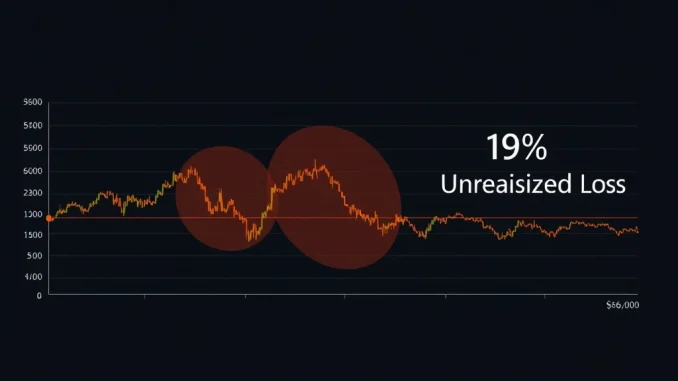
Global, May 2025: A critical divergence is emerging in the Bitcoin market. While the price of Bitcoin (BTC) has shown resilience, recent on-chain data reveals a deepening strain beneath the surface. Analysis from leading blockchain intelligence firms indicates that the aggregate unrealized loss across the Bitcoin network has reached approximately 19%. This metric, coupled with Bitcoin’s struggle to maintain support above the $67,000 threshold, signals a pivotal moment for market structure and investor psychology. The data suggests a growing disconnect between the asset’s nominal price trajectory and the underlying financial reality for a significant portion of its holders.
Understanding Unrealized Loss in the Bitcoin Market
Unrealized loss represents the paper losses held by investors who purchased Bitcoin at higher prices than its current market value. Unlike realized losses, which occur upon selling an asset for less than its purchase price, unrealized losses reflect a state of holding. This metric is a powerful, real-time gauge of market-wide financial stress and sentiment. When a large percentage of the Bitcoin supply is held at a loss, it often indicates that a broad base of investors entered the market during a period of higher prices, creating overhead resistance and potential selling pressure if prices fail to recover. The current 19% figure, derived from the aggregate cost basis of all UTXOs (Unspent Transaction Outputs), places the market in a historically significant zone that has preceded both major consolidations and trend reversions in past cycles.
The $67,000 Price Level as a Technical and Psychological Battleground
The $67,000 price point for Bitcoin is not an arbitrary number. It represents a crucial technical and psychological support zone that has been tested multiple times throughout 2024 and into 2025. This level acted as a springboard for previous rallies and, more recently, as a floor during corrections. Its importance is magnified by the current unrealized loss data. Holding above $67,000 is critical for preventing the 19% unrealized loss metric from expanding further, which could trigger a negative feedback loop. Key factors defining this zone include:
- Historical Support/Resistance: $67K has flipped between major support and resistance multiple times, establishing it as a high-liquidity area.
- Institutional Entry Points: Data suggests significant accumulation by large-scale investors occurred near this range, making it a foundational cost basis for a portion of the market.
- Options Market Dynamics: A high concentration of open interest for Bitcoin options is centered around the $65,000-$70,000 strike prices, increasing volatility and importance around this level.
- Miner Economics: For many public and private miners, the profitability threshold sits near this range, influencing their selling behavior for operational costs.
The Mechanics of On-Chain Sentiment Analysis
On-chain analytics move beyond simple price charts to examine the behavior and financial position of market participants directly on the blockchain. The unrealized loss percentage is calculated by comparing the current price of Bitcoin to the price at which each coin last moved (a proxy for its acquisition cost). When this aggregate value dips into negative territory, it paints a clear picture of underwater holders. Other complementary metrics, such as the Net Unrealized Profit/Loss (NUPL) and the Spent Output Profit Ratio (SOPR), confirm the current strain. This data-driven approach removes speculation, offering a factual basis for assessing market health. The divergence occurs when price action appears stable or slightly positive, but these underlying metrics flash warning signs of broad-based discomfort among investors.
Historical Context and Potential Market Implications
Examining previous instances where Bitcoin’s unrealized loss approached or exceeded 20% provides crucial context. Historically, such levels have often coincided with local price bottoms or periods of extended consolidation. They represent a point of maximum financial pain for late entrants, which can either exhaust selling pressure or, if broken, lead to capitulation events where investors sell at a loss en masse. The current scenario’s implications are twofold. If Bitcoin decisively reclaims and holds territory above $67,000, it could solidify the level as support, gradually turning unrealized losses back into profits and restoring bullish momentum. Conversely, a sustained break below could see the unrealized loss percentage climb, potentially testing the resolve of leveraged positions and long-term holders alike, leading to increased market volatility.
Broader Market Conditions and Macroeconomic Factors
The situation with Bitcoin does not exist in a vacuum. The current pressure at $67,000 and the rising unrealized losses intersect with a complex macroeconomic landscape. Traders and analysts are weighing several external factors that influence capital flows into and out of risk assets like cryptocurrency. These include central bank interest rate policies, particularly from the U.S. Federal Reserve, which affect the attractiveness of non-yielding assets. Furthermore, traditional equity market performance, geopolitical stability, and the strength of the U.S. dollar all contribute to the risk-on or risk-off sentiment that governs crypto markets. The on-chain data provides a pure view of the Bitcoin network’s internal state, but its future trajectory will be a product of both this internal stress and these external financial pressures.
Conclusion
The convergence of a 19% unrealized loss across the Bitcoin network and the repeated testing of the $67,000 price level creates a critical inflection point for the market. This data-driven snapshot reveals a tangible divergence between surface-level price action and the underlying financial reality for many investors. While not predictive of an immediate downturn, these on-chain statistics serve as a clear warning signal about mounting internal pressure. The coming weeks will be decisive in determining whether this pressure is absorbed through consolidation and a firm hold of support, or whether it manifests in increased volatility. For market participants, understanding these fundamental on-chain metrics is now as essential as reading a price chart.
FAQs
Q1: What does “unrealized loss” mean for Bitcoin?
An unrealized loss occurs when the current market price of Bitcoin falls below the price at which an investor purchased it, but the investor has not yet sold the asset. It’s a “paper loss” that only becomes real if the position is closed. The 19% figure represents the aggregate of these losses across a large portion of the Bitcoin supply.
Q2: Why is the $67,000 price level so important for Bitcoin?
The $67,000 level has established itself as a major technical and psychological support/resistance zone through repeated tests over the past year. It represents a key accumulation area for institutional investors and a profitability threshold for many miners, making it a high-liquidity battleground that often dictates short-to-medium-term market direction.
Q3: How is the unrealized loss percentage calculated?
Analysts use on-chain data to track the price at which every Bitcoin last moved on the blockchain (its “realized price”). By comparing this historical cost basis to the current live market price for all coins, they can calculate the total percentage of the supply that is currently held at a loss.
Q4: Does a high unrealized loss always lead to a price drop?
Not always. Historically, high unrealized loss can signal a capitulation bottom or a zone of maximum pain that precedes a reversal. However, if the underlying support (like $67K) fails, it can trigger further selling from investors looking to cut losses, potentially leading to a sharper decline.
Q5: What other on-chain metrics should I watch alongside unrealized loss?
Key complementary metrics include the Net Unrealized Profit/Loss (NUPL), which shows the total profit/loss ratio; the Spent Output Profit Ratio (SOPR), which indicates whether coins are being spent at a profit or loss; and exchange flow data, which shows if coins are moving to exchanges (often to sell) or into cold storage (to hold).